Exceptionally rare 'golden cats' discovered in Africa
AI and wildlife conservative communities unites to protect golden cat species in Africa

Cats are among the most common pets worldwide, but a rare golden cat discovered in Africa by conservationist and biologist Mwezi Mugerwa has caught everyone's attention.
The Wildlife conservationist spotted the unique cat for the first time while reviewing camera-trap footage in Bwindi National Park, Uganda, Africa.
Mugerwa said, the first time he spotted the golden cat, he did not know what it was.'
The biologist explained that he spotted an unfamiliar creature, about twice the size of a domestic cat, in the grainy black-and-white footage.
Mugerwa recalls that none of his colleagues could identify it at first glance; "but, when I talked to the hunters and communities who lived around the park, they knew the species.”
Known as ‘Embaka’ in the local African language, the ‘cryptic’ golden cat is often caught accidentally in forest snares, and conservationists fear we may lose this rare species.
“That was really concerning for me-that we may lose this unique specie before we even get to know about it,” says Mugerwa.
He explained that the unique African golden cat is so elusive that it's rarely seen in the wild except in hunter snare traps.
The cat is exceptionally rare as it is around twice the size of a domestic cat. The stout and sturdy animal appears in two colors: reddish gold and Gray-gold.
According to Indianapolis researchers, the cat species also features dark spots across its fur, ranging from all-over patterns to only spotting on its undersides, which makes it unique and helps individual cats be identified.
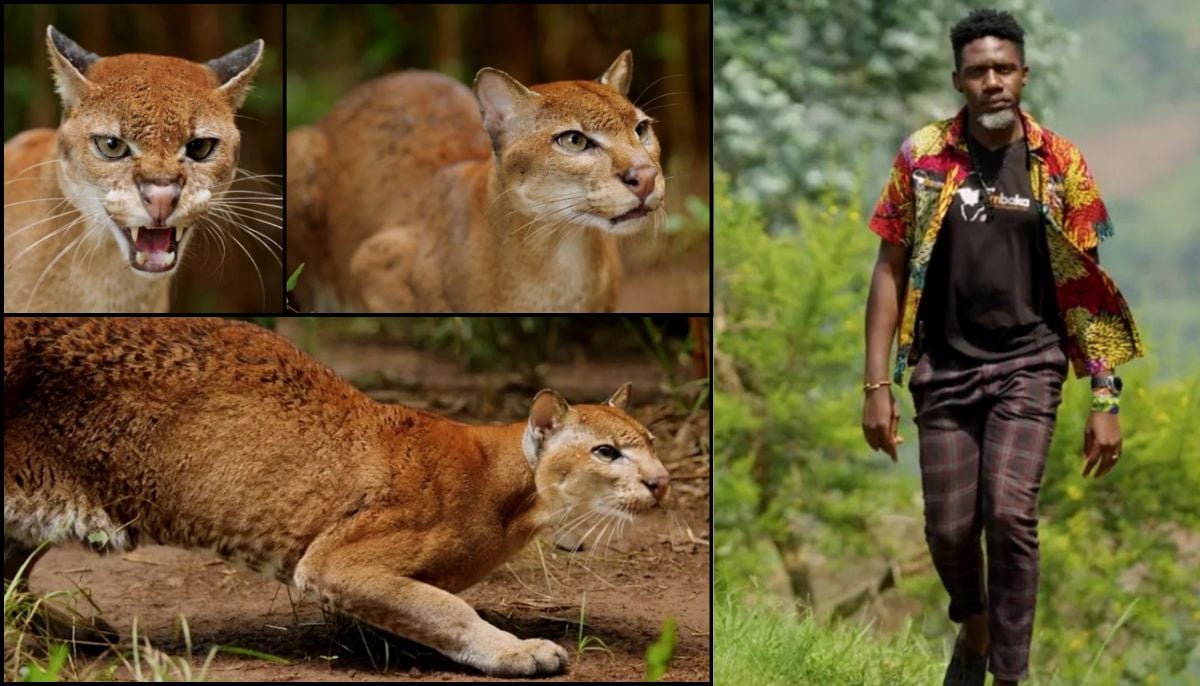
Over the past 16 years, Mugerwa has devoted his life to working with “the most elusive, least understood and least studied of Africa’s big cats.”
The International Union for Conservation of Nature (IUCN) tracks, threatened species and this work vividly demonstrates how rare this cat is.
“It is very hard to see them in the wild,” says a Ugandan Conservationist.
Mugerwa said that understanding an exact population count is the first step toward conservation. He founded the first comprehensive initiative to count the cat across its range, with publication expected next year.
In 2019, Mugerwa founded the African Conservation Alliance for the African Golden Cat (AGCCA), a network of 46 conservationists from 19 countries.
Together, they launched a standardized camera-trap study across the cat’s entire suspected range with support from the National Geographic Society.
Meanwhile, Panthera, a U.S.-based nonprofit, developed an artificial intelligence AI algorithm that quickly sorted images and identified individual cats by their unique fur patterns.
"It’s really important because now we can talk about population size and density," says Mugerwa, adding that without AI, recognizing individual cats would be almost impossible due to their small size and nuanced markings,” says Mugerwa.
Additionally, early data indicate that the species is at low density even in protected areas.
According to the latest surveys from Uganda and Gabon, only 16 individual cats were spotted per 100 square kilometers.
Mugerwa also received the Indianapolis Prize for Conservationist of the Year for the work on the species.


-
 Taylor Swift and Travis Kelce's wedding guest list revealed
 -
 New GTA 6 features confirmed: Dual protagonists, larger map, social feeds
 -
 Arrest warrant issued for Eminem’s ex-wife Kim Scott
 -
 Why Netflix’s expanded deal for Russian cartoon ‘ Masha and the Bear’ is sparking backlash in Ukraine
 -
 Brad Pitt rejects marriage plans with Ines de Ramon: 'Never feels like his girlfriend'
 -
 'Mildred Pierce' star Ann Blyth passes away at 98
 -
 Sam Smith announces fifth album 'Hazel Eyes,' releases new love song
 -
 Bill Gates' extramarital affairs: Who are Mila Antonova, Karima Nigmatulina and Alice Jacobs?