New concrete power turns buildings into giant energy banks
New batteries can now power homes with just a wall
The breakthrough from Massachusetts Institute of Technology (MIT) scientists shows how everyday walls, sidewalks, and even bridges could act as giant batteries, a feat made possible by significantly improving their electron-conducting carbon concrete (ec³), which functions as a supercapacitor.
It plays a pivotal role in elevating its energy capacity by a factor of ten compared to previous versions.
The material combines cement, water, and electrolytes explicitly, forming a nanomaterial network that stores energy.
This improvement means only about five cubic meters of concrete is needed, which is roughly the size of a basement wall, to produce energy storing batteries.
Nanonetwork experimentation drives concrete battery breakthrough
The team used FIB-SEM tomography to image the material layer by layer and discovered that the nanocarbon black forms an intricate web around pores, allowing electrolytes to penetrate and improving current flow.
They have tested distinct electrolytes and found that seawater could be a viable option, which could lead to the development of practical new utilities.
Separately, instead of soaking concrete later, they mixed electrolytes into the water, allowing for a thicker and more powerful electrode.
MIT researchers got inspiration from Roman construction and found that they made significant advances in concrete construction.
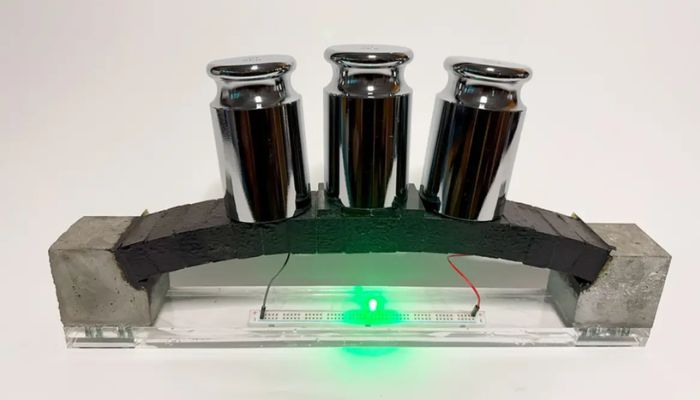
The team analysed a slight EC3 arch to check the potential capabilities, and it supported weight while powering an LED.
Ec3 has already made its mark on sidewalks in snowy Japan, Sapporo, due to its thermal conductivity.
In this connection, the first author of the study, Damian Stefaniuk, said, "One of our biggest motivations was to enable the renewable energy transition."
Additionally, co-author and Cornell professor, James Weaver, said, "By combining modern nanoscience with an ancient building block of civilisation, we are opening a door to infrastructure that doesn't just support our lives."


-
 Biden calls out Trump’s ‘vanity projects’ at Maryland Democratic Gala—Here’s why
 -
 Pima County Sheriff responds to new claims in Nancy Guthrie case
 -
 Mayor Mamdani jumps into NYC pool to revive old tradition
 -
 Trump’s Gaza Board of Peace seeks to grant itself total immunity and free use of property: Here’s why
-
 Top 10 best games of 2026 so far: Which one should you play?
 -
 Google Maps route ends in tragedy
 -
 Aggressive dog shocking end after sending woman and pet to hospital
 -
 Calgary Stampede noise dispute resolved as Alberta and city reach agreement
 -
 Scientists identify Antarctica's first dinosaur bone after 40 years hidden in storage
 -
 Nia Long gushes over Michael Jackson biopic star Jaafar: 'He likes it'
 -
Mayor Mamdani jumps into NYC pool to revive old tradition
-
 Christopher Nolan slams Hollywood studios ahead of 'The Odyssey' release: 'I can do this'
-
 Australian man arrested in Thailand following discovery of 17-year-old’s body in suitcase
 -
Sheriff Chris Nanos breaks silence after claims about Savannah’s mother Nancy Guthrie video
-
Taylor Swift and Travis Kelce's wedding guest list revealed
-
New GTA 6 features confirmed: Dual protagonists, larger map, social feeds