Comet bigger than Mount Everest will rule skies of Earth after 71 years
Comet with size larger than Mount Everest will make near pass of 144 million miles to Earth
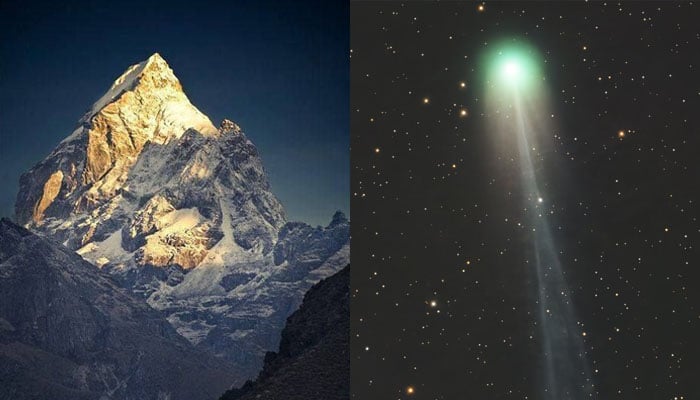
This month, there is a once-in-a-lifetime chance for stargazers to watch a comet the size of Mount Everest speeding across the sky.
Officially identified as Comet 12P/Pons–Brooks, it has drawn comparisons to the Star Wars Millennium Falcon due to two “horns” that may be seen in pictures.
With specialised telescopes, amateur astronomers have already begun taking pictures of the comet, but it should soon be visible to the unaided eye.
Look westward in the night sky to locate the Great Square of Pegasus, which consists of four stars of almost similar brightness, in order to spot Comet 12P/Pons-Brooks.
The comet is making a meandering V-shaped movement from Great Square of Pegasus towards Aries the Ram during the next three weeks.
The comet is a once-in-a-lifetime sight, visible from Earth only once every 71 years when it completes its journey around the sun.
On April 21, Pons-Brooks is expected to approach the sun by as much as 72.5 million miles (116.8 million km).
After that, on June 2, it will make a near pass of 144 million miles (232 million km) to Earth.
However, Jessica Lee, an astronomer at the Royal Observatory Greenwich, says that late March will be the ideal time to observe it if you're in the northern hemisphere.
While comet appearance and brightness are unpredictable, the public should be alert for what seems to be "an irregularly shaped dirty snowball".
“It’s predicted that this comet will reach maximum brightness for viewers in the northern hemisphere in late March,” Lee told MailOnline.
"In late March the comet will be in the constellation of Aries, which is in the western sky just after sunset. Ideally you should go somewhere with a clear view of the horizon in the west, and pick a night with clear skies.," she added.
It is anticipated that 12P/Pons-Brooks will appear to the unaided eye as a dim, star-like blob with a fuzzy tail during this near approach.


-
 ‘A dream for 50 years’: Why world’s first nuclear clock could change timekeeping
 -
 NASA Curiosity captures strange ‘wind-carved’ Mars landscape in dawn image
 -
 NASA's Crew-12 Dragon begins return trip from space station
 -
 Mysterious ‘phoenix planet’ found around the remains of a dying star
 -
 First possible evidence of Planet Nine found in infrared data
 -
 Elon Musk announces SpaceXAI rebrand to SpaceXSI following presidential order on 'Super Intelligence'
 -
 ISS Command changes hands in emotional ceremony
 -
 Moon water acts nothing like it does on Earth, study finds