Solar system may have a much shorter lifespan than we thought
Previous stability estimates assumed the Sun would lose mass smoothly and consistently
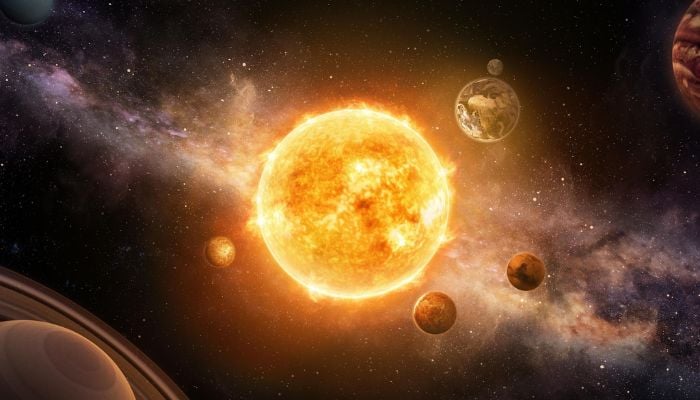
Scientists in a recent study have revealed a new expiration date for our solar system.
A new study published in The Astrophysical Journal Letters suggests the solar system’s lifespan could be dramatically cut short, lasting only about one billion years after the Sun becomes a white dwarf, rather than a quintillion as previously thought.
Previous stability estimates assumed the Sun would lose mass smoothly and consistently as it transitions into a white dwarf (in about eight billion years). However, the new research shows the Sun will likely eject mass randomly in time and direction.
Consequently, these random ejections create gravitational “kicks” that can significantly alter planetary orbits, thereby destabilizing outer planets like Jupiter and Saturn much sooner than expected.
In 40 percent of study simulations, planetary disruption and scattering occurred even earlier, while the Sun was still in its red giant phase.
The findings suggest that centuries-old concerns regarding the eventual breakdown of the solar system's order were closer to the truth than recent models of long-term stability.
"Our results return the solar system's dissolution to astrophysically familiar territory, and relocate its cause: not the slow seep of chaos, nor the chance encounter with a passing star, but the Sun itself, which in dying does not merely enlarge the planetary system it built, it shakes it, and more often than not, spills it," the authors write.
However, this timeline has no practical consequence for humanity; the Sun will become a red giant long before these white-dwarf instabilities occur, making Earth uninhabitable and potentially swallowing it entirely.


-
 Elon Musk’s Mars colonization dream faces reality check from Nobel laureate
 -
 NASA competition model 2.0 cuts mission selection by 45%
 -
 A ‘neglected’ neutrino may hold the key to why the Universe exists
 -
 Can cancer drugs be made in space? Here’s what the new mission aims to find out
 -
 SpaceX Falcon 9 successfully launches Bandwagon-5 mission with 32 payloads
 -
 Europe launched 8 orbital rockets last year, can it rival Starlink?
 -
 Japan launches world’s first mission to bring sample back from phobos
 -
 Orionid meteor shower 2026: Peak date, viewing tips and what to expect