
First possible evidence of Planet Nine found in infrared data
Astronomers combed IRAS and AKARI infrared surveys for slow-moving objects, and one faint pair remains
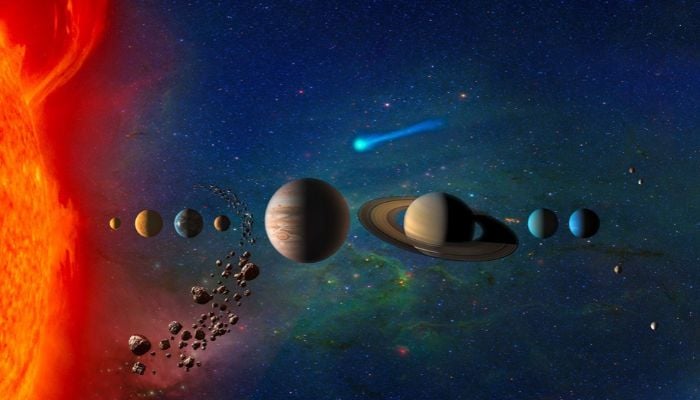
Software flagged 13 candidate pairs of infrared sources. After a manual check, only one survived. It had shifted 47.5 arcminutes across the sky in 23 years, about one and a half times the width of the full moon, and it matches what a Neptune-sized planet in the far solar system would look like.
That makes it a possible first observational hint of Planet Nine. Terry Long Phan of National Tsing Hua University in Taiwan found it during his PhD, working with colleagues in Taiwan, Japan and Australia.
Some researchers say that the arrangement of some TNOs and their orbital tilt indicates the presence of a yet-to-be-discovered planet.
According to calculations, its elliptical orbit would amount to about 300 AU, making it at least ten times more distant from the Sun than Neptune. Despite the efforts of several sky surveys, it still stays unconfirmed.
The problem is that the light would have to reach Earth, travelling from the Sun to the planet and back, thus making a Neptune-size planet ten times farther from the Sun 10,000 times fainter.
The uncertainty of its orbit is the other issue, and nobody is aware of where exactly the telescope should point to.
The thermal emission of the planet would reach us in just one direction. Using the infrared spectrum, Planet Nine would be 100 times fainter than in visible light rather than 10,000. Thus, infrared telescopes in space are the way to go.
In his research, Phan analysed the observational data obtained by two infrared surveys: IRAS, which was launched in 1983, and AKARI, which was launched in 2006. They were conducted 23 years apart.
At over 300 AU, a planet would crawl so slowly it would look stationary within either dataset. Between the two missions, though, it would have shifted slightly. Phan's software sorted through every infrared source and kept only those that had moved by roughly the expected amount.


-
 Beaver Moon 2026: When and where to see a full supermoon rise this week
-
 Physicist discovers new solution to Einstein's equations for 'Black Saturn'
-
 Thailand makes prepares to stop exporting rare earth mining chemicals to Myanmar
-
 Inside COP31 climate deal: COP31 President speaks out
-
 NASA reveals mysterious 'ghost forest' on Mars: Everything to know about it
-
 COP31 talks reach deadlock amid growing fossil fuel dispute
-
 Astronomers observe massive puffy star merging with smaller companion
-
 NASA confirms Voyager 1 is now a ‘light-day’ away from Earth
-
 Google partners with Bezos’ Blue Origin to launch AI computing satellites in 2029
-
‘Craziest is definitely still yet to come’: HEO unveils advanced space intelligence platform in major new launch
-
Anthropic vs SpaceX: How two potential IPOs compare
-
EU climate chief says 'COP31 must drive clean energy shift'


