
What are white phosphorous bombs allegedly used by Israel in Gaza?
Many pro-Palestinian organisations have claimed that Israel is using white phosphorous to attack residents in Gaza after Hamas attack
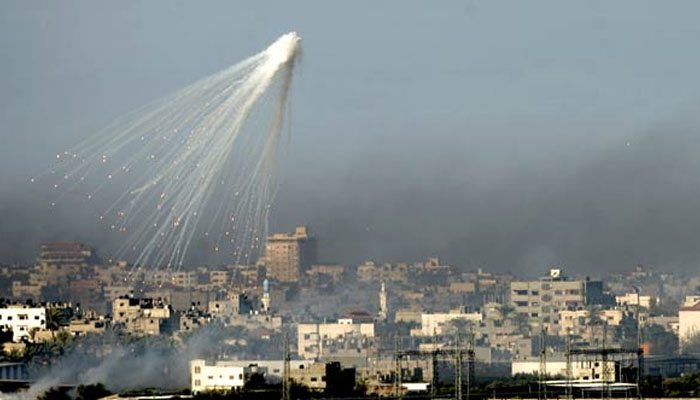
Videos appeared on social media claiming that the Israel Defence Force (IDF) has allegedly been deploying outlawed white phosphorous bombs in the heavily populated area of Gaza after Hamas's attack.
According to several images, videos, and posts on social media, Israeli soldiers are allegedly deploying white phosphorus on Gaza's civilian population. Hamas has long controlled the Gaza Strip, a Palestinian region under Israeli embargo.
The Gaza Strip, one of the most populated regions on Earth, has almost two million residents squeezed into a 362-square-kilometer patch of territory.
What is white phosphorous?
White phosphorus is a chemical that has a strong, garlic-like aroma and is waxy, yellowish to clear. It is a chemical that, when exposed to air, burns swiftly and brightly.
It is utilised by military all over the world, including those of the United States, in incendiary weapons for a number of reasons, such as illuminating targets at night or just inflicting harm on adversaries.
Armed forces use this chemical reaction to generate extreme heat (about 815 degrees Celsius), light, and dense white smoke to construct smokescreens in conflict areas.
White phosphorus can start ground fires that spread quickly. The chemical is exceedingly difficult to extinguish once it ignites because it adheres to so many surfaces, including skin and clothing.
It can result in serious burns that go deep into the bone and tissue, and it can rekindle even after treatment, making it extremely dangerous for people.
Examples of white phosphorous usage in wars
The 1800s saw one of the earliest documented uses of white phosphorous in combat when Irish or Fenian nationalists used it against British soldiers. The Irish Republicans' phrase became known as "Fenian fire".
It was utilised by the British army during both World Wars. After invading Iraq, US forces used the deadly weapon on rebels in Fallujah.
Israel, which is accustomed to receiving these charges, acknowledged using phosphorus shells against Hezbollah in the 2006 Lebanon War.
In the 2008–2009 Gaza War, also known as Operation Cast Lead, a number of human rights organisations claimed that the Israeli Defence Forces (IDF) had used white phosphorous against civilians.
A sizable portion of the world community has accused the Bashar Al-Assad-led Syrian government of employing chemical weapons, notably white phosphorus, during the Syrian crisis.
Recently, in the ongoing conflict with Ukraine, the Russian Army is said to have deployed white phosphorus munitions.
Banned by the United Nations
In a resolution adopted in 1972 by the UN General Assembly, incendiary weapons were referred to as a "category of arms viewed with horror."
"Incendiary weapons are weapons or munitions designed to set fire to objects or cause burn or respiratory injury to people through the action of flame, heat, or combination thereof, resulting from a chemical reaction of a flammable substance such as napalm or white phosphorus," the UN says.
The world came to an agreement in 1980 to prohibit or restrict the use of specific weapons that hurt or inflict excessive agony on civilians. This Agreement's Protocol III limits the use of fire-starting weapons.


-
 Alan Cumming shares plans with 2026 Bafta Film Awards
 -
 OpenClaw founder Peter Steinberger hired by OpenAI as AI agent race heats up
 -
 Chinese New Year explained: All you need to know about the Year of the Horse
 -
 Canadian passport holders can now travel to China visa-free: Here's how
 -
 Edmonton weather warning: Up to 30 cm of snow possible in parts of Alberta
 -
 ICE agents 'fake car trouble' to arrest Minnesota man, family says
 -
 China confirms visa-free travel for UK, Canada nationals
 -
 Bad Bunny's star power explodes tourism searches for his hometown