Earendel: James Webb Space Telescope reaches out to universe's most distant star
Glimpses of Earendel captured as a result of gravitational lensing
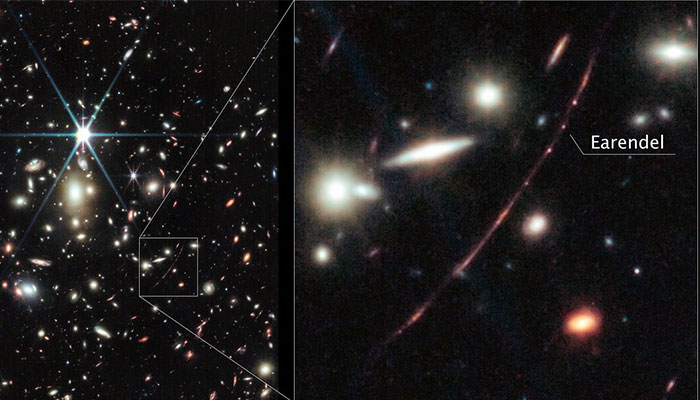
Astronomers recently set sight sights on Earendel, the most distant star ever discovered, which is so far away that the starlight that James Webb Space Telescope (JWST) caught was produced in the first billion years of the universe's 13.8 billion-year history.
Previous calculations put the star's distance from Earth at 12.9 billion light-years, but due to the expansion of the universe and the distance light has travelled to get to us, astronomers now believe Earendel is actually 28 billion light-years away, CNN reported.
The name of the star, Earendel — first discovered by the Hubble Space Telescope in 2022 — comes from Old English terms that denote "morning star" or "rising light."
According to observations as a result of the Webb telescope's discovery, the extremely far-off star, Earendel, is a huge B-type star, more than twice as hot and has a million times greater luminosity than the sun.
The star, which belongs to the Sunrise Arc galaxy, was only visible because the huge galaxy cluster WHL0137-08, which is located in the space between Earth and Earendel and magnified the far-off object, made it visible.
This process is part of gravitational lensing, a phenomenon that happens when nearby objects function as magnifying glasses for farther away ones.
The light of faraway background galaxies is effectively warped and magnified by gravity. In this instance, the galaxy cluster dramatically increased the brightness of Earendel's light.
While astronomers weren't expecting to be able to see a companion star for a massive star like Earendel, the colours picked up by Webb point to the possibility of a cool, red companion star.
Webb was able to see details in the Sunrise Arc galaxy by looking into the furthest reaches of the universe and observing in infrared light, which is invisible to the human eye. Small star clusters and regions of star birth were discovered by the space observatory.
The actual distance of the Sunrise Arc galaxy is still being ascertained by astronomers through further analysis of the data from Webb's observation, according to CNN.
Astronomers can learn more about the early universe and get a peek at what our Milky Way galaxy might have looked like billions of years ago by studying extremely distant stars and galaxies that formed closer to the big bang.
For astronomers, Webb's capacity to investigate such a far-off, tiny object is encouraging. The first stars that formed from unprocessed substances like hydrogen and helium shortly after the universe's creation may one day be seen.


-
 NASA Artemis II splashdown: What could go wrong on mission’s final stage
 -
 What happens to human body in deep space? NASA Artemis II will find out
 -
 Scientists find Earth’s core may be leaking gold
 -
 Mission for the ages: Artemis II crew returns after breaking deep-space historic records
 -
 Robot dogs on Mars: Swiss researchers reveal how autonomy speeds up space exploration
 -
 From Apollo to Artemis: How astronauts honor loved ones with lunar names
 -
 Emperor penguins on verge of extinction: ‘A grim story shaped by climate change’
 -
 NASA Artemis II crew prepares Earth return after historic Moon mission