Euclid telescope sets course to map the cosmos and unravel mysteries of universe
Euclid aims to construct a vast three-dimensional map of the cosmos
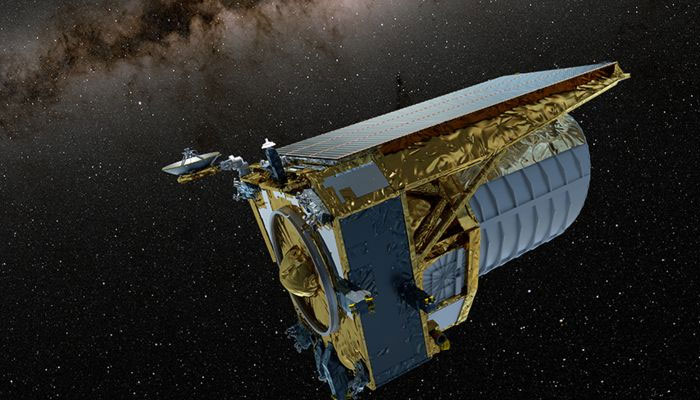
Euclid, a European space telescope, has launched from Florida with an ambitious mission to explore one of the most profound puzzles in science—the composition of the Universe.
By constructing an extensive three-dimensional map of the cosmos, Euclid aims to shed light on the properties of dark matter and dark energy, two elusive entities believed to shape the structure and expansion of the visible universe. Scientists readily acknowledge their limited understanding of these enigmatic phenomena, as they elude direct detection, hindering efforts to unravel the origins of the Universe.
However, the launch of Euclid is poised to bridge this knowledge gap and provide astronomers with a promising pathway to comprehension.
Professor Isobel Hook from Lancaster University likens the mission to embark on a voyage without a compass, uncertain of the destination. Through the meticulous mapping of the Universe, scientists aspire to gain profound insights into humanity's place within it, tracing the journey from the explosive beginnings of the Big Bang to the formation of galaxies, the Solar System, and the emergence of life itself. The €1.4 billion Euclid telescope, propelled by a Falcon-9 rocket from Cape Canaveral, now resides 1.5 million kilometres from Earth, positioned on the opposite side of the Sun. While primarily an initiative by the European Space Agency (ESA), the mission has garnered significant scientific and engineering contributions from NASA.
Euclid's ambitious endeavour encompasses a six-year, two-pronged survey aimed at unravelling the mysteries of dark matter and dark energy. Dark energy, constituting approximately 70% of the Universe's power, and dark matter, accounting for around 25%, have been eluding direct observation. In contrast, visible matter, including stars, planets, and all detectable entities, makes up a mere 5% of the cosmic composition. To investigate the nature of this cryptic 95%, Euclid will meticulously chart the distribution of dark matter and explore the three-dimensional arrangement of galaxies to understand the influence of dark energy on cosmic expansion.
Equipped with its visible camera, the VIS, Euclid will capture monumental images, each surpassing the capacity of more than 300 high-definition TVs. By observing the distortion of light caused by the gravitational effects of dark matter, the telescope will create an extensive map covering 15,000 square degrees of the sky. This groundbreaking endeavour will significantly advance our comprehension of the distribution and properties of this invisible matter.
Euclid's examination of dark energy will involve mapping the positions of roughly two billion galaxies over a vast expanse of 10 billion light-years from Earth. These measurements will unveil insights into the uniformity of the Universe's expansion, potentially challenging existing models and theories, while paving the way for transformative discoveries. The mission may prompt a reevaluation of the techniques employed to detect dark matter particles and offer alternative explanations for dark energy beyond the prevalent notion of it being an intrinsic property of the vacuum of space.
While Euclid may not provide conclusive answers regarding the nature of dark matter and dark energy, it will significantly narrow down the range of possibilities, guiding future research and stimulating novel ideas. With the potential to revolutionize our understanding of the Universe, Euclid's mission stands to influence the fate of cosmic expansion and reshape our perception of reality on a cosmic scale.


-
 Where is Artemis II today? Here is everything to know about NASA’s journey to the moon
 -
 European Space Agency to negotiate with NASA on future lunar missions
 -
 SpaceX AI satellites plan raises doubts after Microsoft setback
 -
 NASA Artemis II lifts off, sending cubesats into deep space study
 -
 Could there be life on Mars? NASA Jared Isaacman claims chances are 90%
 -
 NASA Artemis II Moon mission set for liftoff today: Here’s what to know
 -
 Did the Big Bang happen differently? New theory challenges origin of Universe
 -
 April’s Pink Moon 2026: How to see the full moon in all its glory