
Watch live: SpaceX launching 21 Starlink V2 satellites today
V2 mini Starlink satellites are designed to be more powerful than previous versions and provide increased broadband capacity
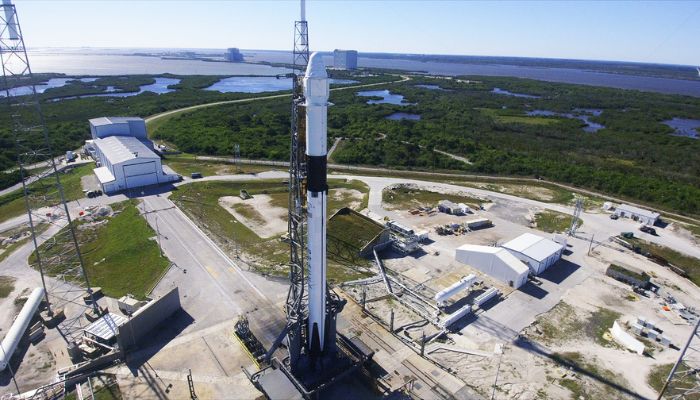
At Florida's Cape Canaveral Space Force Station, a Falcon 9 rocket carrying 21 of SpaceX's latest Starlink "V2 mini" satellites is scheduled to take off at 9:47am ET (1347 GMT). To address any issues that may arise during the initial window, four alternative launch opportunities have been planned for the same day.
Approximately 8 minutes and 26 seconds after lift-off, the first stage of the rocket will try to land on the autonomous SpaceX drone ship, A Shortfall of Gravitas, stationed nearby in the Atlantic Ocean. SpaceX will broadcast the live coverage of this event on Space.com.
According to SpaceX, the V2 mini Starlink satellites are designed to be more powerful than previous versions and provide increased broadband capacity. They incorporate electric propulsion systems called Hall thrusters, which, according to SpaceX, generate over twice the amount of thrust when compared to the first-generation Starlink satellites.
Although SpaceX already has more than 4,000 Starlink satellites in orbit, the company intends to significantly raise that number. It has permission from regulators to launch up to 12,000 additional Starlink craft and is seeking permission to add an additional 30,000.
Despite the benefits of providing broadband internet access to remote or underserved locations worldwide, the vast number of satellites also has drawbacks, with astronomers raising concerns about Starlink craft interfering with scientific observations.
This mission on Wednesday will be the company's 25th flight of the year thus far. The first stage booster that will be used in this mission has already launched the Hakuto-R rover to lunar orbit, three Starlink missions, as well as other payloads.
However, all attention is currently focused on the first launch of SpaceX's enormous Starship rocket into space, which is set to take place on Thursday (April 20). This groundbreaking test flight will make the Starship rocket the most powerful rocket in the world, ushering in a new era of human spaceflight



-
 Brazil fossil of giant dinosaur reveals continents were connected 120 million years ago
 -
 NASA prepares Artemis astronauts crew for first Moon mission in decades
 -
 Comet 3I/ATLAS puzzles scientists, revealing secrets of alien worlds
 -
 Scientists unlock whale longevity secrets – Could humans live 200 years?
 -
 Were humans born on Mars? Scientists raise a stunning possibility
 -
 Anduril acquires ExoAnalytic solutions to bolster ‘Golden Drone’ missile defense capabilities
 -
 Massive 600-kg NASA satellite to hit Earth Today: Could humans be at risk?
 -
 Massive 3D map exposes early universe like never before