Don't miss it: Rare hybrid solar eclipse set to grace the skies!
This alignment happens only a few times per century and is named after the aboriginal term, Ningaloo Eclipse
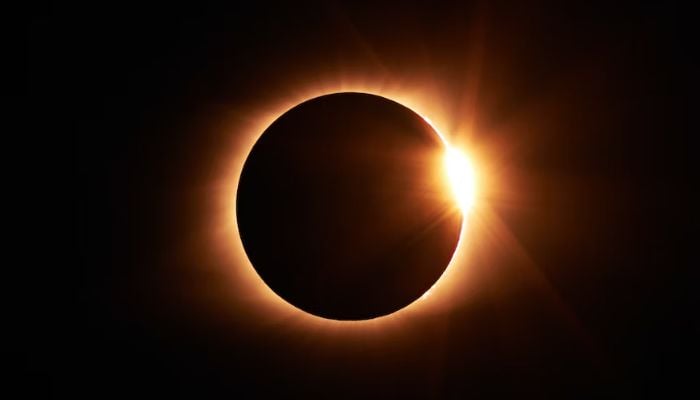
On April 20, a rare hybrid solar eclipse will occur, where the moon will block out the sun and transform the eclipse from total solar to annular, as it moves across the earth's surface.
This alignment happens only a few times per century and is named after the aboriginal term, Ningaloo Eclipse, according to Space.com.
Due to the curved surface of the Earth, an eclipse can transition between annular and total as the moon's shadow moves across the globe. The last hybrid solar eclipse took place in 2013, with the next one predicted for 2031 and then later on March 23, 2164.
Eclipses occur when the sun, the moon, and the Earth align, partially or fully. NASA states that there are four types of solar eclipses: total, annular, partial, and hybrid. During a total solar eclipse, the moon passes between the sun and Earth, fully blocking the sun's face. In contrast, during an annular solar eclipse, the moon is at or near its farthest point from Earth, making it appear smaller than the sun and resulting in a ring-shaped eclipse.
When the moon passes between the sun and Earth but they are not perfectly aligned, a Partial solar eclipse occurs, with only a part of the sun appearing to be covered in a crescent shape.
On the other hand, the Hybrid solar eclipse, which is the rarest type, is characterized by the moon's shadow moving across the curved surface of the Earth, causing the eclipse to shift between annular and total, as explained by NASA.
When to watch
The hybrid solar eclipse, unfortunately, might not be visible from Pakistan, but people in western Australia, East Timor, and eastern Indonesia will get a chance to see it.
According to a Sky News report, the eclipse will be visible from the South Pacific, over western Australia, East Timor, and Indonesia, starting at 9:36 pm EDT on April 19 and ending at 2:59 am EDT on April 20. As per reports, the eclipse timings will be from 10:29 pm to 10:35 pm EDT in Western Australia, 11:19 pm-11:22 pm EDT in East Timor, and from 11:23 pm-11:58 pm EDT in Indonesia.
How to watch eclipse LIVE
As per Space.com, YouTube channels like TimeAndDate.com will live stream at 9:30 pm EDT on April 19 while Gravity Discovery Centre & Observatory will live stream at around 10 pm EDT.


-
 First possible evidence of Planet Nine found in infrared data
 -
 Elon Musk announces SpaceXAI rebrand to SpaceXSI following presidential order on 'Super Intelligence'
 -
 ISS Command changes hands in emotional ceremony
 -
 Moon water acts nothing like it does on Earth, study finds
 -
 Hawaii’s Hōlei sea arch collapses after centuries on Big Island: What happened
 -
 Solar system may have a much shorter lifespan than we thought
 -
 Singapore builds world’s ultra-precise clock outperforming US, China
 -
 NASA expands Moon base research with three new investigations