VIDEO: Hubble accidentally captures 'invisible monster' supermassive black hole
If it were in our solar system, supermassive black hole, which weighs as much as 20 million suns, might travel in 14 minutes from Earth to Moon
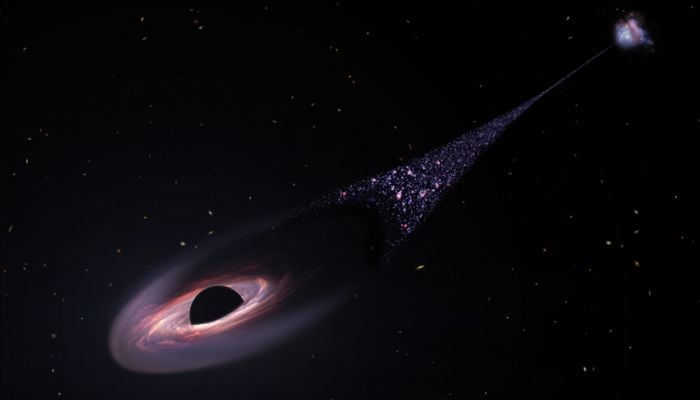
A runaway black hole is speeding across the cosmos and leaving a never-before-seen trail of stars in its wake, according to NASA. If it were in our solar system, the supermassive black hole, which weighs as much as 20 million suns, might travel in 14 minutes from Earth to the Moon.
It has left behind a trail of brand-new stars that is 200,000 light years long and twice the size of our Milky Way galaxy.
The phenomena was unintentionally captured by NASA's Hubble Telescope; the astronomer who made the discovery described the discovery as "pure serendipity."
"The black hole lies at one end of the column, which stretches back to its parent galaxy. There is a remarkably bright knot of ionized oxygen at the outermost tip of the column," NASA said in a statement.
"It didn't look like anything we've seen before," said Pieter van Dokkum of Yale University.
The star trail was "quite astonishing, very, very bright and very unusual", he said, describing it as like the wake of a ship.
This led him to the conclusion that what he was seeing was the debris left behind by a black hole that had passed through the gas ring that surrounded the host galaxy.
According to researchers, the black hole's collision with the gas in front of it is what creates the stars.
Three black holes interacting with one another most likely produced the supermassive black hole. Before another galaxy connected with its own black hole, scientists think that two of the black holes may have fused 50 million years ago.
Then one of the black holes was ejected from its home galaxy, with two black holes going in one direction and one black hole travelling in the other.
Researchers will conduct additional observations to support this theory.


-
 SpaceX: Starship V3 all set for debut launch ahead of IPO
 -
 Four alien species recovered from crashed UFOs, Ex-CIA researcher claims
 -
 NASA delays Moon landing as Artemis III shifts to orbit mission
 -
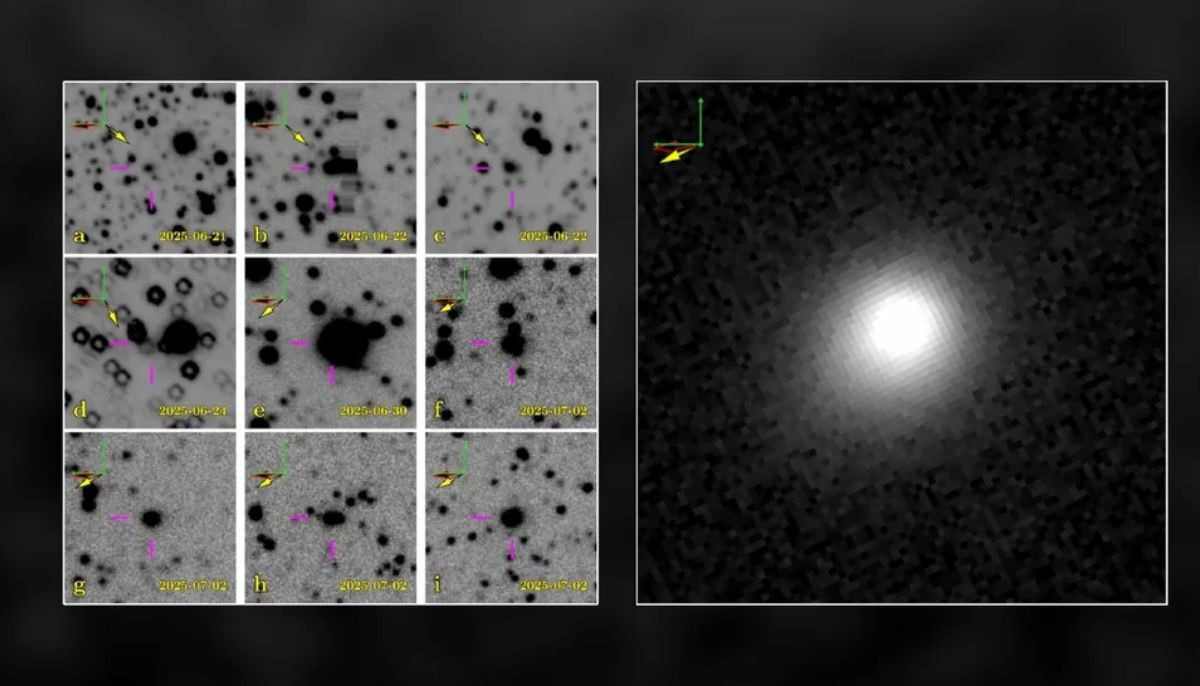 Scientists reveal shocking early sighting of 3I/ATLAS comet
 -
 Asteroid 2026 JH2 to pass extremely close to Earth on May 18: Should we be concerned?
 -
 Meet the ‘last titan’: Giant new dinosaur identified from fossils in Thailand
 -
 Can we finally find aliens? Scientists reveal a surprising new ‘organizational’ approach
 -
 Study reveals how to tell real alien life from chemical fakes
-
 Scientists find hidden third ancestral group in Japanese genomes
 -
SpaceX ‘Space Junk’ is on a collision course with the Moon, scientists say
-
Do you know what happened on May 10, 1967? NASA's M2-F2 disaster explained
-
Why the Southern Ocean is melting: Antarctica’s sea ice resilience reaches a breaking point