
Stunning image of hourglass-shaped newborn star explained
Orange-blue hues visible in the photograph correspond to cavities created when material ejected from the protostar collided with the environment
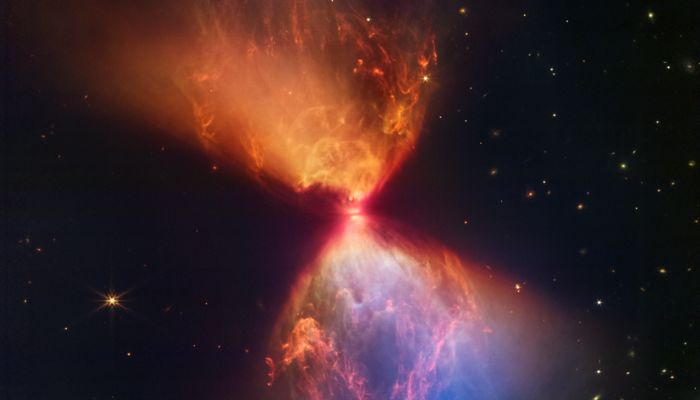
A new star is born, and it has a remarkable shape! A breathtaking new photograph shared by NASA scientists shows what appears to be an hourglass on fire.
In reality, the James Webb Space Telescope captured a blazing protostar that had arisen from the opaque cloud L1527. Astronomers may gain deeper understanding of the early appearance of our own Sun and solar system by following the birth of stars.
Although the star itself is concealed from view in the hourglass's "neck," a black line running through the centre can be made out. The star's light is evaporating, illuminating the neighbouring gas and dust. This elusive view was successfully captured by James Webb using its near-infrared camera.
The orange-blue hues visible in the photograph correspond to cavities created when material ejected from the protostar collided with the environment.
"Webb also reveals filaments of molecular hydrogen that have been shocked as the protostar ejects material away from it. Shocks and turbulence inhibit the formation of new stars, which would otherwise form all throughout the cloud. As a result, the protostar dominates the space, taking much of the material for itself," a statement by NASA read.
The layers of dust that built up between the clouds and the telescope are what caused the hues. The smallest dust layers have a blue tint to them. As the dust accumulates, less blue light can escape, resulting in patches of orange light.
A young star
While 100,000 years may seem like a long time to humans, to stars it is only a youthful age. It is a class 0 protostar, which is the earliest stage of a star, because of its age and the brightness it emits in far-infrared radiation. Thus, L1527 has a long way to go before it fully develops into a "grown-up" star.
For example, L1527 does not produce its own energy through nuclear fusion because it is still surrounded by a substantial cloud of gas and dust. To become a star at its full potential, energy must be developed. It is also quite unstable. The star, which makes up between 20 and 40% of the mass of the star in our solar system, is a tiny, hot, puffy ball of gas.
This new star cannot produce its own energy, but as it gathers mass, it is getting closer to doing so.
More mass causes the core to gradually compress to a point where nuclear fusion might be possible.
The term "accretion disc" refers to the thick spiral disc that forms around the centre as material enters the system. The infant star receives material from the accretion disc to help it expand. The core temperature will eventually increase to the point where nuclear fusion is possible as a result of all the accumulated mass and compression.
At first sight, the photo's disc might appear modest, but astronomers believe it to be the size of our solar system.



-
 Northern Lights: Calm conditions persist amid low space weather activity
 -
 SpaceX pivots from Mars plans to prioritize 2027 Moon landing
 -
 Dutch seismologist hints at 'surprise’ quake in coming days
 -
 SpaceX cleared for NASA Crew-12 launch after Falcon 9 review
 -
 Is dark matter real? New theory proposes it could be gravity behaving strangely
 -
 Shanghai Fusion ‘Artificial Sun’ achieves groundbreaking results with plasma control record
 -
 Polar vortex ‘exceptional’ disruption: Rare shift signals extreme February winter
 -
 Netherlands repatriates 3500-year-old Egyptian sculpture looted during Arab Spring