
Fresh estimates put flood losses at $28bn and counting
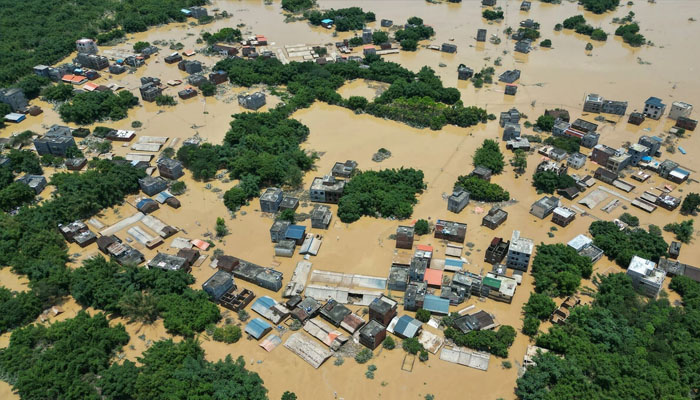
ISLAMABAD: Pakistan has firmed up Post Disaster Needs Assessment (PDNA) in the wake of severe floods and estimated damage to the extent of $28 billion and an upsurge in poverty by 5 percent, indicating that nine to 12 million people might fall below the poverty line.
On unemployment front, official estimates reveal that 1.8 to two million jobs have been lost in this flood. The government has made up plans for reconstruction and suggested that it might take two to 10 years for long-term construction of the flood-affected areas. Average inflation might touch 23 to 25 percent mark in current fiscal.
Alarmingly, the Planning Commission concedes that the agriculture growth might plunge into negative by -0.7 to -2.1 percent compared to the envisaged target of positive 3.9 percent for current fiscal. Export losses might face a burnt of $3 billion.
Among four provinces, Gilgit-Baltistan (GB) and AJK, Sindh has suffered the most and its damages stand at whopping $5.9 billion. Balochistan is second with $3.04 billion losses. The losses in the Punjab stand at $0.55 billion, KPK $0.54 billion, AJK $0.02 billion and GB $0.03 billion.
These firmed up figures were presented by the Planning Commission’s chief economist during a consultative meeting held with renowned economists of the country Monday. Representatives of international donors were also present.
Total losses faced by the four provinces, GB and AJK stand at $10.09 billion. According to the PDNA, total accumulated losses stand at $28 billion out of which federal ministries and divisions face total losses of $2.9 billion.
Pakistan Railways suffers the most with $2.4 billion losses, Ministry of Housing and Works $0.02 billion, National Highway Authority and Pakistan Post Office $0.2 billion and Ministry of Water Resource $0.29 billion.
The Flood Protection Plan (IV) requires resources of $4 billion in accordance with its revised estimates. Total accumulated economic losses stand at $11 billion. Grand total of damages is close to $28 billion. Major crops, including cotton, rice, maize, and sugarcane, have largely been affected by the floods.
Growth in major crops is expected to remain negative by 14-15.4%. Growth in the other crops is expected to remain negative (12-15%). Around one million large and small animals have perished. The anticipated growth of 3.7% in livestock is now expected to remain between 2pc and 3pc.
The loss in agriculture sector is expected to be 3.5-4.5%; agriculture growth may remain negative (0.7 to 2.1%) compared to the target of 3.9 percent. The loss in growth of industrial sector will be 3.5-4% due to its backward linkages with agriculture sector.
The lower availability of domestic cotton and high global prices, growth in textile sector is expected to drop. Due to lower demand, automobiles and fertilizer sectors are also expected to be affected.
Industrial growth for FY 2023 is expected to be 1.9-2.5% compared to the target of 5.9 percent. In services sector, wholesale and retail trade services will be adversely affected and growth will remain at 3% compared to the target of 6.5%.
Transport and storage services are expected to grow by 3% compared to the target of 4.5% due to damages of crops, livestock, roads and rail networks. Hoteling, tourism and education services are also expected to suffer.
Services growth for FY 2023 is now expected to be 3-3.5% compared to the original target of 5.1 percent. Inflationary pressures are expected to further aggravate due to supply chain disruptions and shortage of perishable items.
The National Price Monitoring Committee is continuously reviewing the situation. Timely import decisions have started to ease SPI. Rehabilitation is expected to further dissipate inflationary pressures. However, average inflation for FY23 is expected to remain between 23-25% compared to the target of 11.5 percent.
In external sector, overall export losses are anticipated to be around $3 billion during FY23 due to a decline in global demand and lower exports of rice, cotton, fruits and vegetables. Import of raw cotton, wheat, and vegetables is expected to increase due to flood losses. Water availability is expected to improve energy mix, resulting in lower oil imports.
Additionally, lower GDP growth and income level will lead to lower aggregate demand, causing a reduction in overall import bill. GDP growth for FY23 is expected to be at 1.8-2.3% compared to annual plan target of 5% i.e. an income loss of Rs2.4 trillion.


