
Syed Geelani’s first death anniversary today
Sept 1 marks the first death anniversary of veteran Kashmiri separatist leader Syed Ali Shah Geelani
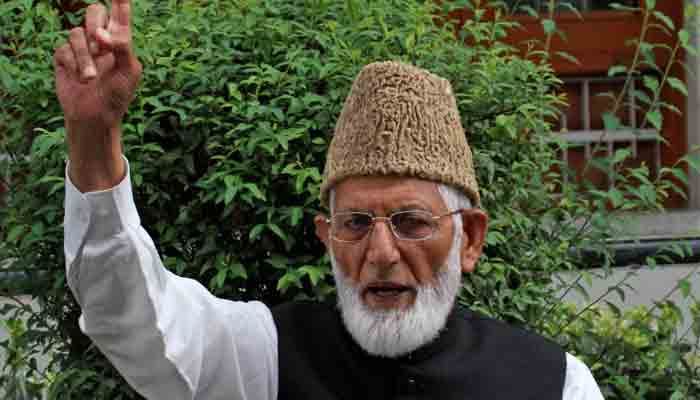
ISLAMABAD: Sept 1 marks the first death anniversary of veteran Kashmiri separatist leader and former chief of the All Parties Hurriyat Conference (APHC) Syed Ali Shah Geelani. Last year, on this date, Indian authorities imposed a security clampdown in occupied Kashmir shortly after Geelani’s death. Police then went to his home and seized his body, denying his family proper time to say their farewells.
During his lifetime, Geelani had expressed a desire to be buried in the Martyrs’ Graveyard in Srinagar. But Indian authorities knew that such a burial would be accompanied by a procession of his supporters marching with his body. So, they buried him in haste, in the cover of darkness, with only a couple of close relatives in attendance.
Indian police authorities at the time hoped to avoid a spectacle, yet their actions in the early hours of Sept 1, 2021, did exactly that; Illegally Indian Occupied Kashmir once again became the stage of a controversy and global condemnation was directed at India for the disrespectful manner in which it handled the last rites. In a fitting finale to his grand political life, Geelani’s last act was making a political statement; it was unavoidable, no matter how or where he was buried. His stature was too great. Even his opponents were compelled to recognise this.
Like any distinguished political figure, Geelani was a divisive personality, inspiring deep loyalty within his supporters and attracting strong critiques from his opponents. Syed Ali Shah Geelani was an uncompromising Kashmiri separatist leader, advocating a maximalist position all his life; that the only path to dialogue with India was through acceptance of its status as a disputed territory and demilitarisation.
Born on Sept 29, 1929, in a village on the banks of Wular Lake, he launched his career in politics from the platform of Jammat-e-Islami (JeI) in 1952. He soon rose to prominence as the chief of Kupwara and Baramulla districts. He spent nearly 12 years of his life in jail; his first arrest was on Aug 28, 1962, for questioning the accession and advocating the resolution of the Kashmir issue.
Geelani was a vociferous critic of the Indian law Public Safety Act (PSA) and challenged then chief minister Sheikh Mohammad Abdullah when he introduced the stringent Public Safety Act to the region. The law, termed a lawless by Amnesty International, was initially enacted to prevent timber smuggling. However, it was later modified to imprison political figures. Under the law, anyone could be imprisoned for up to two years without trial.
Geelani performed a central role in the formulation of the Muslim United Front (MUF) in 1987 ahead of provincial elections. He brought all Muslim parties came under a single platform – MUF – against pro-India parties. Only four candidates of the platform, including Geelani, managed to secure seats in a highly contested election. Geelani and the other winners were then jailed by the Indian government.
This was the watershed moment, as it sparked an indigenous armed resistance against India’s unlawful occupation of Kashmir. The National Conference-Congress political alliance formed a government, which was dissolved in early 1990s as an armed rebellion broke out. Lawyers and activists were jailed, and political activity was banned. Geelani and his comrades resigned in protest.
In 1992, the foundation of the All Parties Hurriyat Conference (APHC) was laid. It was a platform of 30 pro-freedom parties calling for Kashmir’s right to self-determination. The JeI was represented by Geelani.
In August 2004, Geelani and Muhammad Ashraf Sehrai launched the Tehreek-e-Hurriyat (Movement of Freedom). He emerged as the face of protest in the civil uprisings after 2008.
In 2009, he launched the demilitarisation movement and in 2010, when three civilians were killed in a fake encounter along the LoC in the Machil area of Kupwara district by Indian forces, a mass uprising was triggered. Geelani was in the forefront.
In 2016, after the killing of popular young freedom Burhan Wani by Indian security forces, Geelani, along with Mirwaiz Umar Farooq and Muhammad Yasin Malik organised protests against the brutal act.
Geelani was placed in house arrest after Aug 5, 2019, in the wake of the revocation of the special constitutional status of Kashmir by the government of India and was restricted to his home till his death.
“The way Geelani was treated in his death is consistent with the history of authoritarian regimes, who try to hide the bodies of important political figures. We saw the same happen to Bhagat Singh and also to Baloch activists… that the funeral rites were not performed appropriately. This proves that he (Geelani) was a popular figure,” said historian Dr Ammar Ali Jan while talking to The News about Geelani’s political legacy.
“There may have been ideological differences but there is no doubt that Geelani was a prominent and popular figure in the Kashmiri struggle for national liberation,” he said.
Dr Jan said Geelani carried a mixed legacy; on the one hand he was very popular and on the other, he was criticised for the use of religion in his politics.
“Overall, the time he stayed in jail and how remained committed to the struggle explains why he was so popular,” he said.
“The key lesson for political activists from his life is steadfastness over a long period of time. The struggle is not short term. One has to remain committed,” Dr Jan said.
“Now, we can also say in hindsight there should be less involvement of religion in a movement. The use of religion did not always create support for him.”
“Geelani was a big name in the Kashmiri struggle and the way he fought against state oppression of Indian Illegally Occupied Kashmir is a big lesson for us,” said Qaiser Javed, a student from Kashmir.
“There is no denying the great work he did, yet he also faced criticism,” Javed said. “He was aligned with Pakistan’s proxy war in Kashmir and supported it. This enabled India to exploit the Kashmiri independence struggle at international forums. Regardless, the effects of Geelani’s politics will be felt in Kashmir for a long time and he will be remembered for generations,” he added.


