
Call for joint movement by civil society, intelligentsia, political parties for free press
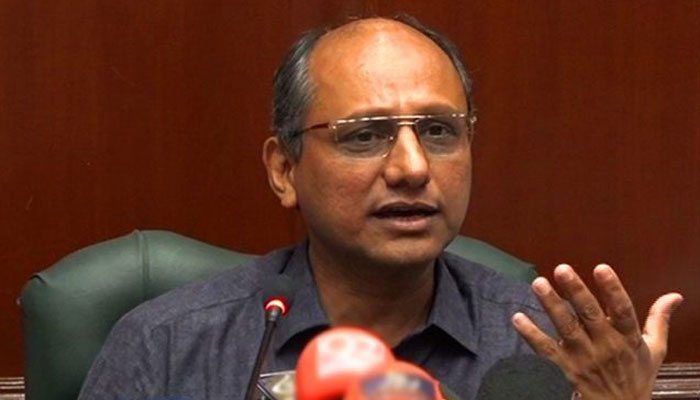
Veteran journalist Ghazi Salahuddin on Sunday stressed the need for a movement for a free press to be collectively backed by civil society, the intelligentsia and political parties, to which Sindh Information Minister Saeed Ghani retorted that these issues are “beyond government level”, and the audience burst into laughter.
They were speaking during a panel discussion titled ‘An Overview of Pakistani Journalism’ on the concluding day of the 14th International Urdu Conference. The roles of press clubs and different journalist associations were also discussed at length.
Journalist and columnist Wusat Ullah Khan lamented how different journalist associations and journalists themselves are engaged in different businesses and malpractices because no true journalism is actually happening in society.
Ghani said the ills of society have been translated in the media as well. “There are problems in politics, administration and each segment of society, and one can’t see the media in isolation because people from the same society run the media.”
The session was moderated by former broadcast journalist Najia Ashar, who is also the founder and president of the not-for-profit Global Neighbourhood for Media Innovations.
Ghani said the rating meters should be abolished in the media, and one should monitor the tickers and news that flash on TV screens on a daily basis to examine how much of the content is fabricated.
Mazhar Abbas spoke on how senior and eminent journalists are shifting towards digital media and YouTube, and then there comes the Prevention of Electronic Crimes Act.
Najia asked him about the dilemma of fake news that the media industry is facing, and yet prominent journalists are being forced to shift from traditional journalism to online journalism.
Abbas started off by saying that since the past 75 years the state has been lying to the people, and the media has been portraying all those lies as the truth in front of its audience. He said they lied to the people of Pakistan that everything was fine in East Pakistan when nothing was fine there.
Referring to the unconventional protest in Gwadar, he pointed out that the mainstream media could not speak a word about it. He shared that the media of Pakistan has a history of publishing fake pictures of sweets distribution whenever a military coup took place.
Replying to a question on the divisions in the media, on what is the truth, Khan said the media is not divided. “It is one. There is a factory where the actual products [media channels] are being made. The distributor attaches different labels [to those products] and we think there are different channels. The channel is one.”
He said the control over the media is to the extent where they even receive assembled tickers to flash on TV screens. He said the dictation has reached a level where it is already decided which issue will get how much airtime and how much discussion will be held on it.
“Few things are out of the media’s reach,” he said, adding that they can cover Balochistan if there is any terrorist activity, but if the terrorist attack is on any sensitive installation, “we can’t cover it unless there’s at least a yellow light from powers that be, if not the green light”.
Najia asked Khan about the role of press clubs and different journalist associations, to which he responded that journalists are so careful in voicing their concerns for their own people that the banners put up inside the clubs are displayed in a way that no one reads them.
As for the associations, he said that since there is no journalism as such left in the country, they have resorted to businesses of various kinds and malpractices. “We think no one knows [but] a journalist’s corruption and passion can’t remain hidden.”
At this point a young journalist said they are even denied entry inside press clubs. To this Khan responded that in Pakistan careers of veteran journalists are at stake.
Urdu journalist and poet Mahmood Shaam said press clubs take plots and other grants from the government, but in return do not help the impoverished journalists, especially who are laid off from their organisations.
Salahuddin pointed out how the media has a great history of struggle, which they are proud of, but in today’s era civil societies, political parties and the intelligentsia together have to fight for the media’s freedom, which is actually the freedom of society.
To this Ghani responded that these issues are beyond the control of the government. He stressed that the parliament, the media and the judiciary cannot be free in isolation because all of them are interlinked with one another.
He said he has read about the era of the military dictator Ayub Khan, and has seen the eras of General Ziaul Haq and General Pervez Musharraf, and in each era there were some rebels who were always the voice of dissent.


