
NEC approves Rs1,324 bn national development outlay
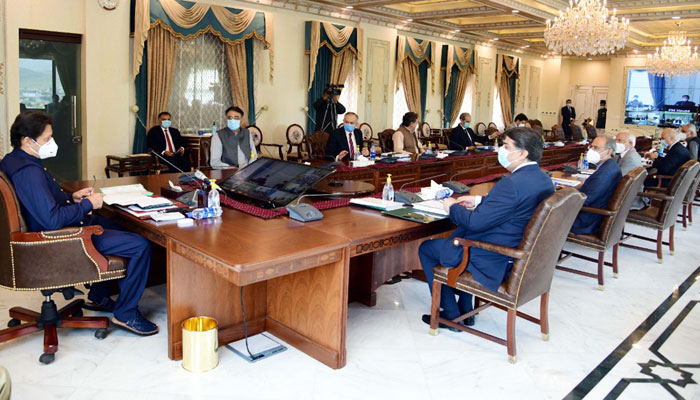
ISLAMABAD: With special allocation of Rs70 billion for COVID-19 pandemic response, the National Economic Council (NEC) under chairmanship of Prime Minister Imran Khan on Wednesday approved the national development outlay of Rs1,324 billion for upcoming budget 2020-21.
Amid protest by Sindh Chief Minister Murad Ali Shah, the NEC approved federal Public Sector Development Programme (PSDP) of Rs650 billion with foreign exchange component of Rs72.5 billion and provincial annual development programmes (ADPs) of Rs 674 billion including foreign component of Rs222.5 billion for upcoming budget.
The NEC, highest constitutional economic decision making body of the country, also approved macroeconomic framework and envisaged GDP growth rate at 2.1 percent from earlier projected figure of 2.3 percent and inflation at 6.5 percent for the next budget 2020-21. The NEC also granted its nod to discretionary development allocation of Rs24 billion for PM’s Sustainable Development Goals (SDGs) achievement programme for next budget 2020-21 against utilised amount of Rs30 billion for this programme in outgoing financial year 2019-20 ending on June 30, 2020.
The NEC approved Rs364 billion for infrastructure projects for coming budget against Rs383 billion in outgoing fiscal. Out of infrastructure sector allocation, the energy sector projects allocation stood at Rs80 billion in coming budget against Rs80 billion in outgoing fiscal. The transport and communication sector allocation will be standing at Rs197 billion in next budget. The water sector allocation stands at Rs70 billion and physical planning and housing Rs35 billion in coming budget.
The social sector allocation has been jacked up to Rs249 billion for coming budget against allocated amount of Rs206 billion for outgoing fiscal year. Out of allocations for social sector, the allocated funds for health and population stood at Rs20 billion, education including Higher Education Commission (HEC) Rs35 billion, SDGs achievement programme Rs24 billion, climate change Rs6 billion, special areas such as AJK, GB Rs40 billion, merged districts of KP Rs48 billion, governance Rs4 billion, COVID-19 response Rs70 billion and others Rs2 billion. The NEC approved Rs20 billion for Science and Technology and Rs14 billion for production sectors such as food and agriculture Rs12 billion and industries Rs2 billion. For ERRA, the NEC approved Rs3 billion for upcoming budget against allocated funds of Rs5 billion in outgoing fiscal year. The allocation for programme managed by the Finance Division stood at Rs78 billion in outgoing fiscal year but there was no amount mentioned into summary forwarded to the NEC for approval for the next budget.
The allocation for ministries/divisions was envisaged at Rs307.2 billion, corporations such as NHA, Wapda and power Rs158.3 billion for next budget.
The macroeconomic framework approved by the NEC for 2020-21 envisages overall macroeconomic stability in view of fiscal consolidation, improving external account and revival in agriculture and industrial growth. The GDP growth for 2020-21 is targeted at 2.1 percent with contributions from agriculture (2.8 percent), industry (0.1 percent) and services (2.6 percent). The growth targets are subject to favourable weather conditions, post COVID-19 economic recovery, managing current account deficit, consistent economic policies and aligned monetary and fiscal policies.
Fiscal policy during 2020-21 envisages containing fiscal deficit, additional resource mobilisation, controlling current spending and switching to targeted subsidies while prioritising development spending.
The balanced monetary policy is aimed at supporting adjustment process to restore macroeconomic stability and manage aggregate demand. However, the challenge would be to strike a balance between growth and stability in such a way that monetary policy tools many not suffocate economic growth while containing inflationary pressure.
Average inflation during 2020-21 is projected at 6.5 percent on the basis of subdued demand and suppressed commodity prices in the international markets and second round effect of COVID-19 related economic implications.


