
All eyes on India
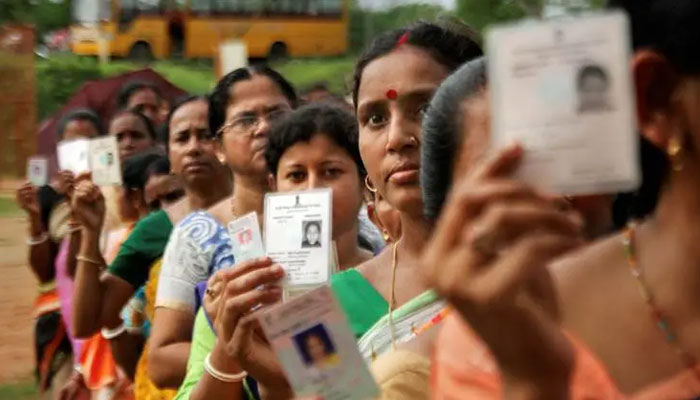
The 18th Lok Sabha elections have started in India and will run till June 4, 2024. According to the Indian Election Commission, 960 million people are eligible to cast a vote.
Elections will be carried out in seven phases spanning 44 days, marking these the world’s longest and largest elections. There are two types of political parties contesting the Lok Sabha elections – national parties and state parties.
National parties have a significant presence in several states, while state parties are confined to specific states. Through the electoral lens, these parties could be divided into three blocs. The first bloc is the ruling coalition of the National Democratic Alliance (NDA). The second bloc consists of the Indian National Developmental Inclusive Alliance (INDIA), while the third bloc comprises those parties that have not yet decided to be part of any of the two alliances.
The ruling coalition (NDA) has claimed that it will secure over 400 seats out of 543 seats. The late Rajiv Gandhi is the only prime minister of India who secured 414 seats in Indian electoral history.
The electoral dynamics of the Lok Sabha and Vidhan Sabha elections are largely dissimilar. The trends of all Lok Sabha constituencies and the dynamics of constituency politics could be understood through the data available on the Indian Elections Commission’s website.
The results of the 15th till 17th Lok Sabha elections largely divide Indian electoral constituencies into three categories. The first category consists of around 100 seats where the Bharatiya Janata Party (BJP) will not be able to secure a single seat. These constituencies are dominantly in the southern and western parts of India.
Since 2004, the BJP’s vote share in these constituencies has not improved as compared to its popularity in other constituencies of India. In the previous election, the BJP performed worst in these constituencies and ended up somewhere between fourth and seventh position.
The second category consists of 200 seats where the two arch-rivals, the BJP and the Indian National Congress (INC), will be primary contenders. The centre and northern part of India – the Hindi belt – belongs to the second category of constituencies.
Since 2014, the Congress has gradually lost its space in these 200 constituencies. In 2014, the BJP secured 112 out of 200 seats. This figure further improved in the 2019 Lok Sabha elections when the BJP secured 182 out of 200 seats, which is a remarkable achievement in electoral politics.
Due to the Congress’s worst performance, the NDA secured 303 seats in the 2019 Lok Sabha elections. There are several reasons for this consistently worst performance of the Congress in the previous two Lok Sabha elections. These include the incumbency factor, the absence of strong and charismatic leadership, internal rifts, the Modi factor, Hindutva’s popularity, and allegations of nepotism and corruption, etc.
These collective issues restricted the Congress to 52 Lok Sabha seats in the 2019 elections. On the contrary, the BJP’s perception management through consistent media campaigns, promotion of Hindu nationalism, propagation of a strong and aggressive foreign policy, temple politics, and perception of development under Modi’s rule has helped the ruling party sweep the Hindi belt of India.
If the Congress overcomes a few of these issues and secures around 90-100 seats, it will significantly affect the BJP’s political and strategic ambitions, which seems less likely.
The BJP’s primary contenders in the third category are state parties in India, such as the All-India Trinamool Congress (AITC), Dravida Munnetra Kazhagam (DMK), Telangana Rashtra Samithi (TRS), etc. This is the largest category among all three categories with 243 constituencies out of the total 543 seats of Lok Sabha.
These constituencies are primarily concentrated in the south, south-west and south-east of India. The performance of these regional political parties as compared to the Congress against the BJP has been significantly better in the previous two Lok Sabha elections.
In 2014, the BJP secured 92 seats, while in 2019 it secured 118 out of 243 seats. Significant space exists for the BJP in this category, and any improvements anywhere between 160 and 180 seats out of 243 will help the BJP cross the 362 mark required to secure a two-thirds majority in Lok Sabha. This is why the focus of the BJP’s political campaign has been the constituencies in this category.
The BJP has adopted a two-pronged strategy to strengthen its position in these constituencies, which includes frequent visits by the BJP’s top leaders, including Modi, Amit Shah, and Rajnath Singh and establishing electoral alliances with the local parties.
The first two categories are largely predictable in recent Lok Sabha elections. The third category of constituencies will be proven the real battleground for the 2024 Indian elections, with the BJP trying to improve its vote percentage.
The results of the third category will tell whether the BJP secures a two-thirds majority or falls short of its dream of amending the Indian constitution.
The writer is a director at the India Study Centre, Institute of Strategic Studies Islamabad. He tweets/posts @itskhurramabbas and can be reached at directorisc@issi.org.pk


