
Music conference concludes with beautiful performances
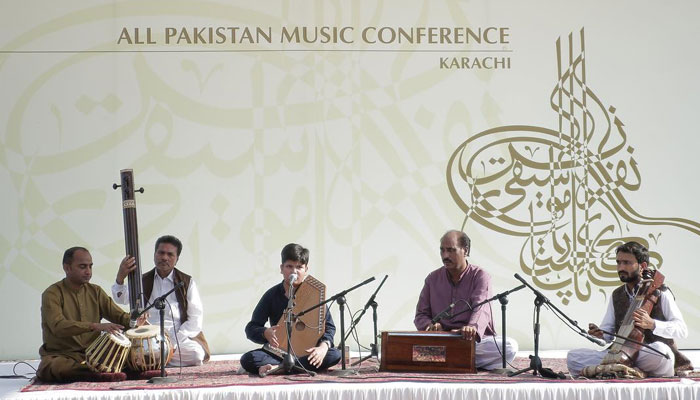
The All Pakistan Music Conference (APMC) Karachi’s annual conference offered a multitude of performances on its concluding day on Sunday, by under-training musicians as well as veteran performers of the Indian classical music.
The last day also offered a balanced mix of instrumental and vocal interpretation of various raags. The instruments that shone during the day were the tabla, the bansuri, the sitar and, interestingly, also the clarinet, which is not generally seen in Indian classical music concerts.
There was also a remarkable diversity in the places the performers had come from, as the musicians included a Lahore-based clarinettist, a Khayal singer from Quetta, a doyen of the Gwalior Gharana from Hyderabad and a sitarist living in Germany.
The day began with performances of inexperienced singers, some of whom were more inexperienced than others, as they tried to reproduce exactly what they had rehearsed without attempting any improvisation.
When this scribe entered the auditorium of the National Museum of Pakistan, the performances of junior artistes were under way, and a girl was playing a sweet romantic melody on the sitar. A senior musician explained that it was Raag Gorakh Kalyan that she was playing.
Later, a duo presented a Khayal in Raag Puriya Dhanasri. As it was just before sunset, it was perhaps the only raag of the day that was performed on its time.
For general readers, all raags of the Indian classical music should preferably be sung at a specific time of the day in order to extract the maximum aesthetic content out of them.
However, since all the musical concerts nowadays take place in and around the evening hours, the time requirement for the raag is relaxed, otherwise the raag of the morning and noon would never get the chance to be played.
Puriya Dhanasri, which embodies the pathos of sunset, was sung by Nasfa Nizar Ali and Aaqib Shah, who are students of Ustad Mehmood Ali. They had rehearsed well, as their performance showed. Another highlight of the day was the solo tabla performance by Hasnain Raza, student of Waqas Gulab, who is also a young tabla player performing for over a decade.
Raza played Tintaal, which is a rhythmic cycle of 16 beats, as his brother played the Lehra in Raag Aiman on the harmonium. Given the fact that the young player has received training in the tabla for less than a year, his performance was quite impressive.
The last two performances of inexperienced musicians were by students of Ustad Shahid Hameed, both of whom played the taanpura themselves, which is not a common sight these days.
Firstly, Muhammad Hashim sang Raag Durga, a soothing melody similar to Pahadi in its feel. He started with a prolonged Alaap and sang some Taans as well. However, the ending of the performance was a little abrupt, as it seemed that the accompanying musicians did not expect him to end there.
The best part of the evening was to see Mehak Rashid perform Raag Gawati, which was later called a difficult Raag by Ustad Fateh Ali while he awarded her and other junior performers certificates.
It took time for the visually impaired artiste to reach the stage and settle, but she immediately grabbed everyone’s attention when she began singing. She performed very well in both the Vilambit (slow) and Drut (fast) renditions of the Khayal.
The second part of the day started with the young prodigy of the Gwalior Gharana, Izzat Fateh Ali Khan, singing Malkauns. Izzat, son of Ustad Fateh, has already established his name as a promising musician, so it was not a surprise to see a child singing so confidently.
He was followed by Ibad Ali on the clarinet. Ali came from Lahore to participate in the conference. The raag he chose was Saraswati. Later, he told this scribe that the clarinet was introduced in the region by Europeans and it was adopted by local musicians who practised Indian raags on it.
After the clarinettist was the turn of Vijay Kumar, a Quetta-based vocalist of the Gwalior Gharana who was initially trained by his father Motilal. Kumar sang Madhuvanti, which is an afternoon raag expressing somewhat sad or bitter emotions. He ended with a well-sung Tarana with intricate and melodious Taan.
The concert continued until the late hours of the night. Those who performed at the end included Germany-based sitarist Ustad Ashraf Sharif Khan as well as Ustad Fateh Ali.





-
 Daniel Radcliffe Reveals Rare Public Freedom After Years Of Keeping Low Profile
 -
 Why Majority Americans Are Unhappy With Trump’s Ballroom Plan—Explained
 -
 Trump Says 'time Is On Our Side,' Defends Iran Talks And Slams Obama Deal
 -
 SpaceX IPO Buzz Intensifies As Strategists Debate $2 Trillion Valuation
 -
 Lee Andrews Mystery Takes Another Twist After Reported Phone Activity
 -
 'Industry' Season 4 Made HBO Heads Deeply 'uncomfortable', But Why?
 -
 Meghan Markle Issues Stark Warning To Prince Harry
 -
 Fake CAPTCHA Scam Installs Malware In Seconds: Here’s How To Stay Safe
 -
 'Blue Blood' Prince Harry Turns ‘wildly’ Different From Meghan Markle
 -
 Probe Against Andrew Mountbatten-Windsor Widens From Windsor To Buckingham Palace
 -
 Princess Beatrice Eyes £60K-a-year College For Stepson Wolfie: Details Inside
 -
 Ex Prince Andrew Managed Arms Deals For Mom? He Made Her A Lot Of Money’
 -
 Google's AI Bans Artists' Accounts With Zero Human Review
 -
 New Study Suggests Rapid Weight Loss May Be More Effective Than Gradual Dieting
 -
 'Never In Million Years': Dog Owner Looks Back At Beloved Pet Nearly Losing Life
 -
 Prince Harry, Meghan Markle Offer Peace To King Charles, William: 'Fresh Start'