
Pakistan may face more economic misery if election result unclear
LONDON/ISLAMABAD: The possibility of a political stalemate in Pakistan leading to delays in both reforms and crucial foreign funding has sparked a selloff in its international bonds and fuelled analysts' fears of further economic misery for the country.
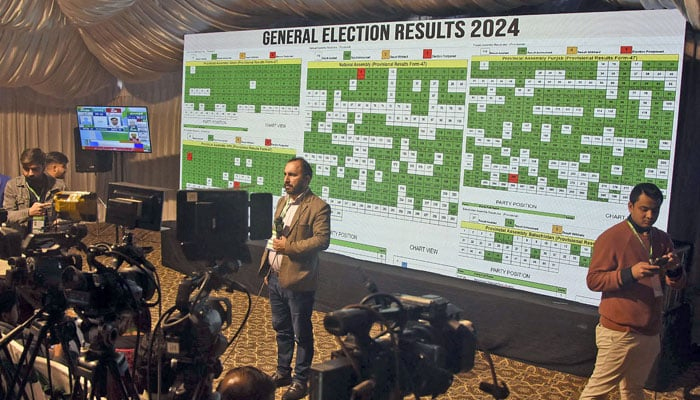
Results coming in from Thursday's election saw an unexpectedly strong showing for independents - mostly supporters of jailed former prime minister Imran Khan - trailed by former prime minister Nawaz Sharif's Pakistan Muslim League-Nawaz (PML-N) and the Pakistan People's Party of Bilawal Bhutto Zardari.
Sharif has already claimed victory, but his party remains far short of the necessary number of seats to form a government on its own.
The election, which was itself much delayed, comes at a pivotal moment.
Pakistan is in an economic crisis, with dwindling foreign currency reserves that will be further strained by a $1 billion bond payment due in two months, while its $3 billion funding programme with the International Monetary Fund expires on April 12.
"Pakistan will be entering into more severe political and economic instability if no party emerges with a simple majority," said Sajid Amin of the Sustainable Development Policy Institute, a former adviser to the ministry of finance.
"But most important is credibility of elections and legitimacy of the government - any government which lacks credibility will not be able deliver on much needed reforms."
Securing funding will be a top priority, with the country having not yet fully covered its external financing requirements for 2024 and its near $100 billion external debt burden casting a long shadow over the
A new government is expected to quickly take the necessary steps for example on governance of state-owned enterprises to complete the last remaining review of the current $3 billion IMF Standby Arrangement - a bridge loan that helped pull the country back from the brink of default.
Doing so would secure it a final $1.1 billion tranche before the current IMF programme expires in mid-April - with the government then having to secure a follow-up programme straightaway.
"We expect one of the most immediate policy initiatives taken by the new government will be to negotiate a new IMF Extended Fund Facility program, which typically runs for about 3-4 years," said Johanna Chua, global head of emerging market economics at Citi in a note to clients.
While the country's international bonds make up just 3.4 percent of its total public debt - dwarfed by the near 13 percent it owes to China, external debt amortisation is high in percent of FX reserves, according to calculations by Oxford Economics.
China is a major creditor for Pakistan and has in recent times rolled over loans to the country, as have the United Arab Emirates and Saudi Arabia.
"Investors will be worried about protests, worried that Imran Khan might end up coming back and worried that a non-Khan government will find it harder to push through further austerity – which is required given the IMF deal expires in April," said Charlie Robertson, head of macro strategy at asset manager FIM Partners.
Political fragmentation might make it harder to push through painful and unpopular but necessary measures such as widening the tax base, analysts said.
Should the unrest and demonstrations that Pakistan witnessed in the run up to the election continue, this would also have an impact on the economy, said Joe Delvaux, a portfolio manager at Amundi, whose firm is invested in Pakistan bonds.
"This is a country that is in and out of political turmoil on a regular basis, so we are monitoring this very closely," Delvaux said.
Pakistan's international bonds dropped as much as 5 cents in the dollar on Friday before trimming some losses. Its sovereign dollar bond due on April 15 trades at 95 cents in the dollar, reflecting expectations that investors will get paid back, but maturities coming due in 2027 and beyond trade at or below the 70 cents in the dollar below which debt is seen as distressed, Tradeweb data showed.
Pressure on the bonds could continue depending on how quickly a government can be formed and how effective it will be able to operate, investors and analysts said, with time running out.
"Our reserves will evaporate in weeks," said former finance minister Hafeez Ahmed Pasha, who pointed to the current level of FX reserves at just over $8 billion being equivalent to just 1-1/2 months of import cover - well below the minimum three months generally seen as safe.
"It's very important that we have the cushion and the umbrella of an IMF programme, especially before the budget scheduled in July."


