
Imran tried to talk to Modi after Balakot airstrikes: ex-envoy
According to Bisaria, then Pakistan Foreign Secretary Tehmina Janjua received a message from army saying that nine Indian missiles were pointed towards Pakistan and could be launched any time that day
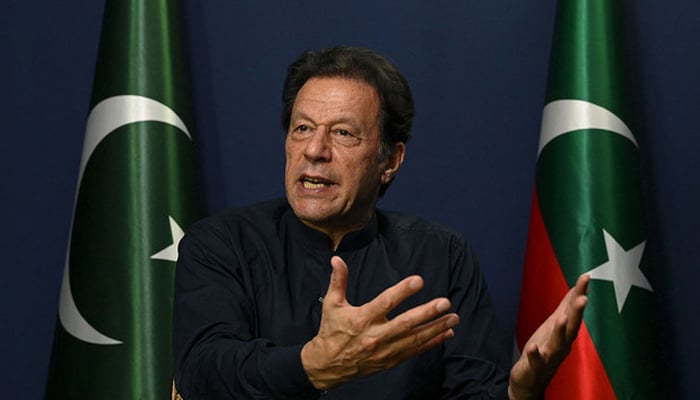
LAHORE: Former Pakistan Prime Minister Imran Khan had made a panic midnight call to Prime Minister Narendra Modi on February 27, 2019, following the Balakot airstrikes in a bid to avert a military crisis, reports Indian media citing a the memoirs of a former high commissioner to Pakistan.
In his upcoming book — The Anger Management: The Troubled Diplomatic Relationship between India and Pakistan — Ajay Bisaria notes that on the night of February 27, a day after Balakot airstrike conducted by the Indian Air Force, Pakistan feared an imminent attack from India. India had conducted an airstrike in Balakot on February 26 while Pakistan responded by conducting airstrikes in Indian-held territory and in an ensuing dogfight, PAF jets shot down two Indian jets and captured Indian pilot Abhinandan Varthaman.
According to Bisaria, then Pakistan Foreign Secretary Tehmina Janjua received a message from the army, saying that nine Indian missiles were pointed towards Pakistan and could be launched any time that day. The foreign secretary requested foreign envoys to report this intelligence to their capitals and ask India not to escalate the situation, notes Bisaria. As the crisis deepened, Imran Khan took a decisive step by requesting a midnight phone call to PM Modi, seeking urgent dialogue to defuse the escalating tension. The call was reportedly facilitated by the then Pakistani High Commissioner Sohail Mahmood, who contacted his counterpart in Delhi.
“At around midnight, I got a call in Delhi from Pakistani High Commissioner Sohail Mahmood, now in Islamabad, who said that PM Imran Khan was keen to talk to Prime Minister Modi. I checked upstairs and responded that our prime minister was not available at that hour, but in case Imran Khan had any urgent message to convey, he could, of course, convey it to me. I got no call back that night,” Bisaria says in his book.
Bisaria writes, “We were willing to send an Indian Air Force aircraft to pick him up but Pakistan refused permission; the optics of an Indian Air Force plane landing in Islamabad after all that had happened over the previous three days, was, of course, not acceptable to Pakistan.
“Even China, not to be left behind, had suggested that it could send its deputy minister to both countries to seek de-escalation. India had politely declined the offer,” he says.
“One of them recommended to her that Pakistan should convey its concerns directly to India,” says Bisaria.
Bisaria says “Pakistan’s PM would himself make these announcements and the pilot would be returned to India the next day. He says India’s “coercive diplomacy” had been effective, its expectations of Pakistan and of the world had been clear, backed by a credible resolve to escalate the crisis.
“Prime Minister Modi would later say in a campaign speech that, ‘Fortunately, Pakistan announced that the pilot would be sent back to India. Else, it would have been ‘qatal ki raat’ (a night of bloodshed)”.
On overall regional geopolitics, Bisaria writes that Pakistan Prime Minister, Imran Khan conveyed to China that it should support Islamabad since the US decided to back India against China, but Chinese President Xi Jinping “declared that China would not be propping up Pakistan against India”.
“I also learnt that Khan had told the Chinese that they should support Pakistan since the US had decided to support India against China. President Xi Jinping apparently responded sharply to Imran Khan for this simplistic geopolitical assessment and declared that China would not be propping up Pakistan against India,” he says.
“He had advised Khan that it was the US that could help Pakistan in its India relationship and it would be in Pakistan’s interest to make up with the US as well as with Afghanistan,” Bisaria writes.
Later that night, the US and UK envoys in Delhi told India’s foreign secretary that Pakistan was “ready to de-escalate the situation, act on India’s dossier, and to seriously address the issue of terrorism”, notes Bisaria.
The next day, Imran Khan addressed the media and announced the release of the pilot. While Imran Khan dubbed the release of Varthaman as a “peace gesture”, Bisaria notes that this was due to India’s coercive diplomacy.
Bisaria also mentions in his book that Pakistan’s then President Pervez Musharraf’s “overreach” in publicly airing his hawkish views on Kashmir, his lack of intent in containing terrorism and insistence on a formulation linking forward movement in overall ties to progress on Kashmir led to the collapse of Agra Summit in 2001 and not because of LK Advani’s hardline approach.
Bisaria reveals Pakistan’s spy agency ISI had tipped off India through the Indian High Commissioner in Islamabad about an al-Qaeda plot to carry out an attack in Kashmir in June 2019, which turned out to be genuine.
Pakistan has maintained since the Balkot incident that it returned Indian pilot as a peace overture. Addressing Pakistan’s lawmakers in the National Assembly on February 28, then PM Imran Khan said, “As a peace gesture we are releasing the Indian pilot tomorrow (March 1).”


