
Judges’ elevation procedure not being followed: Justice Isa
Justice Isa replied that the ECP is an independent constitutional body, and the Supreme Court cannot intervene in its functions
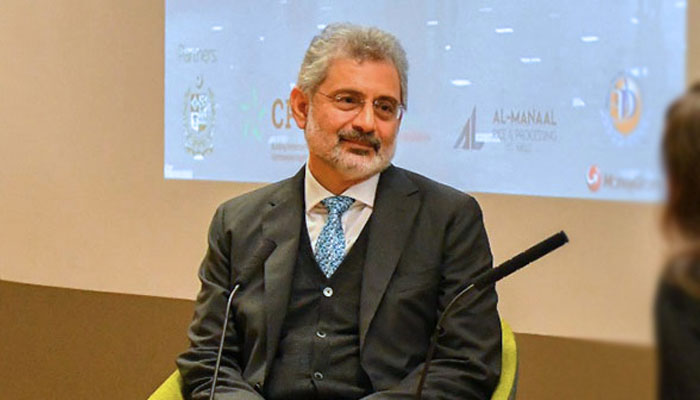
NEW HAVEN: Senior puisne judge of the Supreme Court of Pakistan Justice Qazi Faez Isa delivered a lecture at Yale University and spoke on a wide range of topics, including the Faizabad sit-in judgment, judges’ appointment controversy, blasphemy cases, article 184 (3), climate change and the law, judges’ non-entitlement to plots, the Apex Court’s rarely used advisory jurisdiction, etc.
The lecture was attended by faculty and international and Pakistani-origin students from the Law and Political Science departments of Yale University here on Thursday. Justice Qazi Faez Isa briefly told the students about Pakistan’s geography, history, and essential clauses of the Constitution of Pakistan.
Most of the questions directed to Justice Qazi Faez Isa were related to his landmark judgment on the Faizabad sit-in, to which he briefly explained the background of his decision and the importance of the rule of law.
He was also asked a question about the recent controversy over the judge’s appointment to the Supreme Court of Pakistan, to which he briefed the students on the procedure for judges’ elevation.
While quoting an example, Justice Qazi Faez Isa explained to the lecture participants and asked, “Can Yale University elevate a lecturer to the post of a professor?” “No matter how brilliant you are, there is a procedure that you must follow,” he explained.
“I pointed out the same during the Judicial Commission’s meeting held for the appointment of judges to the Supreme Court of Pakistan,” said Justice Qazi Faez Isa, adding that normally the senior-most judge in the high court should be elevated to the Supreme Court. If the most senior judge cannot be appointed for any reason, then the second-most senior judge should be brought into the Apex Court.
“But one cannot choose a number five or six from the seniority list without considering the seniors and being elevated to the Supreme Court,” said Justice Qazi Faez Isa. When asked if he had any intentions to change the judges’ appointment procedure after taking oath as Chief Justice of Pakistan, he said: “Time will tell.”
In response to a question about blasphemy cases in Pakistan, Justice Qazi Faez Isa mentioned his recent judgment on the Salamat Masih case. A relevant quote of Justice Qazi Faez Isa’s judgment in the Salamat Masih case reads: “It may not be out of place to mention that the Federal Shariat Court had noted the views of a few eminent Islamic scholars who had opined that even in cases where blasphemy was committed if the accused had repented, he should not be punished.”
He said Islam is a religion of peace. “I want to present a bright side of Islam. There is a concept of repentance, and if anyone repents for what he did, Islam teaches a lesson of forgiveness,” he said.
Justice Qazi Faez Isa was also asked if the Supreme Court of Pakistan can play its role in clubbing all the election-related cases together and direct the Election Commission of Pakistan to hold the general elections early, as demanded by the opposition party.
Justice Faez Isa replied that the Election Commission of Pakistan is an independent constitutional body, and the Supreme Court cannot intervene in its functions. He also talked about the importance of climate change and the role of the judiciary in this regard.
Justice Qazi Faez Isa addressed the audience about Pakistan’s commitment to combating climate change. He shared a currency note of Rs 75 issued by the State Bank of Pakistan to commemorate 75 years of independence. The backside of the currency note has a sentence that reads: “Saving climate and species.”
He also referred to a judgment by Justice Mansoor Ali Shah about protecting climate change laws in Pakistan. The senior puisne judge also talked about other issues and answered the audience’s questions related to the Chief Justice of Pakistan’s suo motu powers under Article 184(3), judges’ non-entitlement of residential plots, the Apex Court’s judgment on the issuance of CNIC to transgender people, and the Supreme Court’s jurisdiction, including the advisory role, which is rarely used.







-
 ‘Disgraced’ Andrew Still Has Power To Shake King Charles’ Reign: Expert
 -
 Why Prince William Ground Breaking Saudi Tour Is Important
 -
 AOC Blasts Jake Paul Over Bad Bunny Slight: 'He Makes You Look Small'
 -
 At Least 53 Dead After Migrant Boat Capsizes Off Libya
 -
 'God Of War' Announces Casting Major Key Role In Prime Video Show
 -
 Real Reason Prince William, Kate Broke Silence On Andrew Scandal Revealed
 -
 Drew Barrymore Responds To 'Charlie's Angels' Costar's Comments About Her
 -
 Shakira Slips Hard On Stage During Life Show
 -
 King Charles Speaks Out Over Andrew's Scandal: 'Stand Ready To Help Police'
 -
 Dax Shepard Recalls Horrifying Accident That Almost Killed Him
 -
 Logan Paul's Bodyguard Hits Fan On Super Bowl Day
 -
 Epstein Files: Anne Hathaway Mentioned As Highly Desired Guest For Bill Gates?
 -
 Prince Harry Under A Lot Of Stress As Meghan Markle Makes Bizarre Demands
 -
 Princess Beatrice, Eugenie's Subtle Break From Disgraced Parents Exposed
 -
 Baby Left In Running Bathtub Dies After Father ‘forgets’ Him
 -
 King Charles Takes A Major Step To Keep Horrified Prince William Out Of The Loop On Andrew: Insider