Pakistan’s halted changes to the net metering policy, with the reduction in buyback rates, if implemented, would have marked a critical shift in the country’s renewable energy strategy, but in vain.
SOLAR SUSTAINABILITY
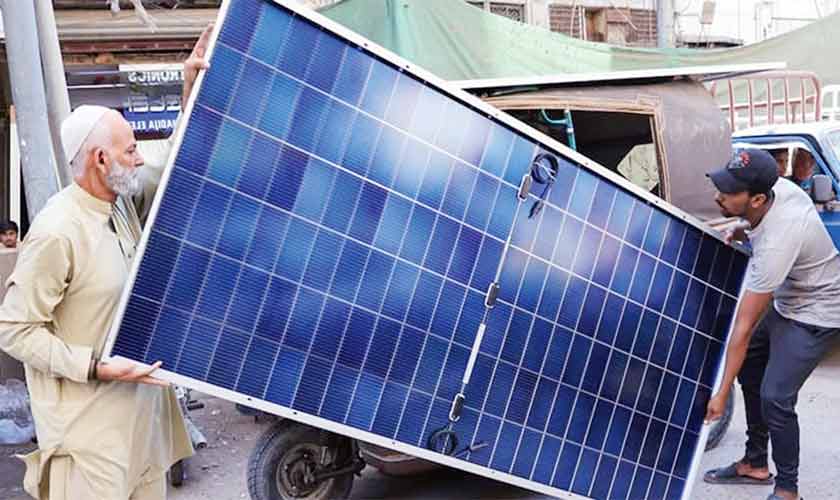
Pakistan’s halted changes to the net metering policy, with the reduction in buyback rates, if implemented, would have marked a critical shift in the country’s renewable energy strategy, but in vain.
While these changes were meant to address the growing financial burden on non-solar consumers and power distribution companies (DISCOs), further reforms may still be necessary to ensure long-term grid stability, fair cost distribution, and a sustainable solar energy transition.
This followed talks between the federal government and the IMF for policy-level discussions for the tranche of the $7 billion loan programme, focusing on new revenue measures, energy sector reforms and debt reduction, besides the revision in net metering tariff. Key proposals under review included a carbon tax on petrol and diesel, levies on coal plants and net metering tariff revisions.
When it comes to solar, one of the most effective ways to balance equity in solar adoption is to transition fully from net metering to net billing -- a model already adopted by Germany, Australia, and parts of the US. In California, the Net Energy Metering (NEM) 3.0 policy, implemented in April 2023, significantly reduced the compensation for exported solar electricity. Instead of receiving retail rates, solar customers now earn wholesale rates (around 25 per cent of the retail tariff) for excess power.
This model ensures that prosumers (producer + consumers) pay their fair share of grid maintenance costs while still benefiting from solar self-consumption. The change in buyback rates from Rs27 to Rs10, halted within days of announcement, had resulted in public furore, also instigated by some political elite. Another attempt by the Power Division to bring it down to Rs11.3 turned into a futile effort. The aim was to maintain fair compensation for net metering customers while ensuring grid sustainability and taking the burden off grid customers, which was caused by having them subsidise solar rooftop prosumers.
A major challenge with net metering is that most solar energy is exported during the daytime when demand is lower, while the second spell of peak demand occurs during early morning hours – a little after midnight, when solar generation is unavailable. Rapid solar adoption has been causing voltage increases and reverse power flows, especially in areas with high solar penetration, including behind-the-meter installations.
According to a study conducted by Arzachel in this regard, called the ‘Distributed Divide’, it was mentioned that energy sales and demand from the grid had decreased by 8.0 per cent to 10 per cent due to increased penetration of solar energy. A 5.0 per cent reduction in demand was to shift Rs131 billion to non-solar consumers. The Ministry of Energy finally ascertained that the shift was a magnanimous Rs159 billion in the last fiscal year.
Learning from international examples, it is known that Australia too had addressed this by shifting from flat-rate solar buyback tariffs to time-of-use (TOU) pricing, where exported electricity is compensated differently based on the time of day. Spain implemented a fixed monthly charge for solar prosumers to cover grid maintenance and ensure fair cost-sharing.
By learning from global examples and implementing reforms such as net billing, TOU tariffs, battery storage incentives and grid modernisation, Pakistan can ensure that solar energy continues to grow without disrupting grid stability or unfairly burdening non-solar consumers
Besides the reduction in buyback rates, the adoption of Battery Energy Storage Systems (BESS) should be strongly encouraged in Pakistan to enhance the viability of solar investments. BESS can allow consumers to store their surplus power and utilise it during peak demand hours, effectively reducing reliance on the grid and maximising self-consumption. Countries such as Australia and Germany have successfully integrated BESS with solar energy by offering incentives and financing schemes to make battery storage more accessible.
To facilitate widespread adoption in Pakistan, the government should introduce subsidies and low-interest financing for BESS, create tariff structures that reward stored energy discharge during peak hours, and develop a regulatory framework for distributed storage participation in the energy market.
Encouraging BESS adoption will not only support solar consumers in maintaining financial benefits but also enhance overall grid stability by reducing fluctuations caused by intermittent solar generation. Without energy storage, Pakistan’s grid will face increasing voltage fluctuations and instability as more solar capacity is added. Eventually, this will allow users to store excess solar power instead of feeding it into the grid, reducing dependence on centralised generation. Introducing a minimum fixed charge for net-metered consumers based on their connection type may be a viable option too, so that they pay to the grid what has been avoided through shifting to rooftop solar. These funds can be used for grid infrastructure upgrades to accommodate higher solar penetration.
Pakistan’s power grid was not designed for bidirectional power flows from distributed solar. Enhancing grid infrastructure to adapt to this change will be essential to prevent overloading and power quality issues. Vietnam rapidly expanded its rooftop solar capacity but faced major grid constraints. In response, the government launched a grid reinforcement program to integrate distributed solar smoothly. Investing in smart grid technologies will be a viable idea to manage solar exports efficiently, manage high solar penetration, and implement locational pricing to encourage solar adoption where the grid can support it.
Countries like the US and Germany allow solar prosumers to participate in ancillary services markets, providing grid support in exchange for compensation. In its list of recommendations, the study, ‘Distributed Divide’ also recommended introducing differentiated Feed-In Tariffs (FiTs) to promote efficient solar energy integration while encouraging battery storage adoption.
A structured approach, such as daytime FiTs (~12 PKR/kWh) and nighttime FiTs (~25 PKR/kWh), can incentivise energy storage, ensuring power availability during peak demand hours. Furthermore, revising the Distribution Code is essential to accommodate the growing share of Distributed Energy Resources (DERs) and to ensure smooth bi-directional power flow management. Implementing control mechanisms for oversupply and curtailment will help maintain grid stability, optimise resource distribution, and mitigate technical constraints caused by increasing solar penetration.
Conducting a Distributional Equity Assessment (DEA) would be viable to understand the impact of net metering reforms on different consumer groups, a step ahead of ascertaining the current Rs159 billion and drawing a pathway towards policy enhancement and ensuring equitable treatment.
Pakistan is at a crucial crossroads in its solar energy transition. While reducing net metering buyback rates will be a step in the right direction, further policy refinements are needed to create a fair, financially sustainable, and grid-resilient energy system. By learning from global examples and implementing reforms such as net billing, TOU tariffs, battery storage incentives and grid modernisation, Pakistan can ensure that solar energy continues to grow without disrupting grid stability or unfairly burdening non-solar consumers. The goal is not to discourage solar adoption but to integrate it responsibly, ensuring that both solar and non-solar users benefit from a cleaner, more efficient energy system.
The writer is the chief executive officer at AKD Securities Limited.