Bankers and economists both deal with poverty in their own peculiar ways. Bankers count money, economists measure misery; bankers fear defaults, and economists advocate giving without returns. That's the enduring dichotomy.
POVERTY NUMBERS
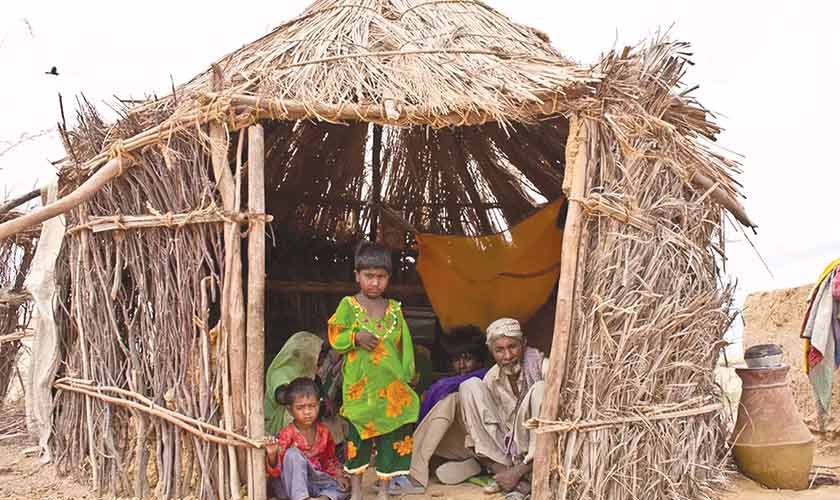
Bankers and economists both deal with poverty in their own peculiar ways. Bankers count money, economists measure misery; bankers fear defaults, and economists advocate giving without returns. That's the enduring dichotomy.
Today, 85 out of every 100 Pakistanis live below Rs1,897/day. Predictably, Pakistan’s economic managers justify their reliance on a poverty-consumption metric, arguing that this approach considers the poor’s welfare and enables targeted policies.
Since 1971, when Pakistan had 62 million people (26 per cent urban, 74 per cent rural) with 55 per cent living in poverty, not much has changed except that the problem has multiplied. The 2023 census places the population at 249.1 million, growing at 2.55 per cent annually, the highest rate in the region and a catalyst for poverty. Today, 38 per cent live in cities, while 62 per cent remain rural -- exceeding Pakistan’s population in 1947 and 1971 combined. Bangladesh successfully controlled its growth rate; why can’t Pakistan? It’s time to declare population growth a National Emergency with cabinet-level oversight.
Government efforts at poverty mitigation are illustrated in the Poverty Alleviation and Social Safety (PASS) Year Book 2023/24 (Feb. 2025). It highlights output metrics (not outcome metrics) -- beneficiaries reached, tasks completed and funds disbursed. Laudable efforts, no doubt. Yet, the report fails to address the broader poverty ecosystem, real poverty reduction targets, or the alignment of poverty programs to achieve self-sufficiency.
Moreover, it offers no critique of each programme, whether the interventions lead to long-term self-sustainability or temporary relief and missing the use of feedback from beneficiaries for corrective measures in future programme.
Nevertheless, the government should be acknowledged for the achievements of the National Poverty Graduation Program (NPGP), which has proved its efficacy in successfully reducing poverty and enabling the self-sustainability of recipients. Shortage of funding should not be repeated for such programmes. Mapping local skills and matching them with the needs of potential local or regional employers, and incentivising employers with shared or fully sponsored salaries (6-12 months) while continuing assistance, reflects an end-to-end philosophy towards self-sufficiency.
The Uraan Pakistan Plan 2024/29, hailed as a game-changer, would drastically reduce poverty in the country, improving the well-being of the population. It envisions per capita income rising from $1,680 in 2023/24 to $2,045 by 2028/29 - a precursor for poverty reduction. However, its reliance on outdated data and cherry-picked figures raises serious concerns.
Despite the October 2023 CCI-approved population census, prior estimates (235.95 million) were used for the FY2023/24 baseline instead of the actual 241.9 million. With 2.55 per cent annual growth, GDP gains would be neutralised by a nearly equivalent population increase, rendering projected improvements highly optimistic.
The PBS places it at $1,669 for FY 2023/24, but if adjusted for the 2023 census, it drops to $1,543. Yet the plan arbitrarily picks an FY2023/24 baseline of $1,680, which was reported for CY 2024, inflating projections.
The plan's national poverty line remains frozen at 2018/19 levels (Rs3,757/month per adult), despite years of inflation and economic decline. Officially, 21.5 per cent of the population (recently projected at 25.3 per cent by the World Bank) was classified as poor in 2018/19. The plan claims national poverty would decline by 12 per cent, and Multidimensional Poverty (MPI) will drop from 41.6 per cent to 21 per cent by 2029 -- these projections are rather misleading.
The PSDP allocated an average of Rs3,278 billion annually (2.68 per cent of GDP), but only Rs21 billion annually (0.02 per cent of GDP) is earmarked for the line-item ‘Poverty Alleviation & Social Protection’ -- a token amount. While BISP is discussed without specifying funding, it is expected to follow past average spending of 0.45 per cent of GDP annually (Rs543 billion). These figures need to be updated per GDP growth, with increased funding for NPGP.
The plan targets 5.1 per cent average annual growth to raise per capita income from $1,680 in 2023/24 to $2,045 by 2028/29. However, adjusted for the 2023 census, GDP would need to grow at 8.45 per cent or even 11.3 per cent if based on the actual per capita income of $1,543. Neither scenario is remotely achievable under current economic conditions.
Unlike Pakistan’s poverty-consumption approach, the World Bank defines poverty by daily income, enabling global comparisons. By this measure, 40 out of 100 Pakistanis live below the lower poverty-income limit of $3.65/day (Rs1,011/day), and 85 out of 100 Pakistanis live below the higher poverty-income limit of $6.85/day (Rs1,897/day).
To put these figures in perspective, Pakistan’s FY2023/24 minimum wage of Rs1,066/day ranks 103rd out of 124 countries -- barely above the lower poverty-income limit, with most informal sector workers earning even less. The poverty bar isn’t high enough to make it a national priority; rather, it downplays the crisis.
For an average Pakistani family of 6.8 people, securing food, shelter, healthcare, education, wedding expenses, old-age savings and parental support under these conditions is nearly impossible. This is not an accident of birth -- it is a governance failure.
What lies ahead? More of the same - unless we radically rethink our approach to poverty classification and reduction. The current economic policies of excessive taxation and tight monetary policies have stifled growth. The finance minister recently declared in a Senate hearing: "Let it be clear to everyone that irrespective of how much pressure is put on me, I will not accelerate economic growth." For 85 out of 100 Pakistanis, the message is clear: Expect more of the same.
The foremost future action is to align the national poverty line with current living costs and the growing poverty level. Probably raise the final monetary outlay by a multiple of the poverty line calculated from the current poverty-consumption method. This gives poor people living dimensions, not just survival.
Making Uraan Pakistan believable requires using the latest census data to generate realistic economic baselines, future projections and poverty funding. The government’s future performance review of PASS undertakings must move beyond the output statistics and incorporate analytical performance measures, targeted poverty reduction goals, SWOT analyses of poverty programmes and mechanisms ensuring transparency.
To combat poverty, the poverty-consumption method needs a compassionate review, as it has failed to bring the plight of the poor to the forefront of national discourse. Current approaches to poverty through a hybrid poverty consumption-income model may address the welfare and living standards of the poor - possibly a better way to fight Poverty. Experts can dwell upon this.
Until then, poverty remains Pakistan’s curse - compounded by an unabated population explosion.
The writer is a chemical engineer.