From Taurees Habib’s Grammy win to Hasan Raheem’s collaboration with Justin Bibis and Karachi Biennale’s announcement for 2027, here’s a look at how Pakistani artists and institutions are reshaping sonic ideas and cultural ethos at home and abroad.

Taurees Habib becomes first Pakistani sound engineer to win a Grammy and launches his solo career with ‘Cannibal Cathedral’
Pakistani-American sound engineer Taurees Habib has quietly made history, becoming the first from his field in the country and only the second Pakistani to win a Grammy Award.
The Karachi-born sound engineer received the honour earlier this year in February at the 2025 ceremony hosted by Trevor Noah. His award for Best Score Soundtrack for Visual Media (Including Film and Television) recognised his contribution to Hans Zimmer’s acclaimed score for Denis Villeneuve’s Dune: Part Two.
Although the win was announced in February, Habib chose to make it public on September 30, when the golden gramophone finally reached his home. Revealing the accomplishment on Facebook, he wrote, “I’m so incredibly honoured to have received this for my work on Dune: Part Two and to be the first Pakistani to receive this for engineering and only the second Pakistani ever to win a Grammy. It’s crazy to walk into my living room and see this thing just sitting there.”
He also shared an Instagram video unboxing the trophy. “So, something happened this February, and I haven’t really talked about it. It felt like one of those things better shown than said,” he shared before lifting the trophy out of its packaging and placing it on the table.
Habib credited his colleagues for bringing Zimmer’s vision to life. “I’m so lucky to have gone along for the ride with all the people on our team who put their blood, sweat and tears into making this possible.”
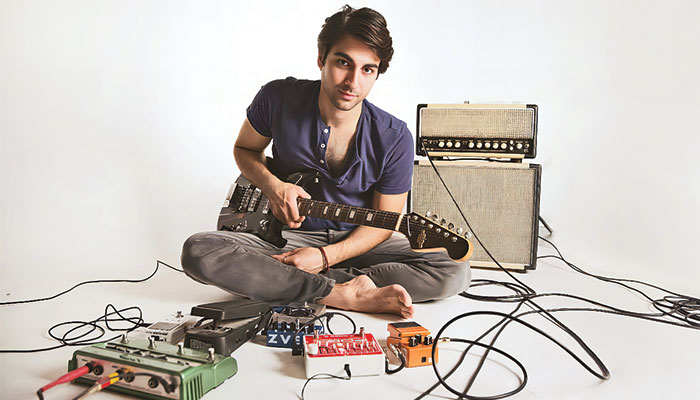
For Habib, the Grammy represents another milestone in more than a decade of work.
Working as a sound engineer for Hans Zimmer for 12 years, he has been credited in the music departments of over 40 productions since 2013, including Interstellar (2014), Blade Runner 2049 (2017), Dunkirk (2017), No Time to Die (2021), Top Gun: Maverick (2022), Kung Fu Panda 4 (2024) and F1: The Movie (2025). Yet the award does not mark the end of his story. This year also marks the beginning of his solo career with the release of ‘Cannibal Cathedral’, his first single under his own name.
The track blends industrial and rock elements with a cinematic atmosphere, signalling his transition from sound engineer to musician. A press release described it as “Trent Reznor and Alex Turner colliding inside a David Lynch fever dream.” The result is a sound that is both original and impressive. With ‘Cannibal Cathedral’, he has stepped into the spotlight on his own terms and onto our playlists.
Taurees Habib’s younger brother, Ziyad Habib, is well-known in Karachi indie circle. He has been a part of Karachi’s indie music group, Mole, who released two albums, went on to perform on Coke Studio in its fourth season. After Mole, he’s been making music under the moniker Noahs Heark and is the founder of Hear Now Records. The RBMA alum is currently a Technical Production Lead at Dreamtek.
Here’s hoping we hear a lot more from Taurees Habib, not only as a fantastic sound engineer, but as an artist. Keep watching this space for more on the artist.

Hasan Raheem plays it safe with his collaboration with Justin Bibis
Every so often, a song arrives that does not just enter playlists but seeps into late-night silences, replayed until it becomes part of lived memory. ‘Memories’ by Hasan Raheem featuring Justin Bibis tries to do just that.
Released under Sony Music, the track has already trended online though its real significance lies in what it reveals about Raheem’s artistic evolution and his limits.
At its core, ‘Memories’ is a lament about love. Raheem sings in a quiet tone, as if speaking directly to the listener. His words, “Kitne tukron men ye dil gir chuka hai ab / Mera ishq hai na-tamam,” sound personal.
The poetry feels sincere but safe. Heartbreak and unrequited love are familiar subjects in pop music. While Raheem gives them emotional weight, the words rarely move beyond the familiar. One wishes for sharper imagery and fresher language to match the rawness of the feelings he is trying to share. But it never translates into the aching ballad that it needed to be.
The return of Justin Bibis feels deliberate, echoing a follow-up collaboration after Coke Studio 14’s ‘Peechay Hutt’. That track worked because it was in complete contrast to Justin Bibis’ style. The energy and audio production value was so high that ‘Peechay Hutt’, in retrospect, is as entertaining as it was when it released three years ago. Given its success, another collaboration with Justin Bibis needed as much gravitas, if not more. However, ‘Memories’ feels like a song that is meant to elevate Hasan Raheem.
The presence of Justin Bibis feels like it is meant to add to the harmonic section of the song, and add character to Raheem’s melancholic mood. As a collaboration, Justin Bibis are underused. Their voices have the strength to carry the track to another level but the arrangement does not give them enough space to shine.
Shehryar Khan’s production is polished, textured with atmospheric synths and restrained percussion. It creates an ambience where Raheem’s vocals take centre stage. Still, the soundscape feels a little too careful, as if unwilling to risk disruption. It works but at times drifts towards predictability. Pakistani pop has been braver in recent years yet ‘Memories’ seems content to stay within boundaries.
The music video adds drama with its wedding setting, complete with ex-lovers disrupting ceremonies and emotions spilling into spectacle. The imagery looks dramatic but leans toward excess. Instead of supporting the quiet mood of the song, it threatens to overtake it.
Placed against Raheem’s earlier discography, ‘Memories’ doesn’t have enough power, as a single, a collaboration and as a music video. His early hits including ‘Joona’ and ‘Aisay Kaisay’ were minimalist and still have recall value. Even ‘Peechay Hutt’ was bold and unpredictable. while his colloborative track with Natasha Noorani ‘Faltu Pyar’ was layered and intelligent.
Compared to any of those songs, ‘Memories’ lacks direction. It leaves behind groove and rhythm, focusing on intimacy. You might think that is progression but all it does is raises questions. In stepping towards sincerity, is Raheem losing the unpredictability factor that once made his music so exciting? Justin Bibis’ restrained role here underscores the same issue. In ‘Peechay Hutt’ they were electrictrifying. But the partnership we heard in ‘Peechay Hutt’ is non existent in this song.
Still, the track’s cultural value cannot be entirely dismissed. Mixing Urdu and Punjabi with R&B and pop is a reflection of the hybrid identity of Pakistani music as it stands today. It may not be revolutionary but it is accessible which explains its quick adoption across reels and playlists. But accessibility is not the same as durability. For a song titled ‘Memories’, the approach feels cautious. Raheem has shown skill at creating music that trends. But music with lasting impact needs risk, both in sound and in words. ‘Memories’ is restrained, but restraint alone may not secure permanence.
In the end, ‘Memories’ is both promise and pause. It proves Hasan Raheem can be more than cool; he can embrace vulnerability. It shows Justin Bibis’ ability to adapt and why we need to hear more from them.
Not every track needs to reinvent the wheel. Some songs choose sincerity and that sincerity finds space if an artist has a strong following. But if Raheem wants his songs to endure he will need to take risks (and by that we do not mean collaboration with rap artists only).
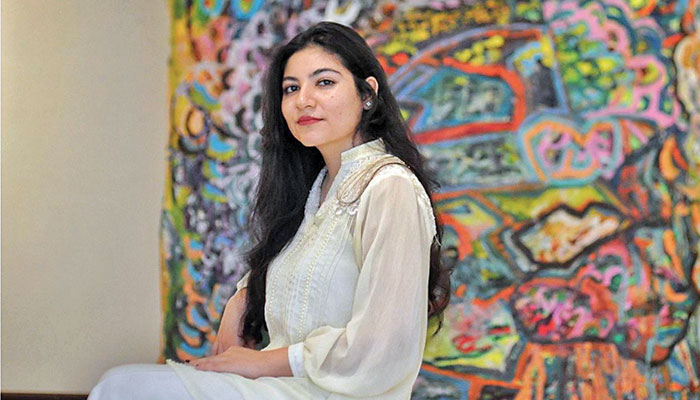
Karachi Biennale 2027: Noor Ahmed to curate fifth edition
The Karachi Biennale will return in January 2027 for its fifth edition, led this time by curator Noor Ahmed. Since its launch in 2017, the Karachi Biennale has grown into Pakistan’s largest international contemporary art event, transforming the city with exhibitions, public art projects and education programmes that bring contemporary art to diverse audiences.
For KB27, the Biennale will once again move beyond gallery walls, spreading across Karachi’s schools, parks and public spaces. The programme will feature commissioned works, site-specific projects, artist residencies, workshops, initiatives for schools and communities and a series of public talks. The Trust aims to explore new ways of engaging audiences and to document the outcomes for future editions.
Noor Ahmed is an interesting choice as curator. She has collaborated on significant projects, including co-curating River Landscapes, a transnational initiative connecting South Asia and Europe through a shared glossary of water. She was also Project Director and Lead Curator of the Digital Curation of Lahore and Taxila Museums, Pakistan’s largest museum digitisation programme.
Her relationship with the Biennale dates back to 2019, when she served as Assistant Curator for KB19 and helped deliver exhibitions across Karachi’s public parks, zoo and botanical gardens.
The Biennale has always sought to expand access to contemporary art and each edition has advanced this mission. Curated previously by Amin Gulgee in 2017, Muhammad Zeeshan in 2019, Faisal Anwar in 2022 and Waheeda Baloch in 2024, the event has steadily strengthened its infrastructure for commissions, exhibition delivery and education while deepening public participation across the city.
With Noor Ahmed guiding KB27, the Biennale is set to continue this growth. The programme will introduce new voices, test fresh formats and reaffirm Karachi’s role as a hub of contemporary cultural exchange. Details of the full programme along with submission dates and ticketing information will be released by the Trust ahead of the January 2027 opening.