
NASA’s dark matter web simulation reveals the universe’s hidden cosmic web
The gravity of unseen dark matter explains why galaxies rotate and orbit so fast, shaping the universe
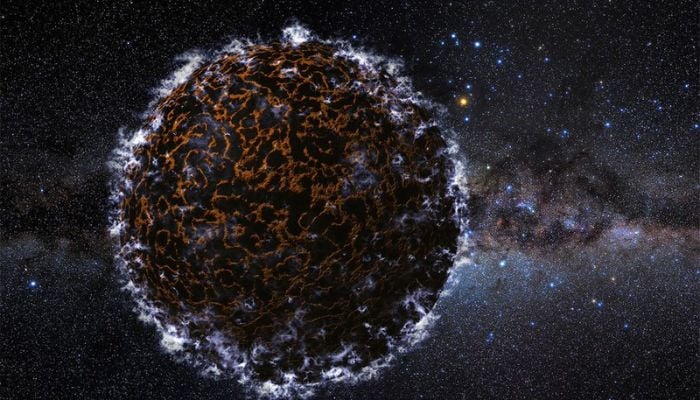
NASA has created a simulation of the cosmic web to help scientists understand how dark matter shapes the entire universe and the formation of galaxies.
NASA’s Astronomy Picture of the Day on October 25 showcased a computer simulation from the American Museum of Natural History's “Dark Universe” show, illustrating the dark matter framework. It was created by Tom Abel and Ralf Kaeshler, explaining why galaxies spin fast, cluster together, bend light and match real observations.
The featured image from American Museum of Natural History’s Hayden Planetarium Space Show, Dark universe underscores one example of how pervasive dark matter might haunt our universe.
In this frame from a detailed computer simulation, complex filaments of dark matter shown in black are celestially distributed like spider webs, while the isolated concentrations of normal baryonic mass are colored orange.
These simulations are observationally constrained models matching astronomical observations. In what is perhaps an alarming turn of events, dark matter, although quite strange and in an unknown form, is no longer thought to be the gravitational anomaly in the universe.
The image has drawn attention to ongoing puzzles like dark stars, early supermassive black holes, and upcoming mission discoveries such as ESA’s LISA revealing how dark matter covers most of the universe’s mass while the cosmos spans billions of years.


-
 Beaver Moon 2026: When and where to see a full supermoon rise this week
-
 Physicist discovers new solution to Einstein's equations for 'Black Saturn'
-
 Thailand makes prepares to stop exporting rare earth mining chemicals to Myanmar
-
 Inside COP31 climate deal: COP31 President speaks out
-
 NASA reveals mysterious 'ghost forest' on Mars: Everything to know about it
-
 COP31 talks reach deadlock amid growing fossil fuel dispute
-
 Astronomers observe massive puffy star merging with smaller companion
-
 NASA confirms Voyager 1 is now a ‘light-day’ away from Earth
-
 Google partners with Bezos’ Blue Origin to launch AI computing satellites in 2029
-
‘Craziest is definitely still yet to come’: HEO unveils advanced space intelligence platform in major new launch
-
Anthropic vs SpaceX: How two potential IPOs compare
-
EU climate chief says 'COP31 must drive clean energy shift'


