First-ever radio signal from exoplanet reveals its magnetic field
Beta Pictoris b is a gas giant roughly 12 times the mass of Jupiter
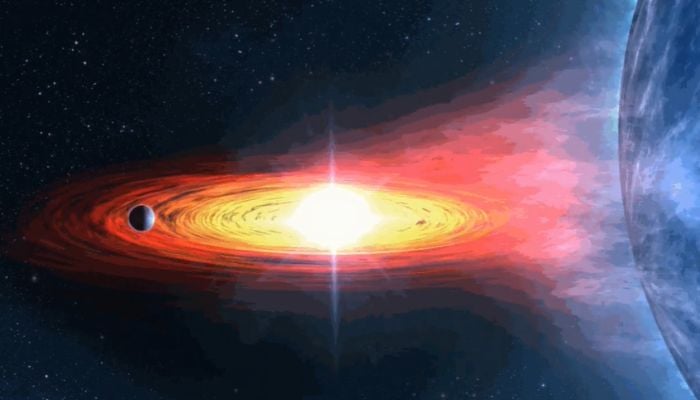
Astronomers in a recent breakthrough have captured a strange radio signal coming from a distant planet outside the solar system for the first time.
According to the researchers from the Harvard-Smithsonian Centre for Astrophysics, the signal came from an exoplanet named Beta Pictoris b which is about 64 light-years away and it came from its aurora.
The existence of such a signal points to the presence of a strong magnetic field which is 1000 times stronger than that of Earth's.
Speaking about aurora, this phenomenon is common on Earth responsible for producing northern and southern lights. On an exoplanet this is caused by electrically charged molecules coming in contact and colliding with its massive magnetic field. Soon they come into contact, the excited ones release light and glow as they return to their normal states.
According to the findings published in a yet-to-be-peer-reviewed study, “Although auroral radio bursts are observed in Solar System planets and in some ultracool dwarfs, no radio detection has previously been unambiguously localised to an extrasolar planet rather than its host star.”
The scientists made the first-ever radio signal discovery emitted from an exoplanet while surveying space using South Africa’s MeerKAT array. Positional tracking confirmed the signals originated from the planet, and their circular propagation pattern matched radio waves produced by auroras.
The signal strength indicates a planetary magnetic field of over 1,250 Gauss (1.25 kG), a massive power compared to Earth's surface magnetic field of about 0.5 Gauss. This discovery marks the first time scientists have successfully isolated radio signals from an exoplanet and directly measured its magnetic field strength.
"This result, if it holds up in peer review, is an incredibly exciting advancement...It would be a fantastic result," astronomer Joe Callingham of the University of Amsterdam, who was not involved in the study said.


-
 Starship flight 14: Why SpaceX’s first-ever orbital test matters to NASA’s Artemis
 -
 New study explains 364-day Qumran calendar puzzle
 -
 Why does time feel faster as you age? Science explains
 -
 Scientists name newly discovered snake after Guns N' Roses' Slash
 -
 SpaceX secures three new NASA crew flights: What to know
 -
 Sovereign AI fund in talks to back Political Sciences: What to know
 -
 What recent discovered Moon Crater Means for Future Astronauts
 -
 Scientists discover new wild cat species in Bolivia for the first time in a century