South Korea markets sink as Kospi records worst day in decades amid Iran conflict
The Korea Exchange temporarily halted trading in the Kospi, while a circuit breaker was triggered for the Kosdaq index
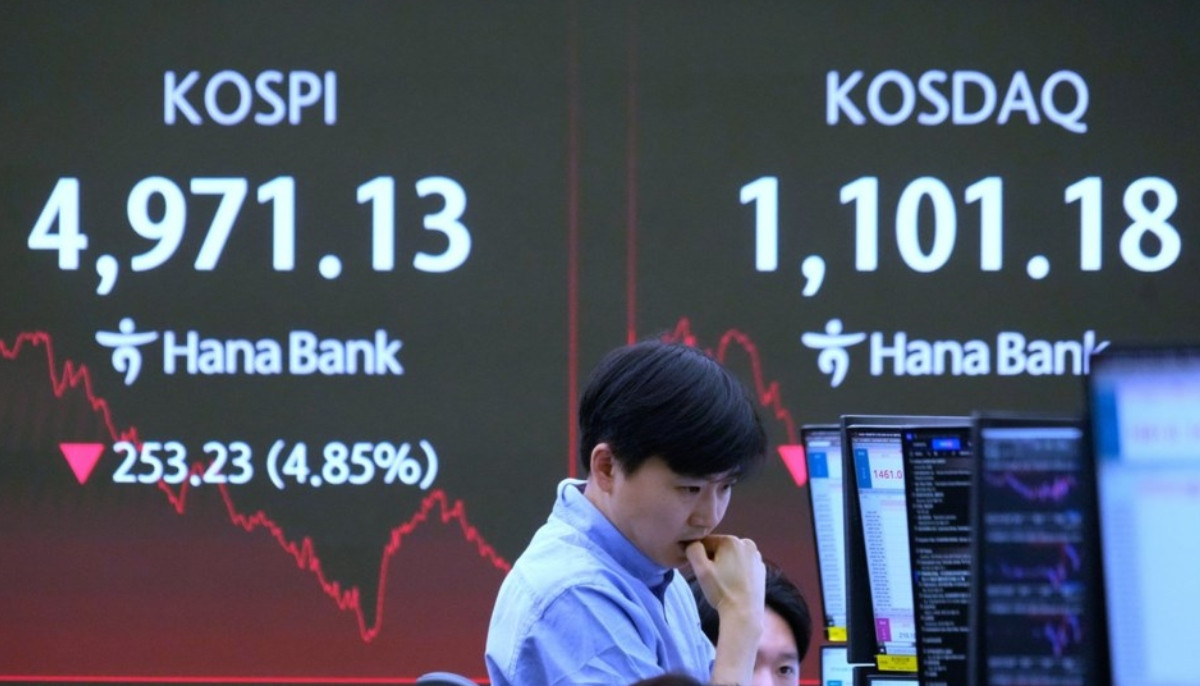
South Korea’s stock market suffered a major sell off Wednesday as the Kospi index plunged more than 12 percent, putting it on track for its worst trading day in decades.
According to a report by CNBC, the sharp decline comes amid rising geopolitical tensions linked to the conflict involving Iran.
The Korea Exchange temporarily halted trading in the Kospi, while a circuit breaker was triggered for the Kosdaq index, which also dropped around 13 percent.
Major South Korea technology companies led the losses. Samsung Electronics and SK Hynix fell about seven percent and five percent respectively.
“The decline in the KOSPI can broadly be attributable to the single-name concentration that we see in the Korean markets,” Lorraine Tan, Asia director of equity research at Morningstar, told CNBC.
According to Morningstar data, Samsung and SK Hynix together make up nearly half of the index.
Tan said the sell off reflects profit taking after a strong rally and concerns about the pace of AI data center expansion.
“We believe that the drop in share prices is partly driven by profit taking after a strong runup amidst a risk-off environment but also implies growing concern that the AI datacenter adoption pace might slow due to its significantly higher energy costs than regular data centers,” she said.
Analysts also say South Korea’s economy is highly sensitive to oil price swings, making it vulnerable during Middle East conflicts.


-
 Tesla drops as spending cuts raise questions about AI and robotics plans
 -
 Barclays to cut 5,000 jobs as AI reshapes banking
 -
 China's brain-computer interface market could reach $920m by 2028
 -
 Putin-Witkoff meeting: 5 key takeaways on Ukraine peace talks
 -
 Sheriff Chris Nanos insists Nancy Guthrie was taken alive
 -
 Yankees extend Brian Cashman's tenure after another disappointing playoff exit
 -
 Poland's abortion ban faces new challenge as lawmakers vote to loosen restrictions
 -
 New York Democrat Brad Lander released after detention in West Bank
-
 Ohio chemical tank explosion triggers mass evacuations and shelter-in-place orders in Toledo
 -
Trump suffers record low approval rating weeks before US midterm elections
-
El-Sayed leads Rogers by a narrow margin as Michigan Senate election approaches
-
Russia ready for new Ukraine peace talks in November after Putin-Witkoff meeting