Scientists stunned as 1950s material beats silicon’s fastest chips
The germanium material has reportedly achieved a hole mobility of 7.15 million cm2 per volt-second
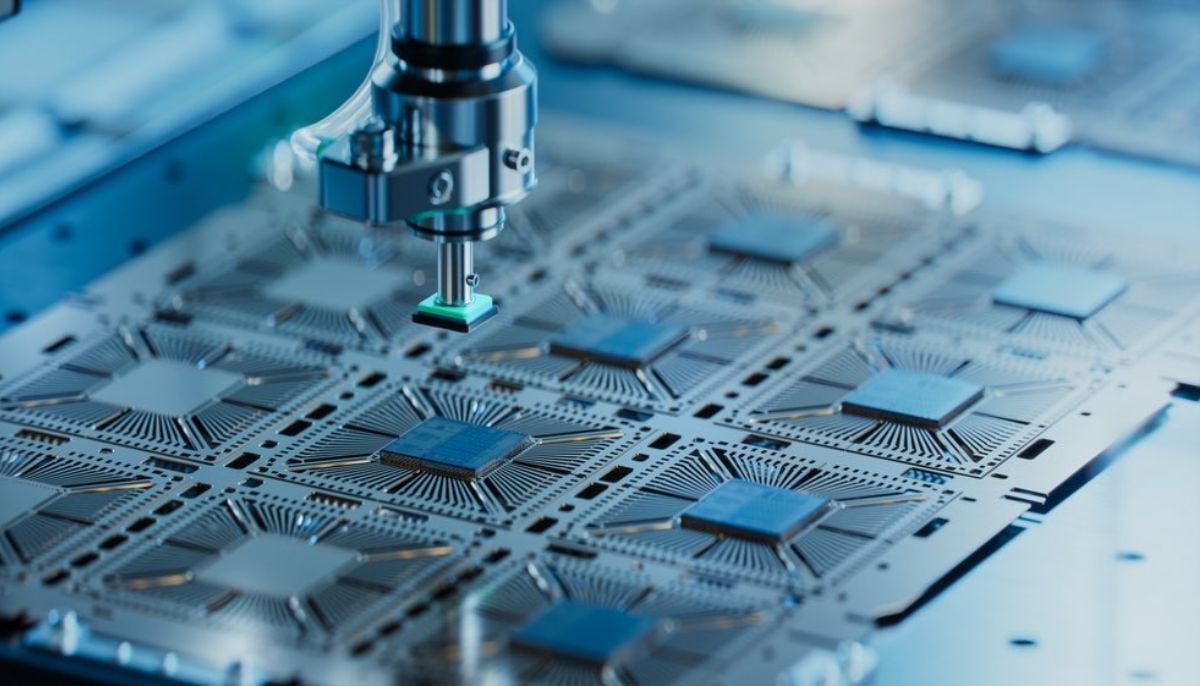
Scientists in a recent breakthrough have achieved the “highest hole mobility” ever measured in a material compatible with standard silicon-based semiconductor manufacturing.
In modern semiconductor devices, silicon holds a significant importance due to its outstanding properties. But, a 1950s-era material named Germanium is drawing the attention of researchers because of its superior electrical characteristics.
The recent study led by the scientists from the University of Warwick and the National Research Council of Canada, involves a nanometre-thin germanium epilayer on silicon that is engineered under compressive strain.
As per findings published in Materials Today, the engineered structure is capable of enabling electric charge to move faster with record speed than any known silicon-compatible material.
The germanium material has reportedly achieved a hole mobility of 7.15 million cm2 per volt-second, compared to ~450 cm2 in industrial silicon.
Dr. Maksym Myronov, Associate Professor and leader of the Semiconductors Research Group, explains, “Traditional high-mobility semiconductors such as gallium arsenide (GaAs) are very expensive and impossible to integrate with mainstream silicon manufacturing.”
“Our new compressively strained germanium-on-silicon (cs-GoS) quantum material combines world-leading mobility with industrial scalability -- a key step toward practical quantum and classical large-scale integrated circuits,” he added.
The material also helps in building faster and more energy-efficient quantum devices that are fully aligned with existing silicon technology.
The ground-breaking findings set a new benchmark for future applications, including spin qubits, quantum information systems, AI accelerators, cryogenic controllers for quantum processors, and energy-efficient servers.






-
 SpaceX IPO buzz intensifies as strategists debate $2 trillion valuation
 -
 China to launch Shenzhou 23 crew to Tiangong space station
 -
 Antarctic blizzard sends fuel containers floating on an iceberg: Here’s why
 -
 SpaceX Starship test flight succeeds despite engine failures
 -
 Is this Earth 2.0? NASA’s James Webb telescope spots ‘rare’ giant exoplanet
 -
 SpaceX Starship launch delayed again: Here’s what went wrong
 -
 Why do scientists think Neptune’s moon Nereid survived violent cosmic collision?
 -
 NASA set to unveil major Moon Base strategy and mission update
-
 SpaceX’s upgraded Starship V3 ready for high-stakes test flight: Where to watch live
 -
Scientists hatch live chickens from 3D-printed eggshells: Could artificial wombs be next?
-
SpaceX: Starship V3 all set for debut launch ahead of IPO
-
Four alien species recovered from crashed UFOs, Ex-CIA researcher claims