Scientists finally crack ‘Burtele Foot’ mystery, challenging human evolution
Foot fossils belong to species Australopithecus deyiremeda
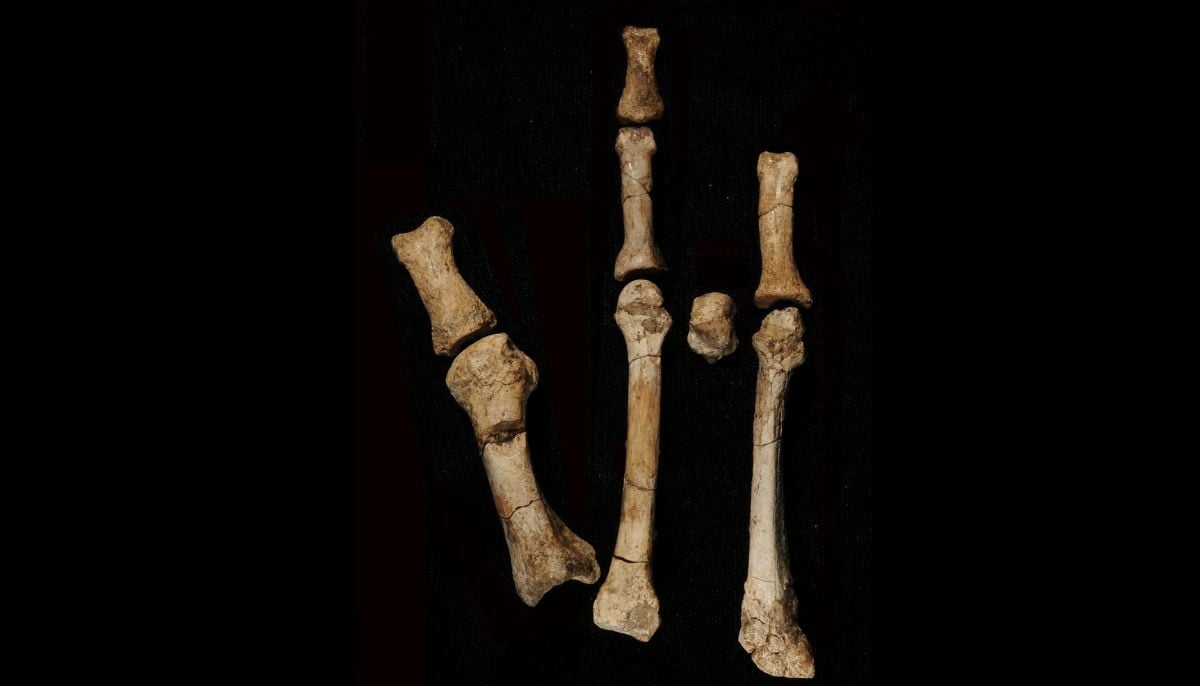
Scientists have finally cracked the mystery wrapped around 3.4 million-year-old fossils called the “Burtele Foot” which was discovered in 2009 in Ethiopia.
According to recent discovery, the foot belonged to a mysterious human ancestor, thereby reshaping the human evolution timeline.
According to researchers, the fossils characterized by eight foot bones, belonged to the species Australopithecus deyiremeda, demonstrating the combination of both human-like and ape-like traits.
These fossils also showed the co-existence of two closely related hominins, as both species, Australopithecus deyiremeda and Australopithecus afarensis, including Lucy, lived at the same place and time.
As per observations, two species consumed different plant-based diets and walked differently.
The diet of Lucy’s species consisted of a broad-spectrum diet including grass-based foods, trees, shrubs, nuts, and fruits.
On the contrary, Australopithecus deyiremeda’s diet was confined to only shrubs and trees.
The new findings, published in the journal Nature, further deepens the mystery surrounding the period of human evolution which occurred 300,000 years ago long before the evolution of Homo sapiens.
According to paleoanthropologist Yohannes Haile-Selassie, director of Arizona State University's Institute of Human Origins, “They provide us with the most conclusive evidence showing that Australopithecus afarensis - Lucy's species - was not the only human ancestor that lived between 3.5 and 3.3 million years ago.”
Australopithecus afarensis may have gained a competitive edge by Eating a greater variety of foods
On the other hand, Naomi Levin, the co-author of the study said, "But we also need to consider. If it was Australopithecus deyiremeda that somehow had the edge, forcing Australopithecus afarensis to broaden its dietary strategy…..We are that much closer to solving this puzzle of co-existence.”


-
 Guerrero Jr. remains hopeful as Blue Jays battle through disappointing season
 -
 Paul Rushforth, Ottawa real estate broker and CFRA radio host, dies at 52
 -
 Ebola spreading ‘like a wildfire’ in Democratic Republic of Congo, expert warns
 -
 Trump administration faces lawsuit over cancelled clean energy grants
-
 Four hidden dead stars found in Earth's backyard
 -
 What happened during SpaceX’s 13th Starship test? First upgraded Starlinks successfully deployed
 -
 Astronomers may have found the first moon beyond our solar system
 -
 Space datacenters could catastrophically pollute Earth, groups warn
 -
 Astronomers just solved a 10-billion-year-old Milky Way mystery
 -
 Why China is crashing a spacecraft into asteroid 2015 XF261
 -
 Australia's Great Barrier Reef at extreme risk of ‘ecosystem collapse’, scientists warn
 -
 James Webb Space Telescope reveals how black holes feed themselves