
Tokyo deploys autonomous vehicle in Antarctica
The underwater vehicle MONACA helps to better understand the melting of ice and its significant impact on the global climate
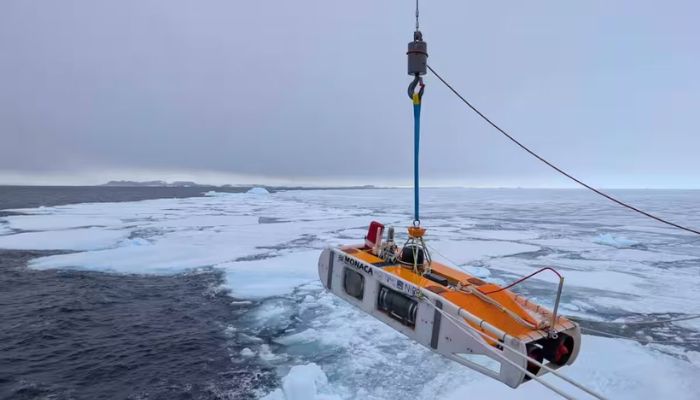
A well-known research team from the University of Tokyo’s institute of industrial science in collaboration with the National Institute of Polar Research has made history by deploying MONACA, a 2.12-meter autonomous underwater vehicle that can travel beneath the ice of East Antarctica.
East Antarctica is one of the most challenging regions in Antarctica due to the melting ice, which is ultimately having an adverse effect on the environment.
For that purpose, the team is planning to return to Antartica in the winter of 2025 and continue developing new technologies to enable the autonomous underwater vehicle (AUV) to navigate underground thicker ice shelves.
What is MONACA?
The underwater vehicle uses advanced technology to understand melting ice in East Antarctica regions and its implications on global climate.
The autonomous underwater vehicle is 2.12 meters long, 65 centimeters wide, and 40 centimeters high. It weights 235 kilograms and can dive as deep as 1,500 meters.
However, the vehicle can be operated for up to 8 hours and can travel as far as 10 kilometers beneath the ice.
Several countries, including the UK and the US have also been operating underwater vehicle beneath Antarctic ice.
The success of this mission marks the first time that a vehicle was deployed in this region, and the data gathered will help researchers in climate related studies.
Technology for safer operation
Primarily, because radio waves do not travel through water, AUV relies on sound waves to communicate and determine their position. When the ice moves, the sound waves can become scattered, which may cause the vehicle to malfunction and prevent it from surfacing directly.
The address this concern, MONACA is equipped with sonar systems that can determine the shape of surrounding objects. It also uses an inertial navigation system to track its position, which allows the tool to operate safely.
Glimpse into the mechanics of global system
Antarctica is covered by a large amount of ice that influences global cycles of heat and water. MONACA is equipped with sensors that measure seawater salinity across wide areas. When the ice melts, the salinity of the water decreases, and by tracking these changes, researchers can determine how much ice is melting.
In addition, MONACA is going to be participated in the upcoming 67th Antarctic Research exploration this winter.
The team is considering deploying the AUV in the sea of Okhotsk off Hokkaido, Japan during the ice season.






-
 Paul McCartney talks 'very emotional' footage of late wife Linda in new doc
 -
 It's a boy! Luke Combs, wife Nicole welcome third child
 -
 Gemma Chan reflects on 'difficult subject matter' portrayed in 'Josephine'
 -
 Rebecca Gayheart unveils what actually happened when husband Eric Dane called her to reveal his ALS diagnosis
 -
 Eric Dane recorded episodes for the third season of 'Euphoria' before his death from ALS complications
 -
 Jennifer Aniston and Jim Curtis share how they handle relationship conflicts
 -
 Apple sued over 'child sexual abuse' material stored or shared on iCloud
 -
 Bunnie Xo reveals why Jelly Roll refused to read her new memoir until release