
Air India crash: Report points to fuel cutoff by pilot
Preliminary report into crash says fuel switches had switched from run to cutoff a second apart just after takeoff
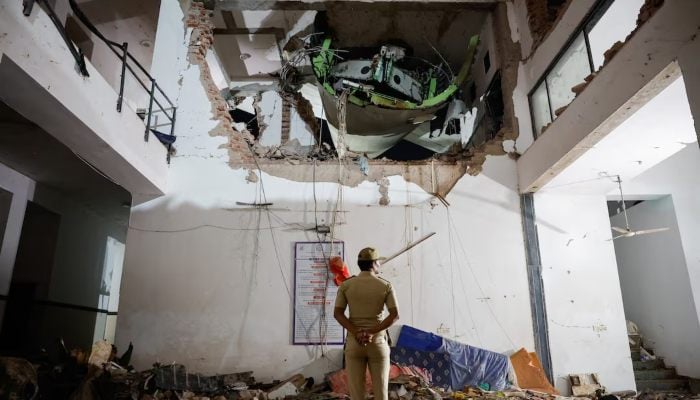
A cockpit voice recording from the Air India flight that crashed last month suggests the captain shut off fuel to the engines shortly after takeoff, the Wall Street Journal reported on Wednesday.
Citing sources familiar with the preliminary findings of the US-led probe into the 12 June crash in Ahmedabad that killed 260 people, the paper said the captain's actions are under scrutiny.
According to the report, the first officer, who was piloting the Boeing 787 Dreamliner, questioned the captain moments after liftoff about his decision to switch the fuel controls to the “cutoff” position.
The two pilots involved were Captain Sumeet Sabharwal and First Officer Clive Kunder, who had total flying experience of 15,638 hours and 3,403 hours, respectively.
India's AAIB, Directorate General of Civil Aviation, Ministry of Civil Aviation, Air India and two unions representing Indian pilots did not immediately respond to Reuters' requests for comment on the Wall Street Journal report. Boeing declined to comment.
A preliminary report into the crash released by India's Aircraft Accident Investigation Bureau (AAIB) on Saturday said the fuel switches had switched from run to cutoff a second apart just after takeoff, but it did not say how they were flipped.
Almost immediately after the plane lifted off the ground, closed-circuit TV footage showed a backup energy source called a ram air turbine had deployed, indicating a loss of power from the engines.
One pilot was then heard on the cockpit voice recorder asking the other why he cut off the fuel. "The other pilot responded that he did not do so," the report said.
Without fuel flowing to the engines, the London-bound plane began to lose thrust. After reaching a height of 650 feet, the plane began to sink.
The fuel switches for both engines were turned back to run, and the airplane automatically tried restarting the engines, the report said.
But the plane was too low and too slow to be able to recover, aviation safety expert John Nance told Reuters.
The plane clipped some trees and a chimney before crashing in a fireball into a building on a nearby medical college campus, the report said, killing 19 people on the ground and 241 of the 242 on board the 787.
No safety recommendations
In an internal memo on Monday, Air India CEO Campbell Wilson said the preliminary report found no mechanical or maintenance faults and that all required maintenance had been carried out.

The AAIB's preliminary report had no safety recommendations for Boeing or engine manufacturer GE.
After the report was released, the US Federal Aviation Administration and Boeing privately issued notifications that the fuel switch locks on Boeing planes are safe, a document seen by Reuters showed and four sources with knowledge of the matter said.
The circumstantial evidence increasingly indicates that a crew member flipped the engine fuel switches, Nance said, given there was "no other rationale explanation" that was consistent with the information released to date.
Nonetheless, investigators "still have to dig into all the factors" and rule out other possible contributing factors which would take time, he said.
Most air crashes are caused by multiple factors, and under international rules, a final report is expected within a year of an accident.
The Air India crash has rekindled debate over adding flight deck cameras, known as cockpit image recorders, on airliners.
Nance said investigators likely would have benefited greatly from having video footage of the cockpit during the Air India flight.
Air India has faced additional scrutiny on other fronts after the crash.
The European Union Aviation Safety Agency said this month it plans to investigate its budget airline, Air India Express, after Reuters reported the carrier did not follow a directive to change engine parts of an Airbus A320 in a timely manner and falsified records to show compliance.






-
 Germany’s ruling coalition backs social media ban for children under 14
 -
 Quinton Aaron reveals why he does not want to speak to wife Margarita ever again
 -
 Why Mikaela Shiffrin celebrated Olympic Gold with Taylor Swift song?
 -
 Political tensions steal spotlight at Berlin Film Festival closing ceremony
 -
 Hong Kong touts stability,unique trade advantages as Trump’s global tariff sparks market volatility
 -
 Friedrich Merz heads to China for high stakes talks in an effort to reset strained trade relations
 -
 Nvidia CEO praises Elon Musk, calls him an ‘extraordinary engineer'
 -
 Conan O'Brien speaks first time after Rob Reiner's killing