Newly-discovered 'Chonkus' microbe could help contain climate change
Mutant microbe seems to pack carbon away within its white granules in cells, beneficial to fight-off climate crisis
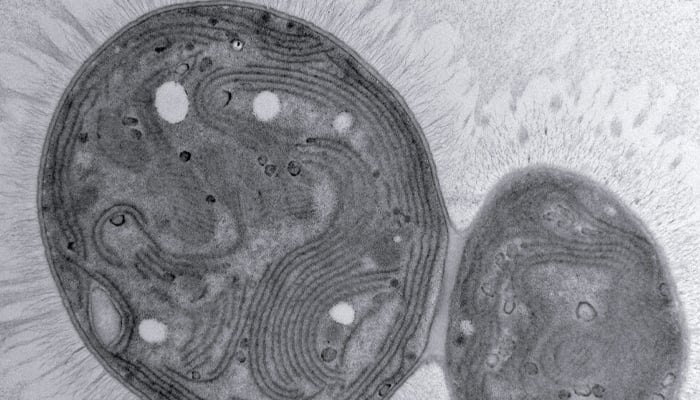
A new green mutant named "Chonkus" microbe has been discovered by scientists which appears to have ability to fight climate change.
Chonkus was found in shallow, sunlit waters off the coast of Italy's Vulcano Island by a team led by microbiologist Max Schubert, according to Science News.
The team had ventured towards the waters in search of micro-organisms that take in carbon dioxide for photosynthesis but instead, they found this naturally occurring microbe strain of Synechococcus elongatus a type of microbe that performs photosynthesis and is a species of cyanobacterium.
Synechococcus elongatus is known for growing fast and is capable of withstanding a wide range of conditions. Chonkus is like a superpowered version of the microbe.
When the team grew it in the lab, individual Chonkus cells were larger than the other fast-growing cyanobacteria. The cells also built larger colonies.
Chonkus was also observed storing more carbon than any other strain of Synechococcus elongatus. The microbe seemed to pack the carbon away within its white granules in its cells.
It also turned out to be heavier than its relatives. Its cells sank quickly to the bottom after it was placed in a test tube and formed a dense sludge.
With Chonkus' ability to store carbon in such a huge amount, it could be very useful for pulling climate-warning carbon out of the air and storing it in or near the ocean floor.
Its cells might be able to absorb more carbon than the cyanobacteria present at the bottom of the ocean and since they sink so fast, they can remove carbon from air above the water.


-
 Real-life ‘Project Hail Mary’ moment: 45 planets that may support alien life discovered
 -
 CERN successfully transports antimatter for first time in historic breakthrough
 -
 Astronomers spot solar system lookalike 87 light-years away
 -
 From Moon base to nuclear spacecraft: Inside NASA’s strategic overhaul to win space race against China
 -
 Northern lights wane, but watch for midnight surprise to dazzle the sky
 -
 NASA, South Korea team up for L4 deep space exploration mission
 -
 Scientists use ‘Space Archaeology’ to rebuild hidden history of giant spiral galaxy
 -
 How to see NASA’s SLS rocket before the Artemis II launch: Here’s everything to know