Scientists discover highest energy cosmic ray electrons ever seen
Finding provides tangible evidence of extreme cosmic processes unleashing colossal amounts of energy
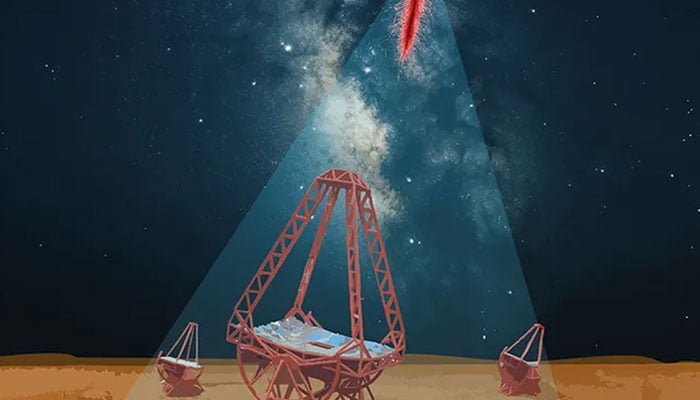
Scientists at High Energy Stereoscopic System (HESS) in Namibia have detected most energetic cosmic electrons ever observed after over a decade of meticulous data collection
The discovery has unlocked new avenues in understanding of the universe.
"Cosmic rays are a century-old mystery," Mathieu de Naurois, deputy director of the HESS collaboration, told Space.com.
After a series of balloon ascents meant to explore ionising radiation that was first detected on an electroscope, cosmic rays were discovered, first reported in 1912 by Austrian physicist Victor Hess.
However, Hess unveiled a natural source of high-energy particles from space after reaching an altitude of 5,300 metres. As of today, those particles are called cosmic rays.
As the finding provides tangible evidence of extreme cosmic processes unleashing colossal amounts of energy, it is exciting.
"Understanding these cosmic rays allows us to unveil big particle accelerators in the universe that are often associated with the most violent phenomena: the explosion of stars; very compact objects with huge gravitational and electromagnetic fields, such as neutron stars and pulsars; cataclysmic mergers; and black holes," said de Naurois.
It is also important to note that detecting these high energy electrons and positrons with energies of several teraelectronvolts, which are higher than any particle accelerators on Earth are able to achieve, has been particularly challenging for many reasons.


-
 Starship flight 14: Why SpaceX’s first-ever orbital test matters to NASA’s Artemis
 -
 New study explains 364-day Qumran calendar puzzle
 -
 Why does time feel faster as you age? Science explains
 -
 Scientists name newly discovered snake after Guns N' Roses' Slash
 -
 SpaceX secures three new NASA crew flights: What to know
 -
 Sovereign AI fund in talks to back Political Sciences: What to know
 -
 What recent discovered Moon Crater Means for Future Astronauts
 -
 Scientists discover new wild cat species in Bolivia for the first time in a century