Pillars of Creation showcased in new 3D visualisation by Nasa
Celestial wonder has amassed worldwide imaginations for its ethereal beauty as new movie shows it more comprehensively
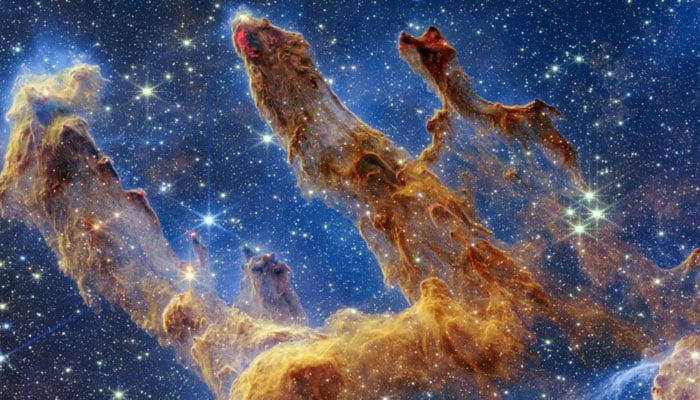
Nasa has released a new 3D visualisation of the Pillars of Creation with the help of data from Hubble and James Webb space telescopes.
Showcasing these star-creating clouds, this turned out to be the most comprehensive and detailed multiwavelength movie till now, reported Science Daily.
Made popular by Nasa's Hubble Space Telescope in 1995, the Pillars of Creation in the heart of the Eagle Nebula, have attracted imaginations worldwide with their ethereal beauty.
"By flying past and amongst the pillars, viewers experience their three-dimensional structure and see how they look different in the Hubble visible-light view versus the Webb infrared-light view," explained principal visualisation scientist Frank Summers of the Space Telescope Science Institute (STScI) in Baltimore. He also led the movie development team for Nasa's Universe of Learning.
"The contrast helps them understand why we have more than one space telescope to observe different aspects of the same object,’ he added.
By the fierce winds and punishing ultraviolet light of nearby hot, young stars; the four Pillars of Creation, made primarily of cool molecular hydrogen and dust, are being eroded.
Moreover, finger-like structures larger than the solar system projects from the tops of the pillars. Embryonic stars can be embedded within these fingers. Across three light-years, the tallest pillar stretches. These three light years are three-quarters of the distance between our Sun and the next nearest star.


-
 Astronomers just solved a 10-billion-year-old Milky Way mystery
 -
 Why China is crashing a spacecraft into asteroid 2015 XF261
 -
 Australia's Great Barrier Reef at extreme risk of ‘ecosystem collapse’, scientists warn
 -
 James Webb Space Telescope reveals how black holes feed themselves
 -
 Japan’s upper-close asteroid flyby: Why scientists said it was too dangerous
 -
 Scientists find hidden structure inside Orion Nebula
 -
 China launches first of 1,000 space-computing satellites
 -
 Perseid meteor shower 2026: Here is everything to know about peak dates and best viewing times