Nasa's Parker Solar Probe snaps closest-ever photos of Sun
Newly obtained data from images pivotal in unravelling mystery of slow solar wind
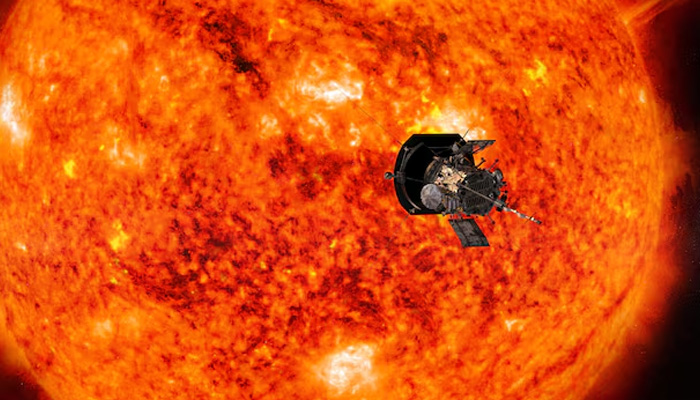
The National Aeronautics and Space Administration's (Nasa) Parker Solar Probe has delivered breathtaking images of the sun, capturing stunning visuals from just 3.8 million miles (6.1 million kilometres) away.
During a flyby on December 24, 2024, the probe captured the groundbreaking images, revealing crucial insights into the solar wind — a continuous flow of charged particles emerging from the sun's outer atmosphere, known as the corona.
This flow contributes to various space weather phenomena, including auroras and disruptive electromagnetic events that can endanger power grids and satellites, according to Live Science.
The newly obtained data is particularly pivotal in unravelling the mystery of the slow solar wind, which exhibits a denser and more erratic behaviour compared to its faster counterpart.
Researchers have long struggled to understand how the solar wind is generated and how it escapes the sun's immense gravity.
"The big unknown has been: how is the solar wind generated, and how does it manage to escape the Sun's immense gravitational pull?" said Nour Rawafi, the project scientist for Parker Solar Probe at the Johns Hopkins Applied Physics Laboratory.
"Understanding this continuous flow of particles, particularly the slow solar wind, is a major challenge."
The Parker Solar Probe's latest pass was able to confirm a key hypothesis: the slow solar wind consists of two distinct types — Alfvénic and non-Alfvénic.
The images are helping scientists pinpoint the origins of these streams, suggesting Alfvénic winds may emerge from coronal holes in cooler regions, while non-Alfvénic winds could be released from hot magnetic loops called helmet streamers.
"We don't have a final consensus yet, but we have a whole lot of new intriguing data," said Adam Szabo, Parker Solar Probe mission scientist at Nasa's Goddard Space Flight Centre in Greenbelt, Maryland, in the statement.
The Parker Solar Probe, which was launched in 2018, is the first spacecraft to have entered the sun's corona. It is equipped with advanced scientific instrumentation, including the Wide Field Imager for Solar Probe (WISPR), the unmanned probe endures extreme temperatures and radiation to collect data.
The probe will continue its mission and is expected to next pass its perihelion — the closest point to the sun's surface — on September 15.


-
 SpaceX: Falcon 9 boosts record-setting ‘Cygnus XL’ cargo spacecraft toward the ISS
 -
 NASA Artemis II mission: real or fake conspiracies spread online
 -
 ‘Howl at the Moon’: NASA’s new strategy for cosmic curiosity
 -
 Inside deadly chimp ‘civil war’ in Uganda—What they reveal about human nature
 -
 NASA Artemis II splashdown: What could go wrong on mission’s final stage
 -
 What happens to human body in deep space? NASA Artemis II will find out
 -
 Scientists find Earth’s core may be leaking gold
 -
 Mission for the ages: Artemis II crew returns after breaking deep-space historic records
-
 Robot dogs on Mars: Swiss researchers reveal how autonomy speeds up space exploration
 -
From Apollo to Artemis: How astronauts honor loved ones with lunar names
-
Emperor penguins on verge of extinction: ‘A grim story shaped by climate change’
-
NASA Artemis II crew prepares Earth return after historic Moon mission