
'The Meg' movie Megalodon was blown up to a fault as new study nails down size anomalies
Palaeontologists believe megalodon had strong, stocky body similar to great white shark and it was not as big as depicted in the movie 'The Meg'
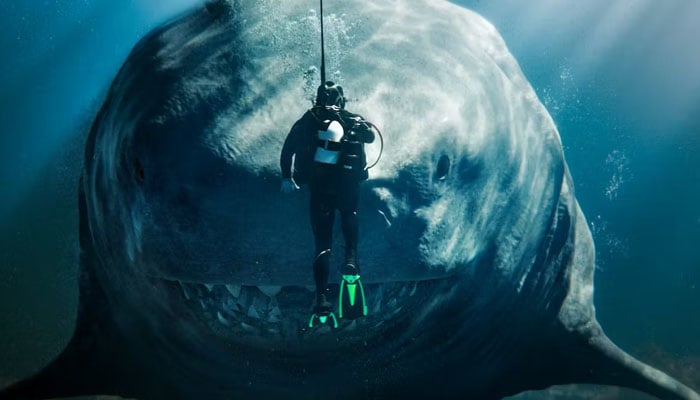
The megalodon, a gigantic shark that went extinct 3.6 million years ago, may have been far smaller than previously believed, as per an international analysis.
The enormous ocean predator gained popularity in literature and film, most notably in the 2018 science fiction movie "The Meg," in which action icon Jason Statham played the supersised shark, according to New York Post.
Palaeontologists believed the megalodon would be up to 65 feet tall and had a strong, stocky body similar to the great white shark due to a lack of fossil evidence.
Together with a group of international marine specialists, researchers from the University of California now think the killer shark was possibly much longer and slimmer. They said its structure was similar to a mako shark's.
“The remarkably simple evidence that [Otodus megalodon] had a more slender body than the great white shark was hidden in plain sight,” said Professor Kenshu Shimada, whose new report was published in the journal Palaeontologia Electronica
When they matched the teeth and spine of a living great white shark to fossil megalodon teeth and a reconstruction of its vertebral column, it was a "eureka moment."
Said study author Phillip Sternes, “It was still a giant, predatory shark. But the results strongly suggest that the megalodon was not merely a larger version of the modern great white shark.”
Their research also implies that, although living with a larger shark than previously thought, the megalodon had a different food and way of life. The powerful monster would have needed more time between feedings to assimilate meals and eat less frequently than the more shortened representation because its larger body necessitated a longer digestive canal.
“With increased ability to digest its food, it could have gone for longer without needing to hunt. This means less predation pressure on other marine creatures,” Sternes explained, adding a hypothetical: “If I only have to eat one whale every so often, whale populations would remain more stable over time.”






-
 Barack Obama addresses UFO mystery: Aliens are ‘real’ but debunks Area 51 conspiracy theories
 -
 Rosie O’Donnell secretly returned to US to test safety
 -
 'Harry Potter' star Rupert Grint shares where he stands politically
 -
 Drama outside Nancy Guthrie's home unfolds described as 'circus'
 -
 Marco Rubio sends message of unity to Europe
 -
 Hilarie Burton reveals Valentine's Day plans with Jeffrey Dean Morgan
 -
 Jacob Elordi, Margot Robbie on 'devastating' scene in 'Wuthering Heights'
 -
 China to implement zero tariffs on African imports in major trade shift