US forms 10-nation coalition to tackle Houthi attacks in Red Sea
The coalition involves the United States, United Kingdom, Bahrain, Canada, France, Italy, Netherlands, Norway, Seychelles, and Spain
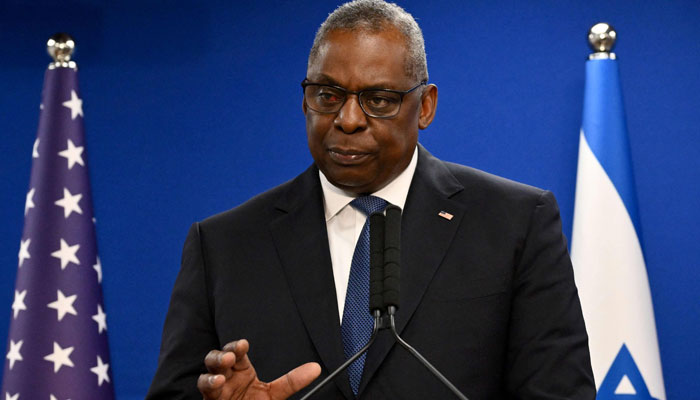
The United States has announced a coalition of 10 nations as part of its efforts to put an end to the relentless missile and drone strikes by Houthi rebels targeting ships traversing the Red Sea.
The multinational security initiative saw countries like Britain, France, Bahrain, and Italy coming together to confront the threats posed by this non-state group.
Lloyd Austin, the US Defense Secretary, highlighted the critical importance of nations upholding the principle of freedom of navigation. He highlighted the necessity for joint action against the challenges presented by the Houthi rebels, who are backed by Iran.
Their escalated attacks on tankers, cargo ships, and other vessels have posed a significant risk to the Red Sea route, a passageway responsible for nearly 12% of global trade.
The primary goal of this security coalition, Austin said, revolves around ensuring unhindered navigation for all countries while enhancing regional security and prosperity.
The coalition involves the United States, United Kingdom, Bahrain, Canada, France, Italy, Netherlands, Norway, Seychelles, and Spain, uniting their efforts against the Houthi threats, he said.
However, recent events have led to misunderstandings and repercussions.
For instance, the owner of Swan Atlantic, Norway's Inventor Chemical Tankers, clarified that the vessel was transporting biofuel feedstock from France to Reunion Island, emphasising its lack of association with Israel. The ship, managed by a Singaporean firm, faced minimal damage during the attack, and fortunately, the Indian crew remained unharmed.
In response to the heightened risks, several major players in the shipping industry have taken precautionary measures. British oil giant BP joined the list of those suspending transit through the Red Sea, while Evergreen, a Taiwanese shipping company, immediately halted its Israeli cargo shipments.
Companies like Frontline, among the world's largest tanker firms, announced the rerouting of ships and limited new business that could utilize the longer and more fuel-consuming route via South Africa's Cape of Good Hope.
The severity of the Red Sea attacks has prompted insurance companies to escalate premiums on ships, rendering some routes through the Suez Canal economically unfeasible.
Renowned shipping companies such as Mediterranean Shipping Company, CMA CGM, Hapag-Lloyd, Euronav, and A.P. Moller-Maersk from various countries have temporarily ceased using the Red Sea, impacting nearly 15% of global container freight.
The situation has been labelled as a maritime security crisis, not just regionally but with implications extending beyond, affecting commercial and economic interests, as per Torbjorn Soltvedt from analysis firm Verisk Maplecroft.


-
 Fugitive businessman Alvaro Pulido arrested in $2bn Venezuela corruption scandal
 -
 German labour minister steps down after stepdaughter's death and political attacks
 -
 Trump could fire Kimberly Guilfoyle as US ambassador to Greece over misconduct reports
 -
 Elon Musk spends millions to become top political donor to keep Republicans in power
 -
 Mark Carney warns Alberta against separation in Thanksgiving message from Edmonton
 -
 Florida and Alabama face widespread power outages as Hurricane Isaias moves north
 -
 Reform UK pledges to suspend UK asylum system for up to 5 years
 -
 Mamdani launches first major NYPD use-of-force review in nearly a decade
-
 Ilhan Omar accuses Trump of political intimidation after federal agents search her home
 -
OPEC slashes 2026 oil demand growth forecast to 400,000 BPD, citing weaker momentum
-
Cornell 7 ‘loophole’ in assault case exposes a deeper legal problem
-
Elon Musk spends $366 million to help Republicans retain control of Congress