Indian Supreme Court's IIOJK special status verdict expected on Dec 11
Pakistan has previously vowed to "exercise all possible options to counter illegal steps" taken by India
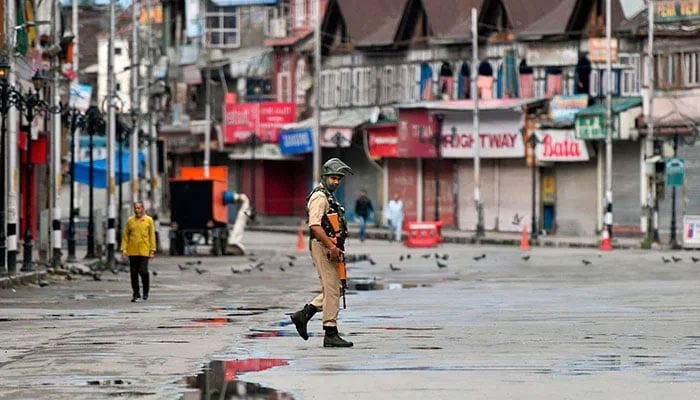
The Supreme Court of India is scheduled to deliver its verdict on Monday, (December 11), on a set of petitions that challenge the abrogation of Article 370 of the Constitution, which granted special status to the Indian Illegally Occupied Jammu and Kashmir (IIOJK).
The five-judge bench, led by Chief Justice of India (CJI) Dhananjaya Yeshwant Chandrachud, had reserved its verdict on September 5 after hearing the matter for 16 days.
Senior lawyers have filed more than 20 petitions alleging that the Indian government misused its parliamentary majority to issue executive orders and divide the occupied region into Union Territories, according to Mint.
In 2020, the Indian Supreme Court refused to transfer the case to a seven-judge Constitution Bench, with the five-judge bench keeping the matter to itself.
Prime Minister Narendra Modi's government abolished the autonomous status of the illegally occupied valley and deployed tens of thousands of additional troops to prevent any protests against the unilateral move.
Thanks to the revocation of Article 370 of the constitution, people from the rest of India were given the right to acquire property in the disputed territory and settle there permanently.
Kashmiris view the move as an effort to dilute the demographics of Muslim-majority Kashmir with Hindu settlers. Pakistan has strongly condemned the move and vowed to "exercise all possible options to counter illegal steps" taken by India.
India has for decades stationed over half a million soldiers in the Himalayan disputed territory. The suspension of IIOJK's semi-autonomous status enabled Indians from other parts of the country to purchase land and claim government jobs there, a policy criticised as "settler colonialism" by critics.
Many residents and critics claim that authorities have since curbed media freedoms and public protests, resulting in the drastic curtailment of civil liberties.
Modi's government has defended the decision in court, claiming that the change has brought "peace, progress, and prosperity" to the restive territory.
Consolidating New Delhi's rule over the IIOJK has long been a key plank of Modi's Hindu nationalist Bharatiya Janata Party (BJP).


-
 Trump vows not to attack Iran before midterm elections
 -
 Italy's PM Meloni secures final approval for contested electoral reform
 -
 UK's FCA proposes 90-day notice period on illiquid assets to curb fund suspensions
 -
 Italy open to more oil stock releases contingent on European pledges
 -
 Zelenskyy makes next move in Russia talks as Ukraine negotiators head to US
 -
 Anne Carson wins Nobel Prize in Literature for ‘bold, inventive’ writing
 -
 South Korea recalls Ukraine ambassador over North Korean POW dispute
 -
 Hurricane Isaias strengthens on path: Which US Gulf Coast states are at risk?
-
 UK, Germany unite against Russia’s ‘shadow war’ as spy chief warns of ‘violent conflict’
 -
US, Russia explore gas sales to Europe via Nord stream pipelines amid Ukraine conflict
-
When will Trump, Putin speak? Kremlin responds to ‘very soon’ call claim
-
Baltimore Ravens acquire Cam Jurgens from Eagles for two draft picks