Do starfish have heads or tails? Marine animal mystery finally gets a body of research
Starfish belong to the class of animals known as echinoderms, which also include sand dollars and sea urchins
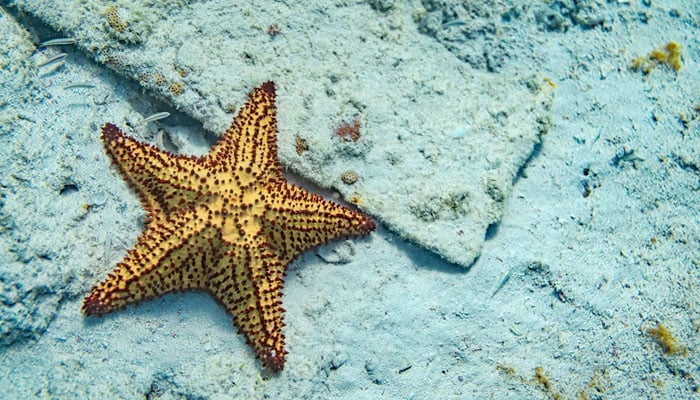
Although it has long been believed that starfish are headless, a recent study indicates that this may not be the case as their bodies are unlike those of most animals, which has long baffled biologists with their unusual shape.
They belong to the class of animals known as echinoderms, which also include sand dollars and sea urchins.
Their bodies are divided symmetrically into five sections, and until now it had been "impossible" to see how those chunks related to the bodies of other animals.
Head or tail, front or rear—even specialists couldn't figure it out.
The composition of echinoderms "has been a mystery to scientists for as long as we've been studying them," according to Dr Jeff Thompson of the University of Southampton.
An international team led by scientists at Stanford University in the US compared the molecular markers of the starfish to those of other animals belonging to a larger animal group known as deuterostomes in an attempt to shed light on the situation.
This includes both echinoderms and vertebrates, but because they all descended from a common ancestor, scientists can directly compare how each group developed.
They produced a 3D map that illustrates the locations of specific gene expression during a starfish's development using cutting-edge molecular and genomic approaches.
Big crawling head, it's just a big crawling head.
The study's co-author, Dr Thompson, stated that a "crucial part" of a typical bilateral body was absent.
"The genes typically involved in the patterning of the trunk of the animal weren't expressed," he said.
"It seems the whole echinoderm body plan is roughly equivalent to the head in other groups of animals."
The results imply that starfish are not headless, but have simply lost their progenitors' bodies over time to become just heads.
The Stanford University lead author, Laurent Formery characterised it as "best described as a head crawling along the seafloor".
The journal Nature has published the peer-reviewed study.


-
 Is this Earth 2.0? NASA’s James Webb telescope spots ‘rare’ giant exoplanet
 -
 SpaceX Starship launch delayed again: Here’s what went wrong
 -
 Why do scientists think Neptune’s moon Nereid survived violent cosmic collision?
 -
 NASA set to unveil major Moon Base strategy and mission update
 -
 SpaceX’s upgraded Starship V3 ready for high-stakes test flight: Where to watch live
 -
 Scientists hatch live chickens from 3D-printed eggshells: Could artificial wombs be next?
 -
 SpaceX: Starship V3 all set for debut launch ahead of IPO
 -
 Four alien species recovered from crashed UFOs, Ex-CIA researcher claims