Li was once seen as a rival of President Xi Jinping for China's leadership
By Web Desk
October 27, 2023
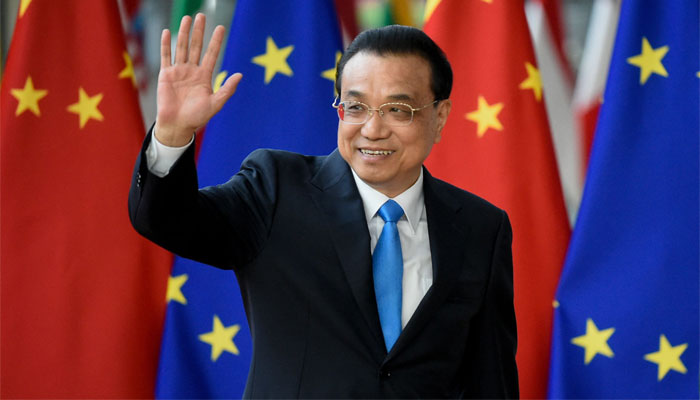
Chinese Premier Li Keqiang waves before the EU-China Summit at the EU headquarters in Brussels on April 9, 2019. — AFP
Former Chinese premier Li Keqiang, a reform-minded bureaucrat who was once tipped as the country's future leader, died at the age of 68, just after midnight on Friday in Shanghai after experiencing a heart attack, Chinese news agency Xinhua reported.
During his 10-year tenure under Xi, Li portrayed himself as a modern Communist Party loyalist, a fluent English-speaking career bureaucrat, and supported economic reforms, contrasting his more rigid colleagues.
The son of a minor party official in eastern China's poor Anhui province, Li was sent to the countryside to work as a manual labourer during the tumultuous Cultural Revolution of 1966 to 1976, AFP reported.
Li who gained a law degree from Peking University embraced Western and liberal political theory, according to his university classmates, as he translated a British judge's book on law
However, he became more orthodox in the mid-1980s, working as a bureaucrat during protests in Tiananmen Square.
Li rose to become the ruling Communist Party's top official in Henan province, and in Liaoning in the northeast — both of which saw economic growth. But his reputation was damaged by his handling of an HIV/AIDS epidemic stemming from a tainted blood donation programme while he was party boss in Henan.
Later, Li was promoted to become a deputy to then-premier Wen Jiabao.
His attempts at tackling China's deep economic challenges were curtailed by the overwhelming authority of Xi, with whom he was once seen as a rival for the country's leadership.
Acclaimed for his role in guiding the nation through the global financial crisis with minimal damage, Xi's tenure witnessed a significant change in China's political landscape from the more consensus-based governance of former leader Hu Jintao and his predecessors to the more focused authority of Xi.
"People always debated whether (China's) institutions would... determine the outcomes, as opposed to just raw power," Victor Shih, an expert on China's elite politics at the University of California San Diego, told AFP.
"And of course, recent events show that raw power still matters more."




 Goldman Sachs’ top lawyer resigns over Epstein connections
 Manhunt continues for suspect who killed 2 at South Carolina State University
 Trump considers scaling back trade levies on steel, aluminium in response to rising costs
 Trump revokes legal basis for US climate regulation, curb vehicle emission standards
 DOJ blocks Trump administration from cutting $600M in public health funds
 Scientists find strange solar system that breaks planet formation rules
 Woman calls press ‘vultures’ outside Nancy Guthrie’s home after tense standoff
 Casey Wasserman to remain LA Olympics chair despite Ghislaine Maxwell ties