
Chandrayaan-3: Lunar rover 'Pragyan' takes a stroll on moon as ecstatic Indians celebrate
India became the fourth nation to land on the lunar surface with the success of their Chandaryaan-3
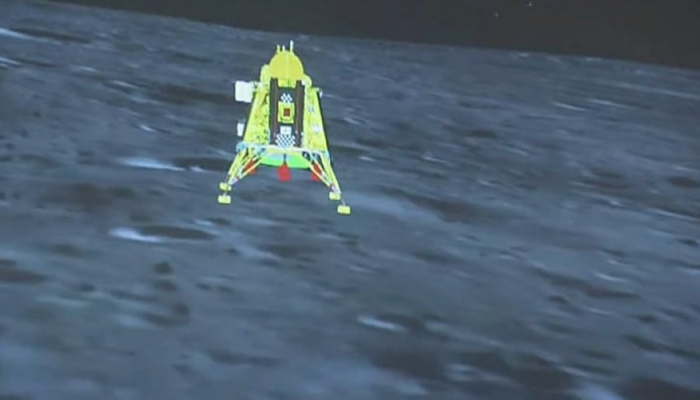
India's Chandrayaan-3 moon rover emerged from the spacecraft on Thursday, embarking on its mission to explore the lunar south pole, conduct experiments, and confront new challenges, ISRO chief S Somanath said Thursday.
India successfully landed on the lesser-explored south pole of the moon on Wednesday, becoming the first nation to do so. This accomplishment follows Russia's Luna-25, which recently faced a setback in a similar undertaking.
The precise landing of the lander, a marked improvement from a failed attempt in 2019, prompted widespread jubilation and pride in India, with the media lauding it as a monumental scientific achievement.
The Indian Space Research Organisation (ISRO) Director confirmed that both the lander and rover were in optimal condition and performing well. While the experiments had yet to commence, Somanath affirmed that all activities were on track and systems were functioning normally.
The ISRO's official communication platform, formerly known as Twitter, conveyed that "Rover mobility operations have commenced."
The rover, named "Pragyan," carries two instruments for elemental and chemical composition experiments, along with a robotic path planning activity aimed at future exploration endeavours.
Derived from Hindi and Sanskrit, "Chandrayaan" translates to "moon vehicle." The rover is projected to remain operational for approximately two weeks, equivalent to a lunar day, which aligns with the lifespan of its solar-powered equipment.
Anticipating challenges, Somanath expressed that the moon's surface presented novel difficulties, particularly concerning lunar dust and temperature extremes that might impact mechanical components.
He elaborated that the moon's unique dust, coupled with the absence of an atmosphere, could hinder the rover's functionality by adhering to its materials. This, in turn, could disrupt moving parts and impede the operation of bearings and motors.
Acknowledging these uncertainties, Somanath stated, "We will confront these challenges; that's the essence of exploration. If everything were already known, the endeavour would lose its essence."
With a budget of approximately 6.15 billion rupees ($75 million), this marked India's second attempt at a lunar landing. The previous mission, Chandrayaan-2 in 2019, successfully deployed an orbiter but faced a mishap during the lander's descent.
The nation united in witnessing Wednesday's landing, with nearly 7 million viewers tuning in to the YouTube livestream alone. Special prayers were held, and schools organized live screenings for students.
Beyond elevating India's stature as a space power and reinforcing its reputation for cost-effective space engineering, the landing is a moment of profound national pride.
Prime Minister Narendra Modi expressed his gratitude for the widespread congratulations and emphasized that the successful landing was a shared achievement for humanity.
The achievement garnered headlines such as "The Moon Belongs to India," "India Ventures Where No Nation Has Gone Before," and "India Illuminates the Moon's Far Side."





-
 Climate change vs Nature: Is world near a potential ecological tipping point?
 -
 125-million-year-old dinosaur with never-before-seen spikes stuns scientists in China
 -
 Scientists stunned as shark appears for first time in Antarctic Southern Ocean waters
 -
 New study suggests universe can end in ‘Big Crunch’ in 20bn years
 -
 Hidden Venus: New data discovers massive underground Lava Tube
 -
 ‘Earth is defenseless against city-killer asteroids’: NASA issues stark warning
 -
 Annular solar eclipse 2026: Where and when to see the ‘Ring of fire’
 -
 Bright green comet C/2024 E1 nears closest approach before leaving solar system