
What will Chandrayaan-3 Vikram lander do after landing on moon's south pole?
The Vikram lander's three payloads will monitor the near-surface plasma density of the lunar surface
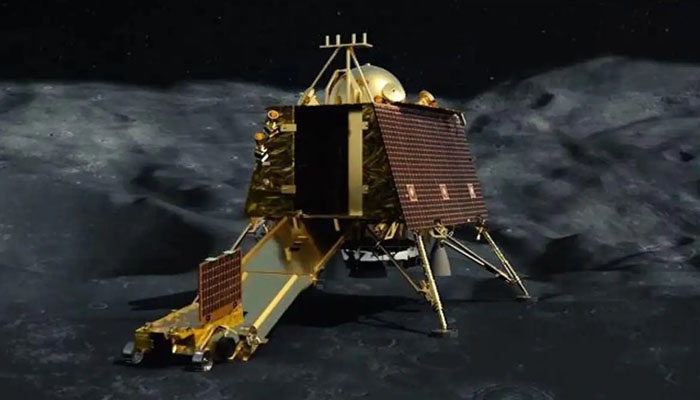
After the failure of a previous mission, India's Chandrayaan-3 has, at last, touched down on the moon successfully, after a 40-day trip that began at the Sathish Dhawan Space Centre in Sriharikota.
The lunar mission's objective is to investigate the southern polar area of the moon, which has a possible presence of water and ice. The site may also provide oxygen and fuel for upcoming moon missions.
The Vikram lander will conduct a number of experiments, including a spectrometer investigation of the lunar surface's mineral composition.
The panel of the Vikram lander unfurled shortly after touchdown, forming a ramp for the Pragyan rover. After four hours, the six-wheeled Pragyan with the ISRO insignia and a national flag dropped from the lander to the lunar surface at a pace of 1 cm per second.
In addition to leaving the tricolour and the ISRO logo indentations on the lunar surface, the rover will utilise navigation cameras to scan the lunar surface. The rover's instruments are set up with payloads that can deliver information about the Moon's surface. The lander will talk to the rover, and send signals to the earth.
The mission objectives of Chandrayaan-3 include conducting in-site scientific research and demonstrating how a rover can move around the moon.
The payloads linked to the lander and rover will conduct numerous studies and relay back data about the lunar surface.
Eight payloads are carried by the Chandrayaan-3 spacecraft, one of which was donated by NASA. The payloads will collect information regarding the elements that make up the moon's atmosphere and transmit it to the lander.
The Vikram lander's three payloads will monitor the near-surface plasma density, the lunar surface's temperature characteristics, and the seismic activity in the area surrounding the landing site. Future moon exploration missions are encouraged conduct this research, especially if people are going to spend a lot of time on the lunar surface or utilise it as a base to travel to other planets.
Additionally, the lander is equipped with a LASER Retroreflector Array (LRA), a passive experiment for studying the dynamics of the moon system. It is also intended to make it easier to determine the distance between the moon and earth in real time. The ability to effectively predict tidal patterns, comprehend ocean currents, and manage coastal areas will all be aided by this information.





-
 Columbia university sacks staff over Epstein partner's ‘backdoor’ admission
 -
 Ohio daycare worker 'stole $150k in payroll scam', nearly bankrupting nursery
 -
 Michelle Yeoh gets honest about 'struggle' of Asian representation in Hollywood
 -
 SpaceX successfully launches Crew-12 long-duration mission to ISS
 -
 US, China held anti-narcotics, intelligence meeting: State media reports
 -
 Goldman Sachs’ top lawyer resigns over Epstein connections
 -
 Manhunt continues for suspect who killed 2 at South Carolina State University
 -
 Trump considers scaling back trade levies on steel, aluminium in response to rising costs