
Europa, Jupiter's oceanic moon's core may be incomplete
Europa may be habitable but understanding its evolution is crucial to determine if it has potential life-supporting activity
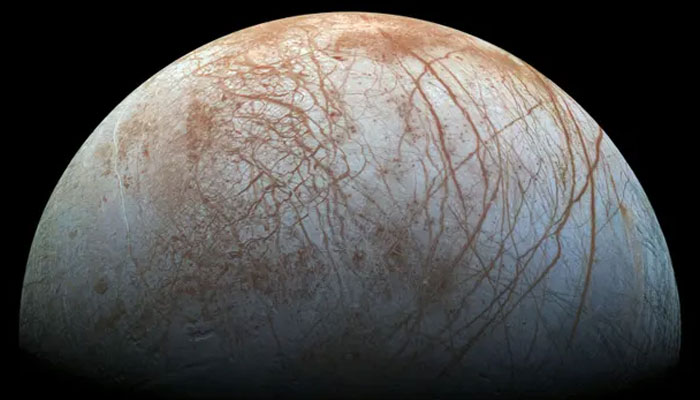
A new study reveals that, if it has formed at all, the core of Jupiter's oceanic moon Europa could have developed billions of years after the rest of it.
The icy shell that surrounds Europa, Jupiter's fourth-largest moon, is present, but scientists believe that beneath its ice-covered surface, Europa is home to a saltwater ocean that is roiling over its rocky mantle.
According to Kevin Trinh, a planetary scientist at Arizona State University in Tempe and lead author of the study published in the journal Science Advances, it might have "more liquid water than Earth."
Previous studies have suggested that Europa may be habitable; for instance, seafloor volcanoes and hydrothermal vents may help deliver heat that supports life and molecules that are beneficial to biological processes into its ocean.
Scientists need to comprehend the nature of the Jupiter moon's interior and how it might have changed over time in order to determine whether such potentially life-supporting activity might exist on Europa.
"While Europa is famously known as a potentially habitable ocean world, over 90% of Europa's mass comes from rock and metal," Trinh said.
According to Space.com, Nasa's Galileo spacecraft's analysis of Europa's gravity field after it arrived in the Jovian system in 1995 suggested that Europa's interior is split into a metallic core and a rocky mantle, just like that of Earth.
Later studies frequently assumed that these layers were formed as part of, or shortly after, the formation of the Jovian moon.
"Now, to our surprise, we found that Europa may have spent most of its life without a fully formed metallic core — that is, if such a core exists at all," Trinh said.
Additionally, the Galileo data were revisited in a study conducted in 2021, and the results indicated that Europa may not be as massive near its centre as previously believed. Its existence as a fully formed core would then become a topic of discussion.
Another reason Europa's core may not have fully formed is believed to be due to its colder formation at a higher distance from the sun. Computer models showed that its building blocks may not have melted and separated into a metallic core and rocky mantle.
Furthermore, scientists discovered that Europa's ocean and ice shell formed 500,000 years after its birth due to chemical reactions. A metallic core, if present, may have formed a billion years after the moon's birth due to heat from radioactive elements and Jupiter's gravitational pull. The core's formation would make Europa more habitable.
According to Trinh, "Nasa's upcoming Europa Clipper mission could aid in measuring the gravity of the Jovian moon Europa in order to improve our understanding of how mass is distributed inside Europa, which relates to the existence of Europa's metallic core."




-
 Climate change vs Nature: Is world near a potential ecological tipping point?
 -
 125-million-year-old dinosaur with never-before-seen spikes stuns scientists in China
 -
 Scientists stunned as shark appears for first time in Antarctic Southern Ocean waters
 -
 New study suggests universe can end in ‘Big Crunch’ in 20bn years
 -
 Hidden Venus: New data discovers massive underground Lava Tube
 -
 ‘Earth is defenseless against city-killer asteroids’: NASA issues stark warning
 -
 Annular solar eclipse 2026: Where and when to see the ‘Ring of fire’
 -
 Bright green comet C/2024 E1 nears closest approach before leaving solar system