We always look for some opportunity, a golden chance or a break in life, which would help us achieve our dreams. We get them, except that more often than not they appear in different garbs. It is on us to identify them, seize them and utilize them to their fullest.
We always look for some opportunity, a golden chance or a break in life, which would help us achieve our dreams. We get them, except that more often than not they appear in different garbs. It is on us to identify them, seize them and utilize them to their fullest. No, I am not blabbing about any rejuvenating personal experience here. Rather, I am talking about an independent theatre society – Khwab – and the group of individuals it brought together to serve one purpose and one purpose only: to contribute to the society by helping the students foster their artistic skills through a concrete platform of performing arts.
Working for a common goal is what defines a successful team, standing tall and proud in face of all adversaries. By unlocking the doors of creativity and reviving theatre in Karachi University (KU), which by the way is notorious for its scarcity of extra-curricular activities, Khwab exemplifies this definition.
It’s true, there are hardly any activities, supervised or not, that KUrians can be part of. It goes unstated then that Khwab’s journey was not an easy one. A great deal of effort was put in to make ‘Khwab’ a reality.
 Fatima Karim was in her third year of B.S. (Psychology) when she came up with the idea of establishing a performing arts society in the campus. Lucky girl, she had prior experience of organizing events to draw upon and exploit for this initiative. However, attempting it solo would probably have been a bit of a folly since it required sensible planning and thorough research. Fatima turned out to be luckier than most in this instance. She discovered the support she needed amongst her friends only. Saman Babar, Isma Azeem, Raza Wazir and Sana Ali Khan all shared her passion for performing arts and desire to do something big. They were ready to tag along with her. The core team established, the next step – the recruitment of other members – in the process was up for discussion.
An absence of strong financial backing stopped them from proceeding with the recruitment process. All of them contributed 100 rupees each before approaching a faculty member for support. The teacher liked their idea, but specifically told them to abstain from singing and dancing to avoid controversial backlash. They complied with their teacher’s advice and pursued the idea of theatre only. Meanwhile, the geniuses had a name for their brainchild: ‘Khwab’. Philosophical much? That’s exactly why it appealed to their creative nature and was so aptly adjusted to their cause with the tagline ‘you dream, we play’.
So now they had the money, they had to begin selling forms. For a first-of-its-kind project, it turned out to be a herculean task. The very concept of a theatre society was alien to the university and buying its recruitment forms was something entirely unknown to the students. Only when a substantial amount of forms were sold, were they able to move onto the next stage: to conduct interviews.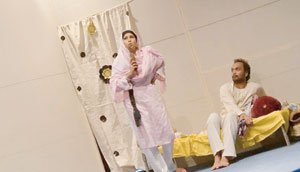
“It’s a truth universally acknowledged that when one part of your life starts going okay, another falls spectacularly to pieces.” – Bridget Jones’ Diary
Everything was going alright until the respective faculty member withdrew from the project and abandoned them. The group suffered a severe blow. It’s not easy to start a performing arts society in a public sector university here. There were so many negative forces everywhere that pursuing their goal became tantamount to fighting a battle. But, they didn’t buckle and remained resilient in their stance that Khwab should see the light of the day.
Rehma Khan and Ali Abbas – who had joined the society in the first round of recruitments and later became vice-president and member board of directors – persuaded Hammad Siddiqui (who along with being a student at KU was learning acting from the National Academy of Performing Arts as well) to join them and train the actors. He agreed. Thus, Khwab came into being on February 23, 2014. Fatima became the President, Saman was elected Vice-President, Creative, Isma controlled Public Relations, Sana took care of Human Resource, Rehma was in charge of Communications, Ali Abbas supervised Script, Hammad Siddiqui leads their Acting division while Raza kept their logistics organised. And from the 128 applicants, 50 were shortlisted.
The team began preparing for its first event. Members started off to work on the script, acting, aesthetical aspects, getting sponsors, marketing the theatre, and making other necessary arrangements for the event to actually happen. Everyone was doing everything that they could do because they all wanted it to be a big hit.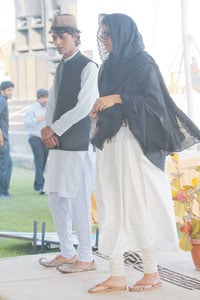
They had their first major victory when they the last of their tickets was sold off. It had been their biggest fear knowing there were not ready buyers (paying for theatres in university is not so common) and to think they had actually overcome it! It was a moment of pure ecstasy and they were all quick to acknowledge the incessant marketing, day in and day out, of their members who went to numerous departments of KU to promote the event, worked in the scorching sun, and stayed back after classes. Khwab secured its first audience only because they had all believed in this cause. “I had become tanned from working in the sun but it was worth it,” Saman remembered nostalgically.
But there were still so many things to be done. As the day of their event was looming closer and closer, tension spiked up. It felt like a do or die situation. “[Despite everything] we were finding it very hard to get sufficient funds for the theatre to actually get staged”, Rehma recalled. After a slight pause and with a smile on her lips, she continued in a low tone, “But then we did succeed in getting them.”
The night before the main event was tough for all. They were in the university till 11pm, trying to wrap up the work. “Fatima and I talked on the phone. We were so scared that night! Various doubts and scepticisms kept us from falling asleep,” Saman exclaimed.
Khwab’s first event ‘Kaavish- The theatre Conference’ took place on October 28, 2014. “When I saw Dr. Salimuzzaman Siddiqui Auditorium, ICCBS (University of Karachi), in the morning, a wave of amazement hit me for the first time. I was equally shocked and happy to know that the theatre would happen there,” Sana stated.
They had planned on two performances to enthral their guests. The first was a training session by Ali Shaikh, who is a NAPA-trained actor associated with the 7th Sky Entertainment and A & B Production. He imparted some basic yet key information to the audience about theatre. The second in their programme list was ‘Khushi’, the main play directed by Hammad Siddiqui. It was a comedy about a man who constantly struggle for happiness and contentment.
When I asked Rehma how she felt during the event she replied, “When I saw the auditorium get fully occupied, I was dumbfounded and when I saw the audience enjoying the performances, I was totally contented. I think every single effort paid off.” Simply put, people loved it. In fact, the response was so overwhelming that Sana couldn’t control her emotions and wept on-site without regrets. Such were the feelings of the members after weeks of immense struggle.
A second event, ‘Karvaan- a Theatrical Journey’, was quickly planned for April 30, 2015. It was a blockbuster as well. The specialty of this event was that it introduced Reader’s Theatre in Karachi University for the first time. FYI, Reader’s Theatre is a bit different from the conventional theatre in the sense that a set is not required and actors deliver their dialogues in such a way that they are self-explanatory and do not require physical movement of the participants. Tariq Raja and Zohair Raza (from ‘Qissa Farosh’) set the stage on fire with their exceptionally well ‘Marhoom Ki Yaad Mai’. The second performance of the day was ‘Siatics – A Game of Power’. This play, which was co-written by Syed Mohammed Ali and Ali Abbas and directed by Hammad Siqqidui, was about the changing dynamics of Pakistani politics and how it influences the lives of the people involved.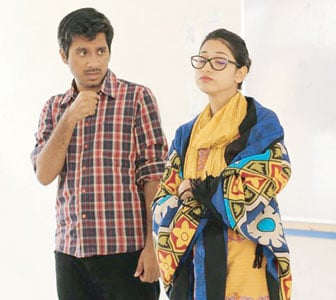
Ali Abbas, while sharing his experience of Karvaan, reflected how his costume had some issues the night before the event. “I had to go late to the market to fix them. On the big day, I was worried about a lot of things. In addition to being the script-writer, actor, and organizer, I had been given the job to prepare the hosts of the event! Well, when it initiated, everything started to flow smoothly. Once again, people loved it; their reaction was not only positive but encouraging, too.”
Sky is the limit for these dreamers. Soaring high on its success, Khwab is no longer confined to the premises of KU. The Indus Hospital’s Family Carnival that took place on February 7, 2016, allowed Khwab to host its first theatre outside the university. Undoubtedly, the experience was totally different and new for the team. Khwab presented two plays there, ‘Kamchor’ (reader’s theatre) and ‘Khushi’ (main play).
Not everything goes as you plan it. Some of the adverse circumstances they got to experience pertained to the stage. The one provided by the organizing team wasn’t presentable. When that was fixed, they had to change their location due to administrative issues. Instead of a proper stage, they were now performing at a stall; in other words, the change in organisation made them to transform their performance from a well-staged theatre to a street theatre. It all appears like a good learning experience in disguise, but can you imagine the stress? You cannot expect it to be a knockout. But, it was! Khwab got a lot of appreciation from general audience, different organizations and individual organizers. While telling me about the supportive response of the audience, Ali Abbas muses on the best part of it all: “I heard people talking about our theatre after the event.”
So, there you have it. Khwab. Other than theatres, these people also conduct different seminars to train their members. A series of writing workshop by the name of ‘Hum Surat Ghar Kuch Khwabon Key’ were launched on August 29, 2014; the first session was conducted by Prof. Dr. Tanzeem-ul-Firdous. Furthermore, they also organize photography and acting workshops.
From a group of inexperienced university students, they have become well-trained professionals. They have learned leadership skills, team management, patience, and, most importantly, they have learned to believe in themselves. These people got a detailed insight of the practical and professional world even before their professional life had actually started. Most of the members quote Fatima and her leadership as the main reason behind Khwab’s success, saying Khwab would’ve disintegrated in its initial stages if it weren’t for Fatima’s patience, resoluteness and persistence.
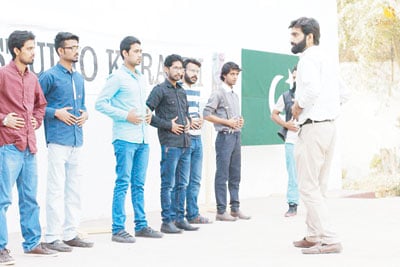
When I questioned Raza what has been his best moment in Khwab so far, he answered, “When Kaavish ended, I asked the attendees about the event while giving out refreshments and there wasn’t even a single person who didn’t like the theatre we had produced. It was our first event and the response was so awesome that I don’t have words to articulate my feelings.”
When asked about her fears, Fatima responded, “One of my biggest fears was that people won’t buy our forms but Isma was extraordinarily good at selling them.” On the other hand, Raza was most afraid of not getting the right venue for their introductory act. “When I visited the venue of our first event for the booking, I was fearful that we wouldn’t be able to do our function there because we didn’t have sufficient funds. But then, we somehow managed it and booked the auditorium.”
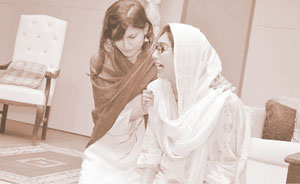 I wonder whether all the efforts on their part were merely a gesture of respect for their friend or was there more to it. “The thing which sparked my interest in this venture was that I could fulfil my ambition of contributing to the society by creating awareness through performing arts,” Saman gushed. Alternatively, Rehma, who wasn’t new to theatre, joined Khwab “to learn the administrative procedure and management.” Their love for Khwab is immeasurable. I could literally feel their excitement and affection while interviewing them. Khwab is their baby; they’ve seen it born, grow and progress. When I inquired about whether they all plan to remain associated with Khwab in future, all of them replied “forever” unequivocally!
This is not it. Now that Khwab has matured from a mere KU society into an organization, its members are working to take it to an even bigger level. Along with a commercial project in the pipeline, different organizations have also offered them to perform. Isma voiced their concerns succinctly, “I want to see Khwab become the best theatre organization of Pakistan.”
Well, best of luck, Khwab!