
Police and judiciary most corrupt institutions, says TI Pakistan
A vast majority (85.9%) of people consider the federal government’s self-accountability to be unsatisfactory
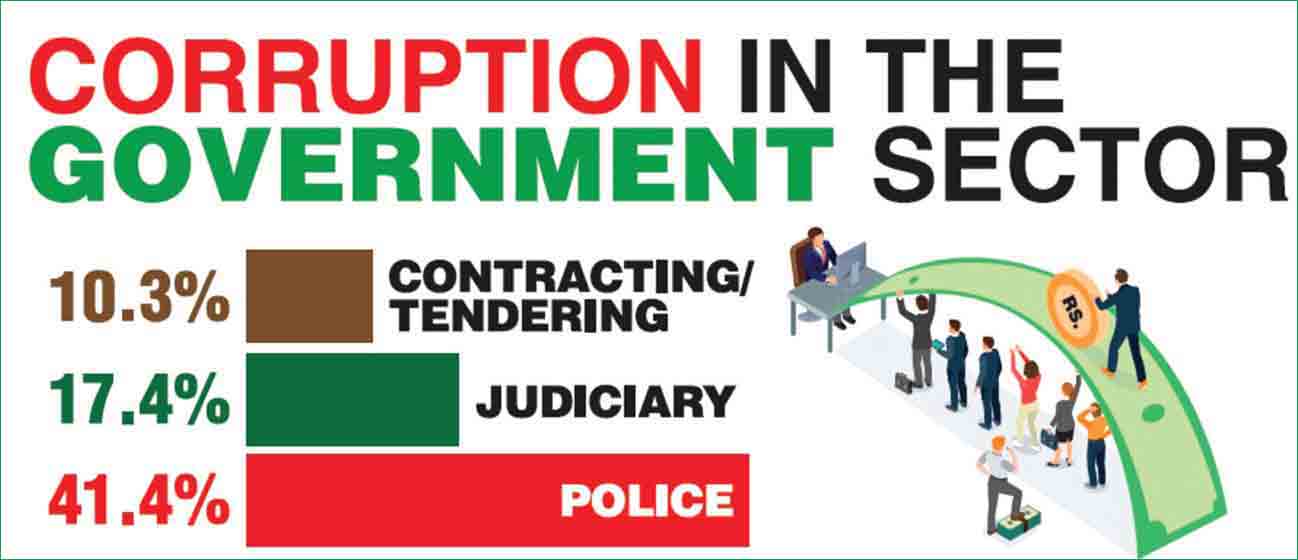
ISLAMABAD: The National Corruption Perception Survey 2021 conducted by Transparency International Pakistan finds the police and judiciary the most corrupt institutions in the country.
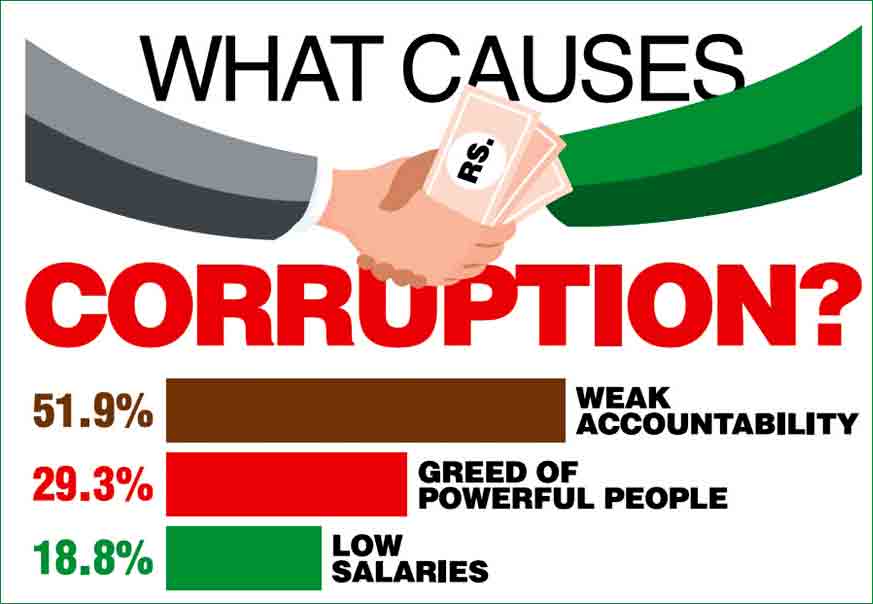
The survey, released on Wednesday at 1:00 am, also reveals that the vast majority of people consider the federal government’s self-accountability to be unsatisfactory. According to the survey, the three most important causes of corruption are weak accountability (51.9%), the greed of powerful people (29.3%) and low salaries (18.8%).
According to a TI Pakistan press release, the TI has conducted National Corruption Perception Surveys five times in the last 20 years: NCPS 2002, NCPS 2006, NCPS 2009, NCPS 2010 and 2011. In 2021, TI Pakistan conducted the National Corruption Perception Survey 2021 in all four provinces. The survey was conducted from October 14, 2021, to October 27, 2021. The survey reflects the perception of the general public on very important governance issues.
As per the TI Pakistan announcement, the following are the key findings of the latest report:
- The National Corruption Perception Survey 2021 has revealed that police remain the most corrupt sector, the judiciary was seen as second most corrupt, tendering and contracting the third most corrupt while health has climbed to become the fourth most corrupt since the last NCPS 2011. According to the Judicial Statistics of Pakistan 2020 report by the National Judicial (Policy Making) Committee, there are 46,698 cases pending in the Supreme Court and 1,772,990 cases pending in the District Judiciary.
- A vast majority (85.9%) of people consider the federal government’s self-accountability to be unsatisfactory.
- Pakistanis continued to believe that the corruption in the government sector is high. The police (41.4%), judiciary (17.4%) and contracting/tendering (10.3%) are the three most corrupt sectors according to the survey, while contracts of roads (59.8%), cleanliness and garbage collection (13.8%), access to water (13.3%) and the drainage system (13.1%) are top the list of public services for which people have to pay bribes to get access to.
- The three most important causes of corruption, according to the NCPS 2021, are weak accountability (51.9%), the greed of powerful people (29.3%) and low salaries (18.8%).
- As measures to reduce corruption, 40.1% of Pakistanis say an increase in/stringent punishments for corruption cases, 34.6% Pakistanis say accountability of public officers by expediting NAB’s handling of corruption cases, and 25.3% say a complete ban on those convicted of corruption from holding public office, are key to combat corruption in Pakistan.
- The survey also sheds light on local governments and how their presence could have helped Pakistan establish a firmer grip on the situation arising out of Covid-19.
- A large number (47.8%) of Pakistanis consider that if local government elected representatives were in place, Covid-19 public awareness campaigns could have been launched in a more effective manner.
- A large proportion of Pakistanis (72.8%) believe that public sector corruption at the grassroots levels has increased due to the absence of local government.
- A total of 89.1% of Pakistanis say that they did not pay any bribe to any government official during the federal government’s Covid-19 relief efforts for deserving citizens.
- A significant proportion of the population (81.4%) has denied that it willingly pays bribes and instead there was a clear perception that bribes are extorted from the public through tactics such as inaction or delay in the provision of public services.
- Compared to the three most recent federal governments, the majority of Pakistanis (92.9%) consider inflation and the price hike to be the highest during the current PTI government (2018-2021), compared to 4.6 % who thought the same for the PML-N government (2013-2018) and 2.5% of the PPP government (2008-2013).
- This coincides with 85.9% Pakistanis who say that their income levels have been squeezed and have decreased during the last three years.
- The main reasons citizens blame for rising inflation and unemployment are: government incompetence (50.6%), corruption (23.3%), undue Interference of politicians in government affairs (9.6%) and lack of implementation of policies (16.6%).
- The majority of Pakistanis (66.8%) believes that the present government’s accountability drive is partial.


