
Economist reports Pakistan inflation fourth highest out of 42 country index
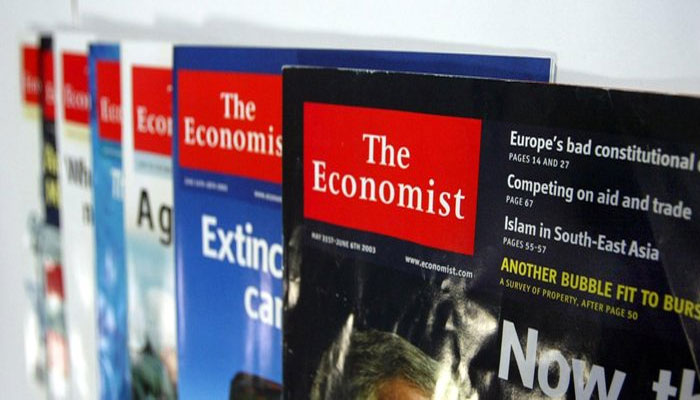
ISLAMABAD: In its latest edition, the Economist magazine tracked inflation in 42 countries plus the Euro region and found that Argentina was on the top with inflation, standing at 51.4 percent, Turkey on the second with 19.6 percent, Brazil at third position with 10.2 percent and then on the fourth position was Pakistan with inflation standing at 9 percent.
The Economist has tracked inflation in countries like the USA, China, Japan, Britain, Canada, Euro area, Austria, Belgium, France, Germany, Greece, Italy, Netherlands, Spain, Czech Republic, Denmark, Norway, Poland, Russia, Sweden, Switzerland, Turkey, Australia, Hong Kong, India, Indonesia, Malaysia, Pakistan, Philippines, Singapore, South Korea, Taiwan, Thailand, Argentina, Brazil, Chile, Mexico, Peru, Egypt, Israel, Saudi Arabia, and South Africa.
The Ministry of Finance issued a statement and claimed that The Economist has not compared Pakistan with countries like Haiti, Ghana, Belarus, Mongolia, Armenia, Malawi, Sao Tome, and Principe, Botswana, Dominique Republic, Guyana, Georgia, Kyrgyzstan, Zambia, Zimbabwe, Suriname, Syria, Lebanon, Sudan, and others.
It said that a section of the press carried news referring to the report by The Economist titled ‘Pakistan has been listed as the fourth highest in terms of inflation in the world’. The Economist magazine has reported in its latest edition set of countries (43) without mentioning the exact comparison of Pakistan with similar economies. As per the The Economist sheet, the months mentioned in CPI are not the same (August & September). The base is different. The ministry also attached a table to indicate the inflation numbers according to which Pakistan stands at 30th place in the world.
The press release also added that the government has decided to release wheat at Rs1,950 per 40 kg and set the price of sugar at Rs90 per kg across the country.
Besides the above, the ministry also claims that under the Ehsaas Emergency Cash Program, the government has disbursed Rs179.3 billion among 14.8 million beneficiaries to provide immediate cash relief of Rs12,000 whose livelihood has been severely affected by the pandemic. The pro-poor allocation under the BISP in 2018 amounting to Rs121 billion has been enhanced to Rs260 billion in FY 2022.
Spokesperson of the ministry also added, “The international scenario needs to be taken into perspective where the producer price inflation is at 26-year high in China. The costly food prices are the biggest challenge for the governments all over the globe amid COVID-19. According to Food and Agricultural Organization (FAO), the global food prices have risen by 33pc in August, 2021 as compared to similar period last year. The Brent Oil has crossed the $85 per barrel recently. This is the highest price since 2018. Similarly, the average coal prices in the last quarter were $167.52 per ton as compared to $52 per ton last year. Therefore inflation is a global challenge and Pakistan is not an exception.”


