
330-year unenviable history of curfews in US
LAHORE: The history of curfews in the United States dates back to 1690, when a law passed by the Connecticut Colony, which later became Connecticut state, forbade people of colour from being away from certain places where they had no business to justify their presence.
These people of colour, all slaves, had to secure a written pass from their respective owners to go to various 'forbidden or unauthorized' places constituting the English Colony of Connecticut, an archival research conducted by the "Jang Group and Geo Television Network" shows.
The penalty of violating such an order included being openly whipped by the constable, not exceeding 10 stripes. Hence, the history of these curfews, mostly associated with sporadic violence and suppressing Black voices in the United States, is at least 330 years old.
Remember, the first American President, George Washington, had served as country's head of state from 1789 to 1797, meaning thereby that curfews were already a 100-year-old phenomenon when the American Constitution of 1788 was ratified, leading the nation to start having elected presidents who could work under a prescribed legal charter.
The "Washington Post" writes: "The law authorized ‘any’ English inhabitant to apprehend such ‘people of colour’, effectively deputizing the free citizenry while reinforcing racial hierarchies. The history of curfews in the United States shows that these types of laws originated — and are most often deployed — as a form of surveillance, control and criminalization of black people, indigenous people and other people of colour."
Meanwhile, the "Bloomberg", a privately-held financial, software, data, and media company headquartered in New York, asserts: "Historically, curfews have been a common tool during American social unrest. But they’ve also been used in other contexts largely to control African Americans and restrict their movements.
Quoting Elijah Anderson, a professor of Sociology at Yale University, this 39-year-old media house having offices at 167 locations and enjoying services of over 20,000 staffers, states: "This idea of the curfew really goes back to slavery and Black-White relations, and not just in the south. Even though Black people were emancipated, White people basically treated them as second-class people and worked to contain them.”
Having boasted for over a century of nourishing democracy in its true letter and spirit, various American states have passed laws in this context during these last three-and-a-quarter centuries.
The "Washington Post" maintains: "In 1703, Rhode Island’s General Assembly had passed a code to restrict activities of free and servant “people of colour and Indians,” stating: “If any people of colour or Indians either freemen, servants, or slaves, do walk in the street of the town of Newport, or any other town in this colony, after nine of the clock of night, without certificate from their masters, or some English person of said family with, or some lawful excuse for the same, that it shall be lawful for any person to take them up and deliver them to a constable.”
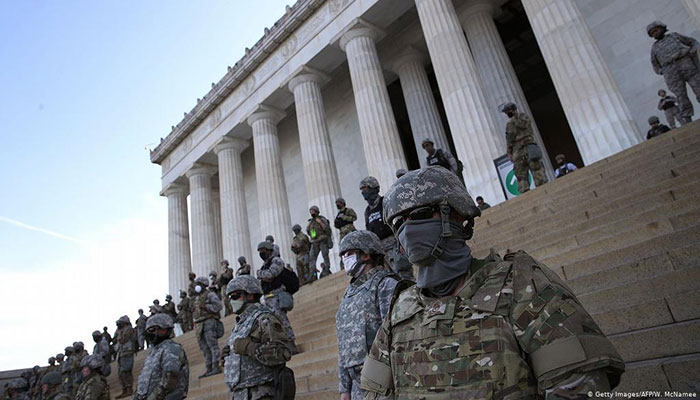
The media outlet then cited examples of the 1726 curfew laws in Hampshire, the 1728 laws in Boston, the 1775 laws in Wilmington, the 1831 laws in Southampton County, and the 1909 laws in Alabama, etc. Not long ago, in June 2020, following the killing of a Black man, George Floyd, at the hands of the Minneapolis police, curfews were imposed across dozens of US cities in over 40 states.
According to the "Washington Post" and the "Bloomberg," one of the earliest uses of curfews to quell unrest was during the Harlem riots of 1943 in New York City, which were sparked by the police shooting of a Black soldier. During the 1965 riots, the Los Angeles had deployed more than 14,000 National Guardsmen alongside the local police force to patrol the 46-square mile “curfew zone” that the city had imposed on poor and predominantly Black neighborhoods. They were used in the Los Angeles riots of 1992, ignited by the police beating of Rodney King.
The state of Missouri was placed under curfew following protests over the police shooting of 18-year-old Michael Brown in 2014. By 2009, 84% of American cities with populations greater than 180,000 had enacted youth curfews, with many touting their success in reducing violent and minor crime, and in juvenile victimization.


