
SHC acquits ex-aircraft engineer of terror-financing charges
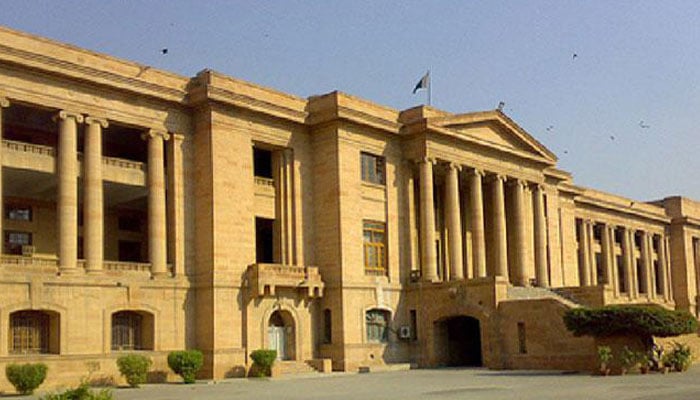
The Sindh High Court has acquitted a former aircraft engineer of terrorism-financing charges, observing that the joint investigation team and the prosecution have failed to prove the case against the suspect.
Khalid Yosuf Bari was sentenced to 10 years in prison by an anti-terrorism court for his alleged involvement in financing the alleged terrorists of banned outfits on August 4 last year. Bari preferred appeal against the conviction and requested the court to set aside the trial court order.
According to the prosecution, the counterterrorism department had arrested the appellant on September 19, 2015, who was said to have admitted during the interrogation that he had been providing funds to ex-Al-Qaeda persons for Jihad and provided meeting facilities to Al-Qaeda persons at his school in PECHS.
The appellant had recorded his statement on oath before the trial court, submitting that he was a retired aircraft engineer and was implicated in the case being a distant relative of Saad Aziz, a convict in the Safoora bus attack case, as he did not meet the illegal demands of the police. He said that he was first illegally detained by the counterterrorism department, which was challenged in the SHC, and later he was implicated in the case.
The appellant’s counsel, Amir Mansoob Qureshi, contended that there was no evidence on record to connect the appellant in the offence except receipt books allegedly seized from his house. He said that no incriminating material was produced by the prosecution that the appellant had links with any terrorist organisation or provided funding to Al-Qaeda terrorists or provided meeting facilities to them.
The counsel submitted that the trial court failed to appreciate the evidence produced by the prosecution as there was no direct nexus with the appellant. He said that the appellant was implicated in the case merely based on a statement of a terror suspect which could not be relied upon under the law of Qanoon-e-Shahadat.
He sought the acquittal of the appellant as the prosecution failed to prove charges against him in the trial court. The deputy prosecutor general opposed the appeal and submitted that the appellant had links with the terror organization, and requested the court to dismiss the appeal.
A division bench headed by Justice Aftab Ahmed Gorar observed in the recently issued judgment that mere recovery of two receipt books showing token/receipts of some amount collected in the years 1996/97 from the house of the appellant allegedly on his pointation does not establish the fact that the amount was collected by the appellant or by someone else.
The court observed that the trial court’s conviction appeared to have been based on the grounds that the appellant was related to Saad Aziz, one of the accused in the Safoora bus killings case, and that he was involved in providing funds to the accused for creating terrorism. The court observed that the trial court’s observation appeared to be based on imagination and not the evidence.
The court expressed concern over the trial court’s recording of evidence wondering how the trial court could believe without any substantive piece of evidence that the receipt of “Idara Barai Falah-o-Behbod Mujhaideen-o-Lawahiqeen” belonged to Al-Qaeda or any other terrorist organisation.
The court observed that the trial court relied upon the joint investigation team’s report that the appellant was a facilitator of the terrorist organization, which was not based on evidence. It observed that the court had to decide the case on the basis of evidence not on assumptions and presumptions; besides, none of the members of the JIT was examined as witness; therefore, the JIT report could not be believed or relied upon, especially while convicting the accused.
The court observed that there were material discrepancies and contractions in the evidence of the prosecution witnesses examined during the trial, which in no manner proved the offence under Section 11-N read with Section 11-H of the Anti-Terrorism Act, 1997.
It observed that the trial court’s conviction was not based on correct appreciation and appraisal of prosecution evidence brought on record; therefore, the conviction and sentence awarded to the appellant could not be withstood. The court set aside the trial court order and ordered releasing the appellant if not required in any other case.







-
 Matt Damon Shares Heartbreaking Talks He And Ben Affleck Keep Having
 -
 King Charles, Camilla's Secret Talks Before Meeting Meghan Markle, Harry Revealed
 -
 How The SpaceX IPO Earned Millions For SBA Administrator Kelly Loeffler
 -
 Seth Rogen Recalls Filming Intimate Scene With Penélope Cruz: 'I Just Kept Saying, Thank You'
 -
 Mariah Carey Already Has Festive Plans For Her Fans: ‘the Wait Is Nearly Over’
 -
 Royal Family 'greatest Challenge' Exposed As King Charles Reunited With Archie, Lilibet
 -
 Do Tech Workers Need To Study AI After Hours Too?
 -
 Indonesia Targets Google, AI Platforms With Sweeping Copyright Rewrite: Here’s Why
 -
 Kate Middleton, Prince William Wish Queen Camilla On 79th Birthday
 -
 Iranians Face Mounting Fear And Uncertainty As US Intensifies Attacks
 -
 King Charles Makes Heartfelt Announcement As Queen Camilla Turns 79
 -
 Prince Harry's Bitter Life In US Exposed After UK Trip
 -
 Prince Harry Knows How To Put King Charles, William On 'opposite Sides'
 -
 Christopher Nolan Reveals Surprising Fear Behind His No-smartphone Rule
 -
 'SNL' Suffers Hugh Blow As Key Member Quits After 7 Seasons
 -
 Jim Parsons Unveils Dark Side Of His 'Big Bang Theory' Success