
Punjab governor slams PM over judges’ issue
Governor said that politicians understand consequences of bypassing merit when selecting judges
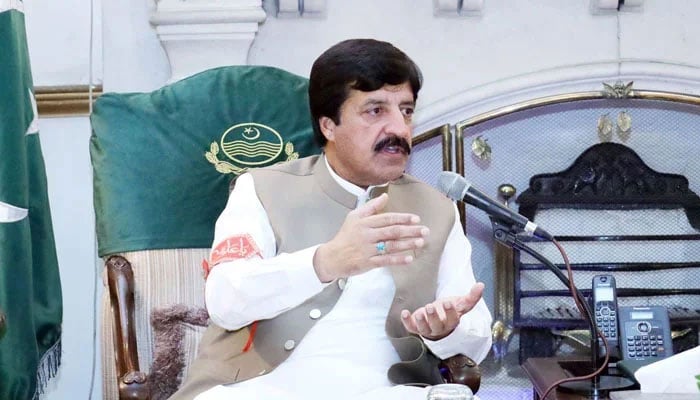
ISLAMABAD: Punjab Governor Sardar Salim Haider Khan on Saturday criticised the prime minister over the appointment of judges in the light of proposed constitutional amendments, saying the chief justice should be appointed based on merit and that no extensions should be granted to anyone.
“I wonder what has happened to the prime minister that he claims he will pick and choose the judge for the post of chief justice from among five or three candidates,” he said while addressing the concluding session of the two-day international conference at Kahuta Law University.
The governor said that politicians understand the consequences of bypassing merit when selecting judges. “Choosing someone from number four — everyone knows what happened to them,” he remarked. He emphasized that politicians must be cautious, insisting that the chief justice should be appointed on merit. “Whether he serves for a month, six months, or a year, let him do so, but no one should be given an extension. When he leaves, let him go. There should be no extensions,” he said.
Sardar Salim Haider highlighted the discrepancy in political attitudes, saying, “When we are in the opposition, we call for merit; when we are in power, we define merit according to our interests.” He argued that the situation would improve when judges, generals, and bureaucrats empathise with the common man and that powerful classes running the affairs must operate on merit.
The governor remarked that the justice system and police culture reflect the true state of society. He said that without political backing, an FIR is often not registered, and if a false FIR is filed against a common citizen, that person may struggle for years to obtain justice.
He acknowledged that police face pressures and stressed the need for reforms to improve police station culture. “A police employee works continuously, often without a break. To enhance police culture, we must provide facilities, which is their right,” he said.
The governor said that the number of pending cases is in the hundreds of thousands, with many people seeking justice. “I have seen the ombudsman’s decisions over four months and realised that all decisions are based on merit,” he said. He further commented that the justice system has become weak and outdated, often creating obstacles for the common man. “Civil cases can take three to four generations without resolution, highlighting the urgent need for legal reforms to address the issues faced by ordinary citizens,” he said.
The governor reiterated that the situation would improve when judges, generals, and bureaucrats genuinely understand the struggles of common man and when the powerful classes prioritise merit in their governance. He concluded that during his four months as governor, he has observed that ombudsman decisions are merit-based and emphasised the necessity of establishing conciliation courts to resolve problems at the local level, alongside urgent reforms in lower courts.







-
 Socialite From Prince William’s Circle Drops Bomb: ‘Meghan Didn’t Give Birth To Archie?’
 -
 Justice Clarence Thomas Says Threats Against Judges Are Growing, As He Seeks Security Funding
 -
 Elon Musk’s Son Lil X Sparks Fashion Craze With Traditional Chinese-style Vest, Tiger-head Bag
 -
 King Charles Gives A Nod To Prince Edward's Latest Appearance
 -
 Canada Says No Financial Help For Travellers Stranded Abroad Amid Global Tensions
 -
 How Sarah Ferguson, Andrew Reacted To King Charles Announcement About Eugenie's Third Baby?
 -
 Elon Musk’s X Accepts UK Rules On Hate Speech, Militant Content
 -
 Canadiens Beat Sabres In Game 5 To Move One Win From Playoff Series Victory
 -
 Mike Tindall Shares Heartfelt Note For Wife Zara Amid Prince William's Major Plans For Cousin
 -
 Ex-OpenAI CTO Mira Murati’s New AI Does Something Most Others Can't
 -
 Millions React After Arianna Roberson, Cooper Flagg Confirm Dating Rumors
 -
 Sienna Miller Opens Up About Struggles After Becoming A Mother
 -
 ‘No Trust In Americans’: Araqchi Says Negotiations Will Occur Only If US Is Serious
 -
 Andrew Mountbatten-Windsor’s Set To Open ‘very Explosive’ Pandora’s Box With His Death
 -
 Prince William Holds Key Decision Until Kate Middleton's Return From Italy
 -
 Argentum AI Signs $2.5 Billion European Data Center Partnership: Here’s What It Means