
How Sindh keeps Sindhi alive
Credit must go to people who speak Sindhi in their households
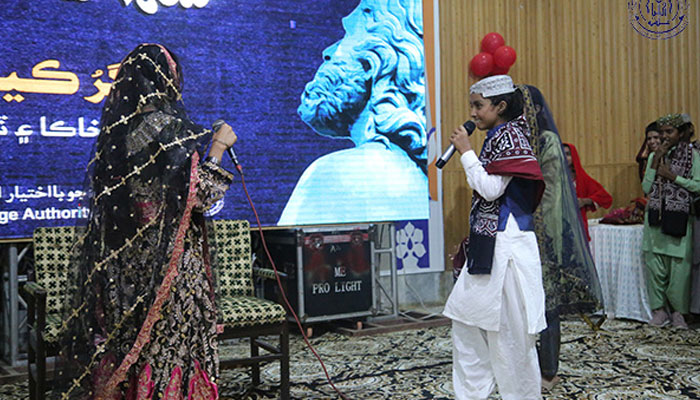
While English and Urdu enjoy dominance across Pakistan, Sindhi appears to be an exception. It is thriving in both the rural and urban areas of Sindh, with vibrant press and electronic media and a large number of Sindhi medium schools across the province.
Credit must go to people who speak Sindhi in their households and to an intellectual circle that is active in discussing and promoting the language it holds close and dear to its heart.
On May 4-5, the Sindhi Language Authority (SLA) organized the Second International Sindhi Language Conference 2024 at the Arts Council Karachi. Dr Ishaq Samejo is chairperson and Dr Ahsan Danish is secretary of the SLA, based in Hyderabad, Sindh. However, their reach has been extended across the province.
Rafique Wassan was the secretary of the conference which had ample support from President of the Arts Council Karachi Ahmed Shah, Provincial Minister of Culture Zulfiqar Shah and Provincial Education Minister Sardar Shah. Though I could not attend the inaugural and concluding sessions due to some other pressing engagements, the discussions and presentations that I attended were highly enlightening and informative.
The theme of this year’s conference was ‘Sindhi language, Indus script and language as indigenous knowledge and heritage’. Since such conferences do not receive the attention they deserve in mainstream media, I would like to share with my readers some of the discussions that took place at the event.
Prof Aijaz Ahmed Qureshi is a well-known writer and educationist with nearly a dozen books to his credit. Discussing ‘Sindhi Language Act: background and perspective’, he highlighted that in 1853 it was the British administration that declared Sindhi as an official medium for communication and education in Sindh.
For nearly a hundred years, Sindhi was an undisputed medium of instruction in schools and colleges, but after Independence, the language received setbacks as the demographic compositions altered in the province. Aijaz Qureshi explained how a rapid conversion of Sindhi medium schools to Urdu medium undermined local heritage and literature. Sindhi intelligentsia had to fight to reclaim their language.
Dr Manzoor Ali Veesrio is an assistant professor of Sindhi language and literature at Quaid-e-Azam University, Islamabad. As a young and prolific writer, Veesrio has been contributing articles, essays and books of immense value. His presentation focused on strategies to preserve endangered languages in Pakistan.
He believes – and rightly so – that languages are not merely a source of communication. Instead, they constitute a significant element of culture and also serve as fountains of indigenous knowledge in society. With over 70 languages spoken across Pakistan, the country has a rich linguistic diversity, but many of the dialects and languages are endangered and close to extinction. Veesrio suggested measures to revive them.
Dr Saeed Rid, another scholar from the same university, discussed ‘Sindhi language and identity in the Sindhi diaspora community’. His research dealt with the Sindhi Hindu diaspora which is perhaps the largest diaspora among South Asian communities that migrated both before and after Partition in 1947.
Sindhi Hindus are now settled in almost all parts of the world. Saeed Rid elaborated on the challenges this diaspora faces while trying to preserve their identity and linguistic distinction. Despite their efforts, the challenges are mounting as demographics change and institutional support is lacking.
Dr Ziaur Rehman Baloch teaches at Allama Iqbal Open University and is an active voice for the promotion of Balochi. His paper discussed the Balochi language in the digital age and the challenges it faces. He examined the evolving role of Balochi in the proliferation of artificial intelligence and the increased use of information technology with the internet. He is a strong proponent of online platforms and AI applications for preserving languages. In this era of globalization, communication paradigms are changing fast, and the Balochi language also needs to adapt to new advancements.
‘Legislative milestones’ for Sindhi in the provincial assembly was the focus of Aamir Ali Mugheri, another young researcher and writer. He works at the Sindh chapter of the Pakistan Institute for Parliamentary Services (PIPS) based at the provincial assembly in Karachi. He discussed key resolutions and bills that the Sindh Assembly has passed for advancing Sindhi and its use in education and teaching.
Aamir Mugheri presented an overview of legislation by the Sindh Assembly from 1937 to 2023 concerning the development and promotion of the Sindhi language. He clearly sets an example for other provinces to conduct similar research.
Dr Fayyaz Latif from the Department of Sindhi at the University of Sindh is an expert on Shaikh Ayaz and his poetry. From his doctoral research to his numerous books and essays, Dr Fayyaz has done some ground-breaking work on the traditional genre of ‘bait’ and how Shaikh Ayaz excelled at it.
‘Linguistic study of Shaikh Ayaz’s Sindhi bait’ was the topic of discussion that attracted a wide audience at the session. Fayyaz Latif delved into the details of Ayaz’s unique style that combines folk and traditional elements of Sindhi in his baits.
Dr Hanif Khalil, director of the National Institute of Pakistan Studies at Quaid-e-Azam University talked about knowledge production in mother languages. His research explored the critical role of knowledge production within the cultural context of Pakistan and its diverse regions.
He discussed both poetry and prose in mother languages and how they contribute to knowledge production for local communities. “For a pluralistic society to thrive, languages other than Urdu also deserve development, promotion, and recognition at the state level.” If any government – federal or provincial – relegates indigenous languages to the periphery, they lose their cognitive and cultural significance.
‘Shades of Balochi in the poetry of Shah Latif’ was the topic of discussion by Pahan Baloch who is an author and freelance researcher of considerable repute on culture, history, and languages of Balochistan.
After penning at least a dozen books and writing scores of articles, Panah Baloch has emerged as an award-winning writer from Balochistan. Now he is focusing on how Shah Latif uses Balochi in his poetry, particularly in his narration of the Sussui-Punhoon story, a tale of love between a Baloch boy and a Sindhi girl.
Perhaps the best feature of the conference was that it tried to attract speakers from across Pakistan speaking different languages. Zafarullah Parwaz represented the Khowar language from Chitral and Ghizer by discussing a cultural heritage that is so unique and almost inaccessible to the rest of Pakistan. Parwaz is a researcher and writer who writes poetry in Khowar and has recently published a novel. He won the hearts of the audience with his simplicity and down-to-earth style at the conference. His presentation, though brief, was full of anecdotes about Khowar culture and language.
Dr Abrar Zahoor from the University of Sargodha specializes in Muslim identity construction in colonial Punjab. He has established himself as a scholar of repute by regularly contributing to various research journals.
He discussed the topic ‘Lamenting the loss of Punjabi in the Punjab of Waris Shah’ that addressed the question of how Punjabi lost its appeal and status as a mother language even for people living in Punjab. He equated the loss of language with the loss of a whole civilization and culture. “When people stop using their language, they are likely to lose not only the wisdom of words but also a worldview associated with them”.
The conference was a major success and credit goes to Dr Ishaq Samejo and his entire team at the Sindhi Language Authority. Nearly all sessions were well attended. My only suggestion is that the organizers must properly edit and proofread all the material related to the conference.
The writer holds a PhD from the University of Birmingham, UK. He tweets/posts @NaazirMahmood and can be reached at:
mnazir1964@yahoo.co.uk


